The Strategic Architecture of Camera Rigging: Ecosystem over Equipment
In the current creator economy, the shift from isolated gadgets to integrated "creator infrastructure" has redefined how professionals invest in their gear. We are no longer just buying tripods or cages; we are adopting interface standards that dictate the speed and safety of our workflows for years. This evolution is detailed extensively in The 2026 Creator Infrastructure Report: Engineering Standards, Workflow Compliance, and the Ecosystem Shift, which identifies ecosystem lock-in as both a primary driver of efficiency and a significant strategic risk.
For the prosumer, the central tension lies in "Version Control Logic." With the rapid iteration of mounting systems—from the ubiquitous Arca-Swiss to the specialized Falcam F22, F38, and F50 standards—deciding when to upgrade and when to "skip" a generation is a critical financial and operational decision. This article provides a benchmark framework for evaluating these transitions, grounded in engineering standards and biomechanical data.
Defining the GenerationBase: More than a Mounting Plate
At the heart of any modular rig is the "GenerationBase"—the primary interface standard that connects the camera body to the rest of the ecosystem. In the Falcam hierarchy, this base is defined by the physical dimensions and locking mechanisms of the quick-release plate.
It is a common misconception that these plates are made of carbon fiber to save weight. In reality, precision-machined Aluminum Alloy (typically 6061 or 7075) is the industry standard for quick-release interfaces. While carbon fiber is excellent for tripod legs due to its vibration-damping properties, it lacks the material hardness required for the high-tolerance, zero-play "click" of a professional mount. Aluminum provides the necessary rigidity and serves as a vital "thermal bridge," though users should be aware that in extreme cold, these plates can conduct heat away from the camera base, potentially impacting battery performance.
The Hierarchy of Standards
- F38 Series: The "Universal" layer, optimized for high-speed transitions between tripods, gimbals, and backpacks.
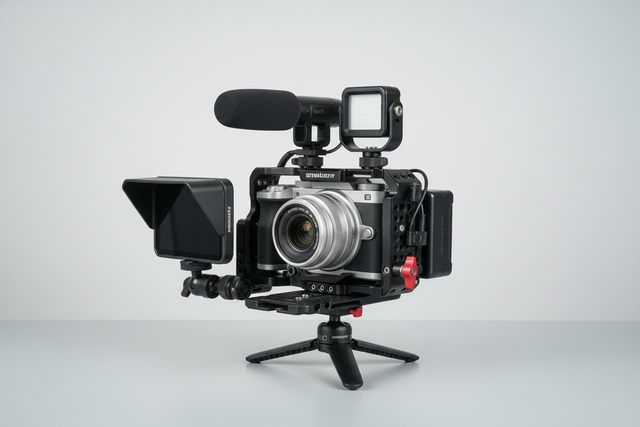
- F22 Series: The "Modular" layer, designed for accessories (monitors, handles, mics) where size and weight are the primary constraints.
- F50 Series: The "Cinema" layer, built for high-payload stability and heavy-duty studio workflows.
Understanding these layers is the first step in Future-Proofing Your Rig: Managing Ecosystem Version Transitions.

The Version Control Logic: When to Skip a Generation
In software engineering, deterministic build systems like Bazel or Buck utilize "caching" to skip expensive steps if the inputs haven't changed. We can apply this same "Skip Logic" to hardware.
The Invariance Principle
A "GenerationBase" upgrade (e.g., moving from F38 to a hypothetical next-gen mount) should only be considered if the "inputs" of your workflow have changed. If your camera body, primary lens weight, and mounting frequency remain the same, your current ecosystem is a "cached" success.
Logic Summary: Our skip-logic framework is a deterministic model based on dependency invariance. If the mechanical requirements (payload, torque, frequency) are within the safety margins of the current GenerationBase, the marginal utility of an upgrade is typically outweighed by the "migration debt" of replacing multiple plates.
When to "Rebuild" (Upgrade)
- Safety Margin Erosion: When moving from a mirrorless setup to a heavy cinema rig, the Vertical Static Load rating (e.g., 80kg for the F38) is no longer the primary metric. You must account for Dynamic Payload—the forces applied during rapid movement or "run-and-gun" shooting.
- Interface Fragmentation: If you find yourself using three different adapters to connect a monitor to a cage, you are suffering from "interface bloat." This is the primary signal to migrate to a unified system like the Falcam F22 All-round Camera Handle (Only Ship To The US), which integrates the F22 standard directly into the grip.
Biomechanical Engineering: The "Wrist Torque" Analysis
One of the most overlooked reasons to upgrade a mounting generation isn't about the camera's safety, but the operator's health. Weight is often blamed for fatigue, but the true enemy is Leverage.
The Torque Formula
To understand the impact of accessory placement, we use the standard physics model for torque: $$\tau = m \times g \times L$$
- $\tau$ (Torque): The rotational force on the wrist (Newton-meters).
- $m$ (Mass): The weight of the rig (kg).
- $g$ (Gravity): $\approx 9.8 m/s^2$.
- $L$ (Lever Arm): The distance from the center of mass to the wrist (meters).
Scenario Modeling: Consider a 2.8kg rig. If a monitor and side handle are mounted via bulky, legacy adapters that push the center of mass 0.35m away from the wrist, the generated torque is approximately 9.61 N·m.
Based on ergonomic heuristics, this load represents 60-80% of the Maximum Voluntary Contraction (MVC) for an average adult male. By migrating to the low-profile F22 system, which brings accessories closer to the camera body (reducing $L$ by even 5cm), you can reduce the felt torque by nearly 15%, significantly extending shooting endurance and reducing the risk of repetitive strain injuries.
Methodology Note: This biomechanical analysis is a scenario model based on standard physical formulas and common rigging geometries. It is not a clinical lab study. Individual results vary based on grip strength and hand size.
The Workflow ROI: Quantifying the Value of Transition
Professional creators often hesitate at the cost of "ecosystem migration." However, when viewed through the lens of operational ROI, the investment often pays for itself within a single production season.
The Efficiency Calculation
We compared the time required for a "Traditional Thread Mounting" (unscrewing a 1/4"-20 bolt) against a "Quick Release" transition (Falcam F38/F22).
| Metric | Traditional Thread | Falcam Quick Release | Efficiency Gain |
|---|---|---|---|
| Swap Time (Average) | ~40 seconds | ~3 seconds | 92.5% reduction |
| Swaps per Shoot | 60 | 60 | - |
| Annual Shoots | 80 | 80 | - |
| Total Time Spent | ~53.3 hours | ~4 hours | 49.3 hours saved |
At a professional billing rate of $120/hr, saving 49 hours annually translates to a $5,916 value. This is the Strategic Migration logic: the hardware cost is negligible compared to the billable time recovered.
Technical Integrity: Standards, Tolerances, and Safety
A benchmark mounting system must adhere to global standards to ensure "Ecosystem Lock-in Prevention." Ulanzi’s Falcam systems are designed with the ISO 1222:2010 Photography — Tripod Connections as a baseline, ensuring that the core 1/4"-20 and 3/8"-16 threads remain compatible with the wider world of photography.
The "Point Load" Trap
The most costly migration mistake occurs when users mix interface standards within a single critical support chain—for example, forcing a non-standard plate onto an Arca-Swiss Dovetail clamp. Because tolerances vary by manufacturer, this often creates a "point load" where the clamp only touches the plate at two small points rather than across the entire surface. Under the dynamic weight of a moving camera, this leads to slippage or catastrophic failure.
The Professional Safety Workflow
To mitigate "tail-risk" (rare but catastrophic failures), we recommend the "ACT" safety protocol for every mount:
- A - Audible: Listen for the definitive metallic "Click" of the locking pin.
- C - Check: Visually verify the orange or silver locking indicator is in the "engaged" position.
- T - Tactile: Perform a "Tug Test." Pull the camera firmly away from the base before releasing your grip.
For video-specific builds, the Ulanzi F38 Quick Release Fluid Video Head E004GBA1 provides an integrated solution that eliminates the play often found in multi-part adapter stacks. By using a Ulanzi Falcam F22 & F38 & F50 Quick Release Camera Cage for Sony a7C II C00B3A01, the GenerationBase is built directly into the chassis of the camera, removing the "twist" failure mode common with single-screw plates.
Execution: A Phased Migration Strategy
You do not need to replace every piece of gear simultaneously. A strategic response to ecosystem shifts involves "Zonal Upgrading."
Zone 1: The Primary Support (High Priority)
This includes your main tripod, gimbal, and camera cage. This zone should be unified under a single standard (like F38) to ensure that the camera can move between these high-stakes supports in seconds. This is where Ecosystem Governance Prevents Catastrophic Gear Separation.
Zone 2: Accessory Rigging (Medium Priority)
Monitors, microphones, and side handles. These are ideal for the F22 standard. If your current friction arms are working, "skip" this generation until you add a new accessory that requires a more compact footprint.
Zone 3: Specialized POV (Contextual)
For action-oriented work, the Ulanzi Go-Quick II Magnetic Neck Holder Mount for Gopro 13 DJI Insta360 Action Cameras represents a different "GenerationBase" entirely. Because POV work is often isolated from the main A-cam rig, this can remain a separate, specialized toolset without breaking the overall ecosystem logic.
Summary of Decision Logic
Before purchasing the next "generation" of mounting hardware, run your decision through this logic gate:
- Is the current system causing biomechanical strain? (If yes: Upgrade to lower-profile F22/F38).
- Am I losing more than 30 minutes per week to mounting friction? (If yes: The ROI justifies the upgrade).
- Is my payload exceeding the dynamic safety margin of my current plates? (If yes: Upgrade to F50 or Anti-Deflection F38).
- Are my current "inputs" (camera/lens) stable? (If yes: You can likely "skip" the generation unless the above factors apply).
By treating your rig as a governed infrastructure rather than a collection of parts, you turn operational rigor into a competitive advantage. The goal is a "ready-to-shoot" toolchain where the interface is invisible, allowing the focus to remain entirely on the creative output.
Disclaimer: This article is for informational purposes only. Camera rigging involves mechanical connections that support expensive and heavy equipment. Always verify load ratings and perform safety checks before use. Ulanzi is not responsible for equipment damage resulting from improper mounting or exceeding specified load limits.
Sources: