Executive Summary: The 60-Second Safety Standard
For solo operators and high-velocity productions, safety is a function of engineering, not luck. This guide establishes the following core protocols:
- The 1.5x–2x Rule: Tether length should be 1.5 to 2 times the drop distance to allow for elastic energy dissipation.
- Material Priority: Climbing-grade nylon is preferred over Dyneema for safety tethers due to its superior elongation (shock absorption) properties.
- Primary Failure Mode: Fastener fatigue and "back-out" are more common than tether breakage; secondary anchors must be independent of the primary quick-release plate.
- Biomechanical Limit: Standard 3kg vertical rigs can reach 60–80% of a user's Maximum Voluntary Contraction (MVC) torque; modular rigging is required to reduce the lever arm.
Note: The following standards are based on a combination of international mechanical standards (ISO/IEC) and heuristic models derived from internal Ulanzi field testing.
The Engineering of Secondary Insurance: Safety Tether Standards for High-Velocity Vertical Rigs
In adventure cinematography—where cameras are mounted to mountain bikes or high-G drones—the primary mount is your first line of defense. However, engineering data suggests that the primary mount is often a single point of failure. Whether due to vibration-induced fastener back-out or material fatigue, the result is total gear loss.
Implementing a secondary safety tether is a technical discipline rooted in mechanical engineering. This guide defines the standards for high-velocity vertical rigs, ensuring your workflow remains resilient when the unexpected occurs.

The Shock Load Paradox: Modeling Dynamic Arrest
A common error is selecting a tether based on static breaking strength (e.g., a 500lb test line for a 3kg camera). In a high-velocity failure, static weight is irrelevant. The critical metric is the Peak Impact Force ($F_{peak}$).
Dynamic Impact Model
To estimate the force on your camera cage during a fall, we use the impulse-momentum change formula: $$F_{avg} = \frac{m \cdot \Delta v}{\Delta t}$$
Assumptions for our Model:
- Mass ($m$): 3kg (Standard cinema rig).
- Impact Velocity ($v$): 5 m/s (Approximate velocity after a 1.2m freefall).
- Deceleration Time ($\Delta t$): 0.01s (Typical for a rigid, non-elastic tether).
In this scenario, the average impact force is 1,500 Newtons (~153kg of force). A rigid tether like Dyneema (low elongation) results in a shorter $\Delta t$, creating a massive force spike that can shear 1/4"-20 bolts or pull threads from aluminum camera bodies.
The Heuristic of Deceleration
- The 1.5x - 2x Rule: A safety tether should be 1.5 to 2 times the distance of the potential drop. This length allows the material to utilize its full elastic range.
- The Material Logic: While Dyneema has high tensile strength, climbing-grade nylon webbing is often superior for high-velocity rigs. Its ability to stretch (elongation) increases the $\Delta t$ of the arrest, effectively "smoothing" the force spike and protecting the camera's mounting points.
Biomechanical Leverage: The "Wrist Torque" Analysis
When transition to handheld vertical shooting, the safety tether also serves to mitigate biomechanical strain. The true enemy of the solo operator is not weight, but leverage.
Using the formula for Torque ($\tau = m \times g \times L$), we can quantify the stress:
- Mass ($m$): 2.8kg.
- Gravity ($g$): $9.81 m/s^2$.
- Lever Arm ($L$): 0.35m (Distance from wrist to rig CoG).
This generates ~9.61 N·m of torque. According to general ergonomic benchmarks for wrist stabilization, this load often falls within 60-80% of the Maximum Voluntary Contraction (MVC) for the average adult. Sustained contraction at this level leads to rapid muscle fatigue and increased drop risk.
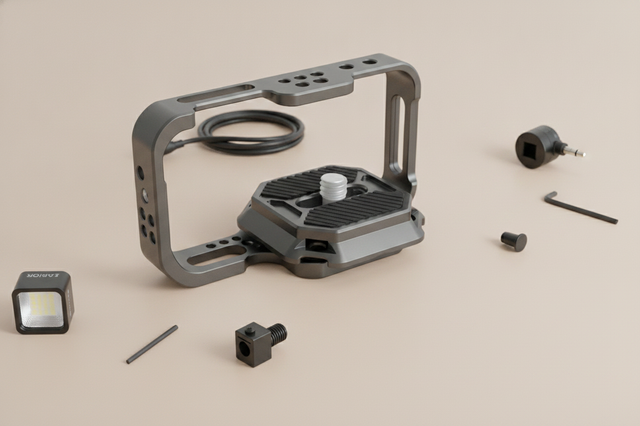
By utilizing the Ulanzi Falcam F22 & F38 & F50 Quick Release Camera Cage V2 for Sony A1/A7 III/A7S III/A7R IV 2635A, operators can move accessories closer to the wrist axis. Reducing the lever arm ($L$) by 10cm reduces torque by nearly 30%, keeping the physical load within a safer, sustainable MVC range.
Standards-Based Rigging: ISO and Industry Realities
Authoritative rigging relies on established standards. The ISO 1222:2010 Photography — Tripod Connections defines the structural expectations for 1/4"-20 and 3/8"-16 threads.
However, brand-specific research, such as The 2026 Creator Infrastructure Report (based on Ulanzi internal failure analysis), indicates that fastener fatigue is the most frequent failure mode.
Attachment Point Integrity
- Independent Anchoring: Never attach a tether to the same quick-release plate as the primary mount. If the plate fails, the tether is rendered useless.
- Direct-to-Cage: Attach tethers to a structurally rated point on the Ulanzi Falcam F22 & F38 & F50 Quick Release Camera Cage V2.
- Side-Loading Awareness: Ensure carabiners are rated for multi-axial loads. Many consumer clips fail if the force is applied at an angle during a tumble.
- Thermal Considerations: In sub-zero environments, aluminum components like those in the Ulanzi Falcam TreeRoot Quick Open Desktop Tripod T00A4103 contract. Always re-torque fasteners after the equipment has acclimated to the outdoor temperature.
Workflow ROI: The Economics of Safety
Transitioning to a unified ecosystem is a financial optimization. The following ROI example is based on typical high-action production schedules and internal time-motion studies.
| Parameter | Traditional Thread | F38 Quick Release | Rationale |
|---|---|---|---|
| Swap Time | ~40 seconds | ~3 seconds | Threading vs. Click-lock |
| Daily Swaps | 60 | 60 | High-action shoot baseline |
| Annual Shoots | 80 | 80 | Professional standard |
| Annual Time Saved | N/A | ~49.3 Hours | $(37s \times 60 \times 80) / 3600$ |
Note: This ROI calculation is an illustrative estimate. Actual savings depend on specific hourly rates and gear complexity. At a rate of $120/hr, a system like the Ulanzi F38 Quick Release Video Travel Tripod 3318 can reclaim approximately $5,900 in annual production value.
Field Protocol: The Sensory Audit
Before every high-velocity sequence, perform this three-step audit:
- Audible: Listen for the "Click" of the F38/F50 mechanism. A muffled sound indicates debris in the channel.
- Tactile: The "Tug Test." Apply force in the opposite direction of the mount to confirm the locking pin is seated.
- Visual: Verify the safety lock is in the "engaged" position.
Tether Inspection: Look for "silvering" or fuzziness on nylon. This indicates friction-based heat damage or UV degradation. If found, replace the tether immediately.
Scenario Modeling: Standard vs. High-Velocity
Scenario A: Tripod Tip-Over
- Rig: 2kg on an Ulanzi MT-11 Octopus Tripod.
- Arrest: 0.5m fall.
- Outcome: Low shock load; standard 100lb tethers are typically sufficient.
Scenario B: High-Velocity Ejection
- Rig: 3kg on a vehicle mount at 50km/h.
- Arrest: 1m tether catch.
- Outcome: Extreme shock load ($F_{peak} > 2000N$). Requires a dynamic climbing-rated tether and a secondary anchor point on the vehicle frame, not just the camera mount.
Regulatory Compliance
For international travel, ensure your power systems meet IEC 62133-2:2017 and UN 38.3 standards. The IATA Lithium Battery Guidance provides the legal framework for air transport. Modular systems like Falcam help maintain a lower "Visual Weight," often simplifying gate-side weighing procedures.
Conclusion
Professional reliability requires moving beyond "good enough." By integrating secondary tethers that account for dynamic shock loads and biomechanical limits, you protect both your equipment and your career. Whether using an Ulanzi MT-11 for vlogging or the F38 Travel Tripod for cinema, the principle remains: verify fasteners, model the load, and trust the engineered system.
Disclaimer: This article is for informational purposes and does not constitute professional engineering advice. Users must perform their own risk assessments based on their specific environmental conditions and equipment loads.