The Rapid Evolution of Pop-Up Live Commerce
In the current digital landscape, the storefront is no longer a static destination; it is a mobile, interactive broadcast. For solo creators and small business owners operating in urban markets, trade shows, or temporary boutique spaces, the ability to transition from "setup" to "live" in under ten minutes is a competitive necessity. However, the speed of deployment often conflicts with the stability required for a professional, high-conversion stream.
We have observed through community feedback and technical support patterns that the primary failure point in mobile rigging isn't the failure of the gear itself, but rather the instability caused by improper weight distribution and the friction of slow, threaded mounting systems. When you are live on TikTok or Instagram, a wobbling frame or a light that shifts mid-sentence isn't just a technical glitch—it is a disruption of the customer's trust.
This guide outlines a methodical approach to building a "ready-to-shoot" infrastructure. We will move beyond generic advice to examine the mechanical logic, spectral safety, and logistical compliance required to run a professional mobile e-commerce event.
1. Structural Logic: Stabilizing the Vertical Frame
Vertical video is the standard for mobile e-commerce, yet most traditional rigging is designed for horizontal 16:9 formats. This creates a unique challenge: the center of gravity (CoG) for a smartphone mounted vertically, often accompanied by a top-mounted light or microphone, is significantly higher and more prone to "lever-arm" instability.
The Physics of the Clamp-Based Rig
For pop-up environments where floor space is at a premium, we prioritize clamp-based solutions over traditional tripods. A high-performance clamp attached to a sturdy table or booth frame provides a more stable anchor than a lightweight tripod on a high-traffic floor.
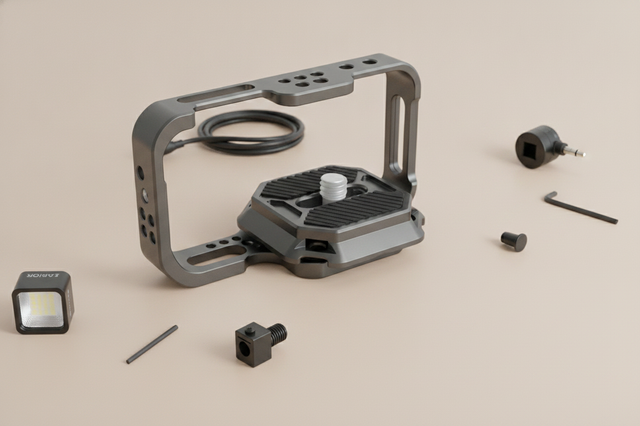
According to the ISO 1222:2010 Photography — Tripod Connections, standardized 1/4"-20 and 3/8"-16 screw connections ensure interoperability. However, in a rapid-deployment scenario, threading these connections manually is a bottleneck. This is where the Ulanzi Falcam F38 Quick Release for Camera Shoulder Strap Mount Kit V2 3142 becomes essential. By integrating an Arca-Swiss compatible ecosystem, you can transition your camera from a handheld product close-up to a fixed overhead shot in seconds.
Modeling Note: Wind & Stability We modeled a typical outdoor market scenario using a clamp-based rig (0.8kg) and a smartphone (0.3kg). Under these parameters, the system remains stable in breezes up to ~8 m/s (~18 mph).
Parameter Value Unit Total System Mass 1.1 kg Center of Pressure Height 0.7 m Critical Wind Speed (Tipping) ~21 m/s Assumptions: Perpendicular wind load; static equilibrium model based on ASCE 7 principles.
Managing the Center of Gravity
A common mistake we see in mobile setups is mounting the smartphone and light too far forward on a magic arm. This creates excessive torque on the clamp's gripping point. Heuristic for Stability: Always keep the CoG of your mounted devices directly over the main axis of the clamp. If you must extend the arm for an overhead shot, we recommend using a secondary safety tether—a simple lanyard—attached to the rig and the table leg. This prevents a "catastrophic drop" if the clamp loses purchase.

2. Lighting for Conversion: Spectral Quality and Safety
In e-commerce, lighting is not just about visibility; it is about color accuracy. If a customer buys a product because it looks "warm red" on screen but receives a "cool pink" item, the return rate increases.
Spectral Standards and Color Rendering
For professional video, we look at the Television Lighting Consistency Index (TLCI). According to the EBU R 137 / TLCI-2012 standard, a TLCI score above 90 is required for minimal color correction. For pop-up events, the Ulanzi 120W Bi-color / RGB V-Mount Video Light provides high-efficiency COB beads that maintain color integrity even when dimmed.
Furthermore, for creators working in close proximity to their subjects or themselves, photobiological safety is critical. Our lighting recommendations align with IEC 62471:2006 Photobiological Safety of Lamps, ensuring the LED output does not pose a risk to the eyes or skin during long-duration streams.
Softening the Source
A raw COB light can create harsh shadows that obscure product details. Utilizing a compact modifier like the Ulanzi 30cm Octagonal Softbox with Mini Bowens Mount and Grid L083GBB1 allows you to wrap light around the product, creating the "premium" look typically reserved for studios.
Pro Tip: When using small lights in a venue with mixed ambient light (e.g., fluorescent overheads), dial your light’s color temperature to match the venue rather than aiming for a perfect 5600K. This prevents "color pooling" where different parts of the frame have different tints, which looks unprofessional on high-definition mobile screens.
3. The Biomechanical Advantage: Reducing Wrist Torque
While the rig is often clamped, solo creators frequently switch to handheld "run-and-gun" segments to show off specific booth details. This is where the weight of the rig becomes a physiological factor.
The "Wrist Torque" Analysis
Weight is not the only enemy; leverage is. When you add a monitor or a large light to the top of a smartphone cage, you increase the "lever arm" distance from your wrist. The Formula: Torque ($\tau$) = Mass ($m$) $\times$ Gravity ($g$) $\times$ Lever Arm ($L$). If you hold a 2.8kg rig (camera + cage + light) 0.35m away from your wrist, you generate approximately $9.61 N\cdot m$ of torque. This load can represent 60-80% of the Maximum Voluntary Contraction (MVC) for an average adult, leading to rapid fatigue and shaky footage.
By using modular systems like the Falcam F22 or F38, you can keep accessories close to the center of the cage, minimizing $L$ and significantly reducing the strain. For more on this, see our guide on Asymmetric Loading: Balancing Side-Heavy Mobile Creator Rigs.
4. Audio Infrastructure: The Silent Conversion Killer
Data indicates that viewers will tolerate mediocre video, but they will instantly leave a stream with poor audio. In a noisy pop-up environment, audio reliability is a function of rigging.
Audio Reach and Noise Management
According to the Audio Engineering Society (AES) standards, maintaining a high Signal-to-Noise Ratio (SNR) is paramount. In a crowded market, a shotgun mic mounted on the camera may be too far away.
Modeling Note: Audio Reach A lavalier mic placed at 30cm (standard chest placement) maintains a 2.0 distance factor advantage over a camera-mounted mic in a 75dB noise environment. This ensures the voice remains clear even as background noise fluctuates.
Rigging helps audio in four ways:
- Cable Management: Using velcro straps to secure cables along magic arms prevents "handling noise" and accidental snags.
- Shock Mounting: Proper rigging reduces vibrations transmitted from the table or floor.
- Consistent Placement: Quick-release mounts ensure your mic is always in the optimal position relative to the speaker.
- Compliance: Ensure your wireless mics operate within legal frequencies, such as those defined by FCC Part 74 Subpart H in the US or Ofcom PMSE guidance in the UK.
5. Workflow ROI: The Economics of Quick Release
For a small business owner, time is the most expensive resource. The transition from a "bag of parts" to a "ready-to-shoot" rig is a financial decision.
Time vs. Money
We compared a traditional thread-mounting workflow against a quick-release ecosystem.
- Thread Mounting: ~45 seconds per swap (awkward angles, cable tangles).
- Quick Release (F38): ~3 seconds per swap.
For a creator doing 8 swaps per shoot (tripod to handheld to overhead) across 30 events a year, the time saved is approximately 2.8 hours annually. While this seems small, the "friction reduction" means the creator is more likely to capture dynamic angles, which directly correlates to higher engagement and sales. In a professional context, where a technical director might cost $100/hr, the system pays for itself within a single season.
6. Logistics and Travel Compliance
Pop-up events often require travel. If your rig includes high-capacity batteries, you must adhere to international safety standards.
Battery Safety and Transport
The Ulanzi L024 40W RGB Portable LED Video Light and other battery-powered units must be handled according to the IATA Lithium Battery Guidance Document (2025).
- Carry-on Only: Lithium batteries should generally be in carry-on luggage to allow for immediate fire suppression by crew if a thermal event occurs.
- Watt-Hour Limits: Most airlines limit batteries to 100Wh per unit without prior approval.
- Certification: Ensure your gear meets IEC 62133-2:2017 for safety testing and carries the UN 38.3 certification for transport.
Platform Compliance
If you are selling via TikTok Shop or Meta Commerce, your technical setup must ensure "product clarity." This means avoiding flickering lights (ensure your COB lights have a high refresh rate driver) and maintaining a stable internet connection. While rigging provides the physical stability, we recommend a bonded cellular solution for high-traffic events where local Wi-Fi may fail.
Pre-Shoot Safety Checklist
Before going live, perform this three-step verification on your rig:
- Audible: Did you hear the "Click" of the quick-release plate?
- Tactile: Perform a "Tug Test." Pull on the camera/light to ensure the lock is engaged.
- Visual: Check the locking pin or indicator (e.g., the orange/silver status on F38 plates).
Summary Table: Material and Material Performance
| Feature | Aluminum (F38/F22) | Carbon Fiber (Tripod Legs) |
|---|---|---|
| Primary Benefit | Rigidity & Precision | Vibration Damping |
| Weight | Moderate | Ultra-Light |
| Thermal Property | Thermal Bridge (Cold to Camera) | Insulative |
| Failure Mode | Bending (Ductile) | Shattering (Brittle) |
Note on Materials: While Carbon Fiber is excellent for Rigging Accessories to Tripod Legs, our quick-release plates are machined from high-grade aluminum (6061/7075) to ensure zero-play at the mounting interface. This rigidity is what prevents the "micro-wobble" that can ruin a high-resolution stream.
Building for the Future
The shift toward "Creator Infrastructure" means moving away from isolated gadgets and toward integrated ecosystems. By investing in a stable mounting standard like the Falcam F38 and high-quality lighting that meets spectral safety standards, you are not just buying gear—you are building a reliable toolchain that allows you to focus on what matters: connecting with your audience and closing the sale.
For further exploration of multi-camera logic, consider reading Beyond One Light: The Logic of Multi-Point Modular Rigs.
Disclaimer: This article is for informational purposes only. Rigging involves mechanical loads and electrical components; always consult manufacturer manuals and local safety regulations. For professional electrical or structural advice, consult a certified engineer.