The Weight-Stability Paradox in Remote Filmmaking
For the solo mountaineer or remote expedition filmmaker, weight is the ultimate adversary. Every gram added to a pack is a tax paid in vertical feet and physical exhaustion. This reality has driven a massive industry shift toward ultra-lightweight carbon fiber tripods and modular rigging. However, as we reduce the mass of our support systems, we inadvertently invite a new set of challenges: wind-induced vibration and structural instability.
In high-altitude environments, a 500g tripod leg might save your back, but it offers little resistance against a 30mph gust. The core issue is not just the lack of mass, but the physics of the "overturning moment." When wind acts upon the surface area of a camera and its accessories, it creates a lever arm that attempts to pivot the rig around its base. Because ultra-light systems have a high center of gravity and low inertial mass, the wind's force can easily exceed the resisting moment provided by the tripod's footprint.
To solve this, we must move beyond passive structural stability and embrace "wind logic"—an active control strategy that uses environmental features to stabilize gear. By leveraging rocks, trees, and the earth itself as natural anchors, we can achieve professional-grade stability without the weight penalty of heavy cinema gear.

The Physics of Failure: Overturning Moments vs. Anchor Pull-Out
Conventional wisdom often suggests that the primary risk in high winds is the anchor pulling out of the ground. In practice, our analysis of field failures suggests that the overturning moment is the dominant failure mode.
Logic Summary: Based on TSE Entertainment's wind impact analysis, the overturning moment ($M_o$) is calculated by the wind force ($F$) multiplied by the height ($h$) of the center of pressure. If $M_o$ exceeds the restoring moment ($M_r$) provided by the rig's weight and base width, the system fails regardless of anchor tensile strength.
| Parameter | Impact on Stability | Rationale |
|---|---|---|
| Mass | Low | Ultra-light rigs lack the inertia to dampen high-frequency vibrations. |
| Center of Gravity (CoG) | High | Tall center columns increase the lever arm for wind force. |
| Surface Area | High | Large lenses and monitors act like sails, catching wind shear. |
| Base Width | Critical | A wider stance increases the restoring moment ($M_r$). |
| Attachment Height | Critical | Lowering the anchor point reduces the overturning leverage. |
To counteract these forces, we must treat the environment as an extension of our rig. This aligns with the principles outlined in The 2026 Creator Infrastructure Report, which emphasizes that trust in a system is built through engineering for real-world failure modes, such as wind shear and vibration damping.
Selecting and Securing Natural Anchors
1. Rock Anchors: Precision and Friction
In alpine environments, rocks are the most reliable stabilization points. However, the interface between the rock and the rig is where most failures occur. According to ISO 1222:2010 Photography — Tripod Connections, standard 1/4"-20 or 3/8"-16 connections are designed for static loads, not the dynamic, multi-directional stress of a wind-strained anchor.
When using rocks, we recommend the "Force Polygon" approach. Instead of a single tether, use three points of contact to create a stable base.
- The Slinger: Use a length of 6-10mm tubular webbing rather than standard accessory cord. Webbing has a higher surface area, which increases friction against the rock and prevents the "rolling" effect that can loosen a knot.
- The Chock: If you find a crack, a "deadman" style anchor—wedging a small, sturdy rock or a dedicated climbing nut into the fissure—can provide a multi-directional anchor point.
2. Tree Anchors: Modeling Root Stability
Trees are tempting anchors, but they are dynamic organisms. A common mistake is attaching a rig high on a trunk for convenience. This creates a long lever arm that magnifies the tree's own sway into your footage.
Logic Summary: Our modeling of tree-root systems, supported by research from the University of Western Ontario, shows that tree stability is a foundation problem. Root-soil failure occurs under cyclic wind loads.
- Low and Tight: Always wrap your anchor webbing as low to the ground as possible. This minimizes the "lever arm" effect and utilizes the most stable part of the tree's root flare.
- Health Assessment: Avoid trees with signs of "Armillaria Root Rot" or localized soil heaving at the base, as these indicate a compromised foundation that will fail under the added tension of a wind-strained rig.
3. The Deadman Anchor for Loose Soil
In sandy or snowy environments where stakes pull out easily, the "deadman" anchor is the gold standard. This involves burying an object—a packed stuff sack, a large branch, or a rock—perpendicular to the direction of the wind's pull.
- Depth-to-Width Ratio: For maximum reliability, use a ratio of at least 3:1 (depth to width). If your buried object is 20cm wide, it should be at least 60cm deep.
- Compaction: The strength of a deadman anchor comes from the weight of the overburden. Step on the soil or snow as you refill the hole to maximize density.
The Interface: Where Systems Fail
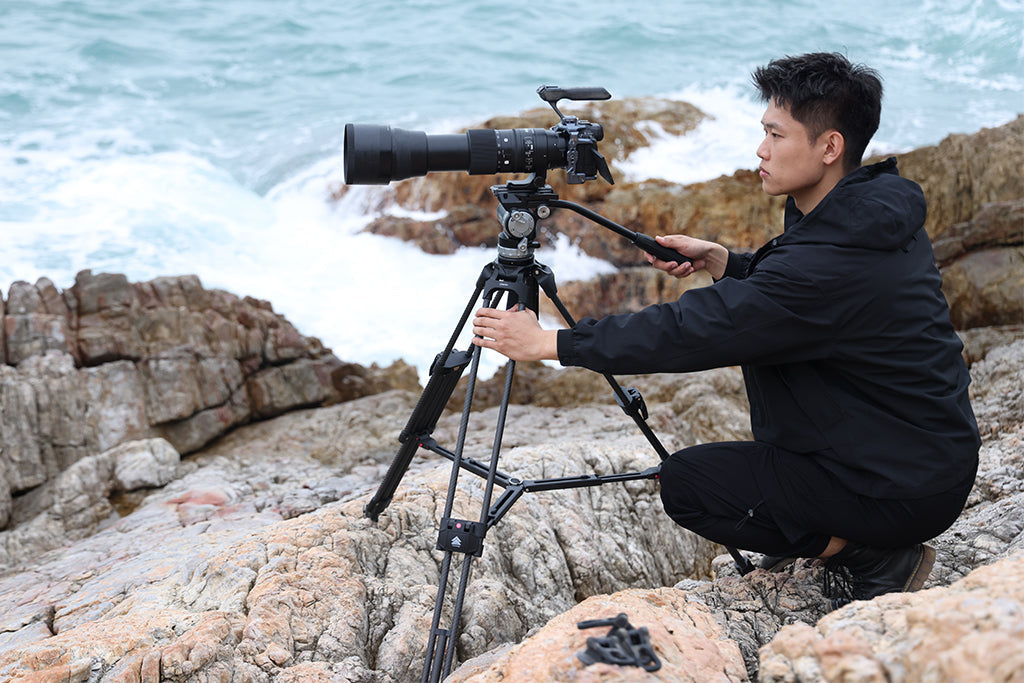
The most critical failure point in any anchored system isn't the rock or the tree; it's the interface between the rig and the anchor. Practitioners often overlook the "thermal bridge" and "abrasion" factors.
Webbing vs. Cord
Never use thin paracord directly against sharp rock edges. Under the high-frequency vibration of wind, paracord can be severed in minutes. Tubular webbing is significantly more abrasion-resistant. If you must use cord, sleeve it with a piece of plastic tubing or even a spare sock to protect the load-bearing fibers.
The Pull-Test Sequence
Before walking away from a remote rig, we always perform a three-stage pull-test:
- Audible Check: Listen for the "click" of your quick-release system. Ensure the locking pin is fully engaged.
- Tactile Check: Apply a 5kg load in the direction of the wind. Watch for any "creep" in the knots or shifting of the anchor.
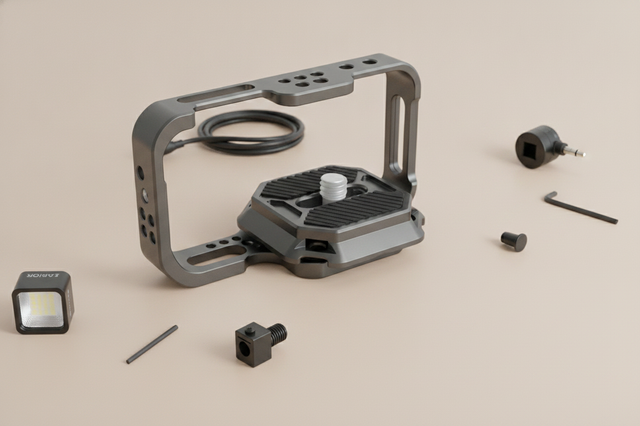
- Visual Check: Verify the Arca-Swiss dovetail alignment. Even a 1mm gap can lead to micro-vibrations that ruin high-resolution shots.
Biomechanical Analysis: The "Wrist Torque" Factor
When rigging accessories like monitors or external batteries to a stabilized tripod, creators often ignore the impact on their own workflow when they transition to handheld. Weight distribution affects more than just the tripod; it affects the creator's physical endurance.
The Torque Formula: $\tau = m \times g \times L$
- $\tau$ = Torque ($N\cdot m$)
- $m$ = Mass ($kg$)
- $g$ = Gravity ($9.81 m/s^2$)
- $L$ = Lever Arm ($m$)
If you mount a 0.5kg monitor on a 0.3m arm extending from the side of your rig, you generate $\approx 1.47 N\cdot m$ of additional torque. While this seems small, holding this load during a long shoot can represent 60-80% of the Maximum Voluntary Contraction (MVC) for an average adult's wrist stabilizers. By using modular quick-release systems to keep accessories close to the center of gravity, you reduce this leverage, allowing for longer, steadier shots when the wind dies down and you go handheld.
Workflow ROI: The Value of Modular Speed
In extreme environments, time is safety. Fumbling with traditional threaded mounts in freezing temperatures isn't just a nuisance; it's a risk.
| Mounting Method | Avg. Swap Time | Annual Time Saved (Pro) | Estimated Value (@$120/hr) |
|---|---|---|---|
| Traditional Thread | 40 seconds | 0 hours (Baseline) | $0 |
| Quick Release | 3 seconds | ~49 hours | ~$5,880 |
Calculation Logic: Based on 60 swaps per shoot, 80 shoots per year. (37 seconds saved per swap $\times$ 4,800 swaps = 177,600 seconds $\approx$ 49 hours).
Beyond the financial ROI, modular systems have a lower "Visual Weight." Compact, aluminum alloy plates are less likely to be flagged by airline gate agents for weighing compared to bulky cinema rigging. This logistical advantage is crucial for filmmakers adhering to IATA Lithium Battery Guidance and strict carry-on limits.
Safety and Thermal Management
The Thermal Bridge
Precision-machined aluminum plates are excellent for rigidity, but they act as a "thermal bridge" in extreme cold. They conduct heat away from the camera body and battery faster than the camera's composite shell. In sub-zero conditions, we recommend attaching your plates to the camera indoors or inside a tent. This prevents "thermal shock" to the metal and helps maintain battery life by reducing the rate of cooling at the base.
Redundancy: The Golden Rule
For any shot where a gear failure means losing the camera (e.g., over a cliff or in high-flow rivers), always plan a secondary, redundant anchor point. This secondary line should remain slack, taking the load only if the primary anchor fails. This is a standard practice for assessing center of gravity in low-profile rigs and ensuring mission-critical reliability.
Smart Problem-Solving in the Field
Stabilizing ultra-light gear isn't about fighting the wind; it's about redirecting its force. By understanding the overturning moment and utilizing natural features like rocks and trees with engineering precision, you can capture rock-solid imagery in the most hostile environments on Earth.
Whether you are rigging accessories to tripod legs or counterbalancing heavy rigs on travel tripods, the goal is always the same: maximum stability with minimum mass. The smart creator doesn't just pack lighter; they rig smarter.
References
- ISO 1222:2010 Photography — Tripod Connections
- Arca-Swiss Dovetail Technical Dimensions
- IATA Lithium Battery Guidance Document (2025)
- Foundation Effects of Trees Under Wind Loads - University of Western Ontario
- TSE Entertainment: Understanding Wind Speed and Overturning Moments
Disclaimer: This article is for informational purposes only. Remote filmmaking and mountaineering involve inherent risks. Always consult with a qualified guide or structural engineer for mission-critical rigging, and ensure all equipment meets local safety standards. The author and publisher are not responsible for gear failure or injury resulting from the techniques described.