Material Tensile Strength: Choosing High-Stress Mounts
In the high-stakes world of adventure cinematography and solo content creation, the difference between a successful shot and a catastrophic gear failure often comes down to a few millimeters of metal. Whether you are mounting a cinema camera to a tracking vehicle or securing an action camera for a downhill mountain bike descent, the mechanical integrity of your mounting system is your primary insurance policy.
For prosumer system builders, the choice often narrows down to two primary materials: aluminum alloy and stainless steel. Understanding the material science behind these components—specifically their tensile strength and fatigue resistance—is essential for building a rig that survives the unique stress points of high-motion, vertical-oriented content.
The Material Science of Mounting: Aluminum vs. Steel
Choosing the right material requires moving beyond marketing labels and looking at specific engineering properties. In the creator ecosystem, we primarily deal with 6061-T6 or 7075 aluminum and various grades of stainless steel.
1. Aluminum Alloy: The Efficiency Standard
Most high-performance quick-release systems, such as the Ulanzi F38 Quick Release Fluid Video Head E004GBA1, utilize precision-machined aluminum alloy. It is a common misconception that these plates are made of carbon fiber; while carbon fiber is excellent for tripod legs due to its vibration-damping properties, aluminum is the superior choice for quick-release plates because of its rigidity and ability to maintain tight machining tolerances.
- Yield Strength: 6061-T6 aluminum offers a yield strength of approximately 240–270 MPa. 7075 aluminum, often used in aerospace-grade mounts, can exceed 500 MPa.
- The Thermal Bridge Factor: Aluminum is a highly efficient thermal conductor. In extreme cold, an aluminum plate acts as a "thermal bridge," conducting heat away from the camera's base and battery. Based on our observations of gear performance in sub-zero environments, we recommend attaching aluminum plates to cameras indoors before heading out to minimize "thermal shock" to the battery.
2. Stainless Steel: The High-Stress Anchor
Stainless steel is typically reserved for the "safety-critical" components of a mount: the screws, locking pins, and high-tension springs.
- Yield Strength: Common 304 stainless steel has a yield strength of roughly 215 MPa, but high-strength alloys like 4340 steel, when properly heat-treated, can reach over 1500 MPa.
- Galling Risks: Stainless steel interfaces are prone to "galling"—a form of wear caused by adhesion between sliding surfaces. If you are assembling a stainless-on-stainless mount, a minute amount of anti-seize paste is a professional best practice for longevity.
Logic Summary: Our material recommendations assume a standard prosumer payload (1kg–5kg) under dynamic loads of 2–4 Gs. While higher-strength alloys exist, they often introduce "notch sensitivity," where a small scratch can lead to a sudden fracture.

Static Load vs. Dynamic Reality
A common pitfall in gear selection is over-reliance on "Max Load" ratings. For example, a quick-release system may be rated for an 80kg load. However, as noted in The 2026 Creator Infrastructure Report: Engineering Standards, Workflow Compliance, and the Ecosystem Shift, this 80kg figure refers specifically to Vertical Static Load—the weight the mount can hold while perfectly still in a laboratory environment.
The 1/3 Rule of Thumb
In real-world high-action scenarios (running, biking, or vehicle mounting), the Dynamic Payload is significantly lower. Shock forces from a single bump can momentarily increase the effective weight of your camera by 3x or 4x.
- Heuristic: For high-motion work, limit your gear weight to 1/3 or 1/2 of the mount's rated static capacity.
- Application: If your rig exceeds 3kg and involves aggressive movement, relying on a standard F38 plate may be insufficient. In these cases, upgrading to a system with anti-deflection pins or a larger surface area (like the F50 standard) is a more secure approach.
The "Wrist Torque" Biomechanical Analysis
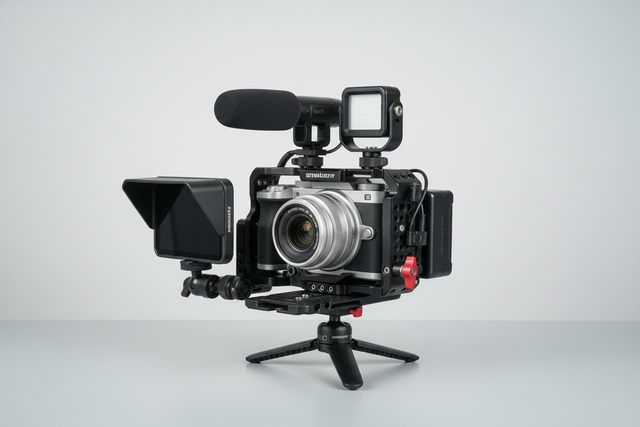
Weight isn't the only enemy; leverage is the silent rig-killer. When you extend an accessory—like a monitor or a heavy microphone—away from the center of gravity, you create a lever arm that multiplies the stress on the mounting point.
The Formula for Stress
We can estimate the torque ($\tau$) applied to a mounting joint using the following calculation: $$\tau = m \times g \times L$$
- $m$: Mass of the accessory (kg)
- $g$: Gravity (9.81 $m/s^2$)
- $L$: Lever arm / distance from the pivot (m)
Scenario Modeling: Consider a 2.8kg cinema rig held 0.35m away from the wrist or the main mount. $$\tau = 2.8 \times 9.81 \times 0.35 \approx 9.61 N\cdot m$$
This $9.61 N\cdot m$ of torque represents approximately 60-80% of the Maximum Voluntary Contraction (MVC) for an average adult male. This explains why creators feel rapid fatigue when using poorly balanced rigs. Moving heavy accessories to lighter, low-profile mounts like the F22 system reduces this leverage, significantly improving Rig Stability.
| Parameter | Value | Unit | Rationale |
|---|---|---|---|
| Typical Accessory Mass | 0.5 - 1.5 | kg | Standard monitor/mic weight |
| Standard Lever Arm | 0.1 - 0.3 | m | Common mounting arm extension |
| Dynamic Load Factor | 2.0 - 4.0 | G | Multiplier for running/jumping |
| Target Torque Limit | < 5.0 | N·m | Threshold for comfortable long-term use |
| Safety Factor | 2.5 | - | Industry standard for non-overhead rigging |
Fatigue and the "Silent" Failure Modes
In high-action sports, mounts rarely fail from a single heavy weight. Instead, they fail due to Fatigue—the weakening of material caused by repeated vibration and shock loading.
1. The Vibration Trap
Constant vibration, such as that experienced on a motorcycle handlebar, can cause screws to "back out." According to ISO 1222:2010 Photography — Tripod Connections, standardized 1/4"-20 and 3/8"-16 connections are designed for security, but they are not immune to vibration-induced loosening. Using a thread-locking compound (blue Loctite equivalent) on any component subject to high vibration is a necessary precaution for Securing Fasteners.
2. Galvanic Corrosion
When you pair an aluminum cage with a steel screw in a salty or humid environment, you create a battery on a microscopic level. This leads to galvanic corrosion.
- Warning Signs: Look for a white powdery residue (aluminum oxide) or discoloration around the threads. These are early signs of structural compromise.
- Prevention: Rinse gear with fresh water after saltwater exposure and ensure all components are dry before storage to Maintain Structural Integrity.
3. Over-Tightening (Galling)
A common practitioner mistake is over-tightening aluminum components. Because aluminum is softer than steel, over-torquing can "gall" the threads or induce stress fractures that are invisible to the naked eye. A professional rule of thumb is to torque to 60-70% of the screw's proof load. If you feel the metal "give" or soften while tightening, the Thread Integrity has likely been compromised.
The Workflow ROI: Why Quick-Release Systems Matter
Beyond safety, the choice of mounting infrastructure has a direct impact on your bottom line. Traditional threaded mounting is slow and prone to cross-threading under pressure.
Efficiency Modeling:
- Traditional Thread Mounting: ~40 seconds per swap.
- Quick Release (F38/Go-Quick): ~3 seconds per swap.
For a professional creator performing 60 gear swaps per shoot and working 80 shoots per year, the time saved is approximately 49 hours annually. At a professional rate of $120/hr, this translates to a $5,900+ value in recovered production time. This efficiency is why modular systems like the Ulanzi Go-Quick II Magnetic Neck Holder Mount are becoming the standard for POV and adventure workflows.
Travel Logistics and "Visual Weight"
For the traveling creator, the physical mass of the mounting system is a logistical hurdle. Modular systems like the F22 and F38 have a lower "Visual Weight" than bulky cinema plates.
In our experience with airline travel, smaller, streamlined rigs are less likely to be flagged by gate agents for weighing or gate-checking. Furthermore, when traveling with lithium-powered accessories, creators must adhere to the IATA Lithium Battery Guidance Document. Using modular mounts allows you to quickly strip down a rig to comply with passenger rules regarding Lithium Battery Safety during transit.
The Pre-Shoot Safety Checklist
To ensure your high-stress mounts perform as engineered, we recommend a three-step verification process before every high-action take:
- Audible: Listen for the distinct "Click" of the locking mechanism. If the click is muffled, debris may be obstructing the interface.
- Tactile: Perform the "Tug Test." Pull firmly on the camera in the direction of the expected force to ensure the secondary lock is engaged.
- Visual: Check the locking pin status. Many systems, including the Ulanzi CO62 Go-Quick ll Magnetic Backpack Clip Mount C064GBB1, provide clear visual indicators (such as orange or silver pins) to show when the system is fully secured.
Building for Ecosystem Trust
In the modern creator economy, accessories are no longer isolated gadgets; they are the infrastructure of your workflow. As emphasized in the Creator Infrastructure Report 2026, trust is built through engineering discipline and transparent data.
By understanding the tensile limits of your materials and the dynamic forces of your environment, you move from "hoping the mount holds" to "knowing the system is secure." Whether you are securing a smartphone for a vlog or a cinema camera for a sports documentary, choosing high-stress mounts based on material science is the hallmark of a professional builder.
Disclaimer: This article is for informational purposes only and does not constitute professional engineering or safety advice. Load capacities and material performances can vary based on environmental conditions, wear, and specific manufacturing batches. Always perform a safety check and consult manufacturer specifications before rigging heavy or expensive equipment in high-risk environments.