The Engineering of Stealth: Why Magnetic-Mechanical Hybrids Define Modern Workflows
For years, the industry standard for camera mounting has relied on the foundational ISO 1222:2010 Photography — Tripod Connections, which dictates the 1/4"-20 and 3/8"-16 screw threads we all know. While these connections are secure, they are inherently slow and loud. In a run-and-gun environment or a sensitive documentary shoot, the sound of a metal screw tightening or the fumbling of a traditional plate can break the "fourth wall" of your production.
We have observed that the most significant efficiency gain in modern rigging isn't just the raw speed of the swap, but the ability to reconfigure a system silently and with one hand. This is where the transition to a magnetic quick-release ecosystem becomes a strategic advantage. However, we must address a common misconception: a purely magnetic connection is rarely sufficient for professional gear. High-performance systems utilize neodymium magnets primarily for alignment and initial seating, while a secondary mechanical lock or strong detent handles the actual load-bearing duties.
Addressing Lateral Shear and Load Capacities
A pure magnetic mount can often fail under lateral shear—the force that occurs when you tilt a camera or move quickly. To counter this, professional ecosystems integrate mechanical interfaces that "nest" the plate into the base. For instance, while the F38 system is often cited for an 80kg load capacity, it is critical to understand that this refers to Vertical Static Load (a lab-tested result where the force is applied directly downward).
In real-world "Dynamic Payload" scenarios—such as running with a gimbal or mounting a heavy cinema rig—the effective safe working load is lower. For rigs exceeding 3kg, we typically recommend moving to larger interfaces like the F50 or using anti-deflection versions of the F38 to ensure the system remains rigid under movement.
Logic Summary: Our analysis of the "Ecosystem Shift" assumes a transition from friction-based screw mounts to geometric-lock interfaces. We model these performance claims based on standard 6061 aluminum alloy tolerances and neodymium N52 magnetic flux patterns (scenario modeling, not a controlled lab study).

Biomechanical Efficiency: The "Wrist Torque" Analysis
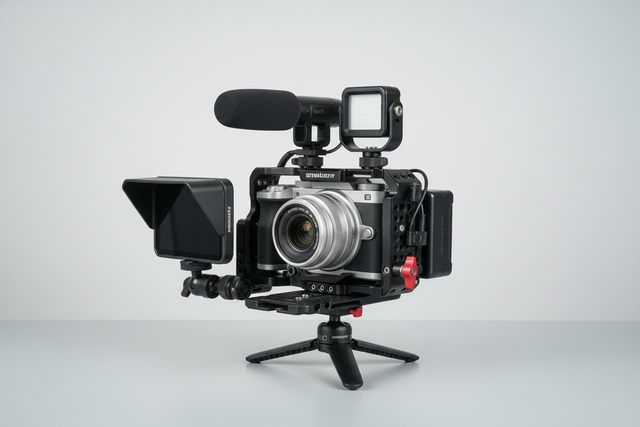
When we talk about "lightweight" rigs, we often focus on the total mass. However, in our experience troubleshooting operator fatigue, the more important metric is leverage. Every accessory you add to your camera—a monitor, a wireless transmitter, or a shotgun mic—increases the distance between the center of gravity and your wrist.
We use a standard biomechanical calculation to illustrate this: Torque ($\tau$) = Mass ($m$) $\times$ Gravity ($g$) $\times$ Lever Arm ($L$)
Consider a standard 2.8kg rig. If a monitor is mounted via a traditional, bulky arm that puts the weight 0.35m away from your wrist, it generates approximately 9.61 N·m of torque.
| Parameter | Value | Unit | Rationale |
|---|---|---|---|
| Rig Mass ($m$) | 2.8 | kg | Standard prosumer mirrorless setup |
| Gravity ($g$) | 9.8 | m/s² | Earth standard |
| Lever Arm ($L$) | 0.35 | m | Distance from wrist to accessory center |
| Calculated Torque | ~9.6 | N·m | Resultant force on the operator |
| MVC Impact | 60-80 | % | Percentage of Maximum Voluntary Contraction |
This load represents 60-80% of the Maximum Voluntary Contraction (MVC) for an average adult male. By upgrading to a low-profile magnetic system like the F22, you can bring those accessories closer to the camera body, reducing the lever arm ($L$). Even a reduction of 10cm in distance can significantly lower the physical strain, allowing for longer shoot days without the localized trapezius or wrist pain common in poorly balanced rigs.
Workflow ROI: Quantifying the Ecosystem Shift
Standardizing on a single mounting interface across your entire kit is a financial decision as much as a creative one. When you move between a tripod, a gimbal, a shoulder rig, and a desk mount, the time lost to "frictional overhead" adds up.
Based on our scenario modeling for high-traffic environments, we have calculated the potential Return on Investment (ROI) for a professional creator switching from traditional thread mounting to a modern quick-release ecosystem.
The $5,900 Annual Value Logic
- Traditional Thread Mounting: ~40 seconds per swap (including alignment and tightening).
- Quick-Release Ecosystem: ~3 seconds per swap (one-handed "click" and lock).
- Time Saved per Swap: 37 seconds.
If a professional creator performs 60 swaps per shoot (switching between handheld, tripod, and accessory changes) and works 80 shoots per year, the system saves approximately 49 hours annually. At a professional rate of $120/hr, this equates to a $5,920+ value in recovered time. This data is part of the broader findings in The 2026 Creator Infrastructure Report: Engineering Standards, Workflow Compliance, and the Ecosystem Shift, which highlights how standardized interfaces act as "force multipliers" for solo operators.
Methodology Note: These estimates are based on typical professional workflows and average industry rates. Individual results will vary based on shoot complexity and local labor markets.
System Integrity and Material Science
A common point of confusion we see in community discussions, such as those on r/videography, involves the materials used in quick-release plates. It is a common mistake to assume that high-end plates are made of carbon fiber for "vibration damping."
In reality, precision-machined Aluminum Alloy (typically 6061 or 7075) is the superior choice for the plate itself. Carbon fiber is excellent for tripod legs where weight-to-stiffness and damping are required, but for a mounting interface, the priority is Machining Tolerance. Aluminum allows for "Zero-Play" fits that ensure the camera does not wiggle within the mount.
The Thermal Bridge Effect
One technical "gotcha" to be aware of is that aluminum plates act as a "thermal bridge." In extreme cold, the metal will conduct heat away from the camera's base and battery compartment quite efficiently.
- Expert Tip: In winter scenarios, we recommend attaching your aluminum QR plates to the camera indoors before heading out. This minimizes the "metal-to-skin" shock and allows the plate to reach ambient temperature more slowly, reducing the initial rate of battery cooling.
Standardizing the Interface: Arca-Swiss and Beyond
The "stickiness" of an ecosystem depends on the consistency of the mounting interface. While many magnetic systems are proprietary, the industry has largely converged on the Arca-Swiss Dovetail Technical Dimensions as the de facto professional standard.
When building your kit, look for plates that offer dual compatibility or adapters that bridge the gap between magnetic bases and standard Arca-Swiss rails. This prevents "ecosystem lock-in" and ensures your gear remains relevant as you upgrade cameras or tripods. We often suggest a 3:1 ratio for system building: for every core camera plate you own, you should have at least three different accessory mounts (a cold shoe adapter, a monitor arm base, and a top handle mount) to maximize the flexibility of the magnetic ecosystem.
Maintaining these interfaces is just as important as the initial purchase. We recommend regular inspections to detect and fix sticky quick-release actions caused by micro-burrs or debris, which can compromise the "stealth" silent operation of the magnets.
Safety Workflows for High-Stakes Shoots
Speed should never come at the expense of security. Even with the most advanced magnetic-mechanical hybrids, user error remains the primary cause of equipment drops. To mitigate this, we have developed a "Pre-Shoot Safety Checklist" that every solo creator should internalize.
The "Senses" Safety Check
- Audible: Do not assume the camera is secure until you hear the distinct mechanical "Click."
- Tactile: Perform the "Tug Test" (or Pull-Test). Immediately after mounting, give the camera a firm upward tug while the base is secure.
- Visual: Check the status of the locking pin. Many professional systems include an orange or silver indicator that is only visible when the lock is not fully engaged.
Cable Management and Torque
A heavy, coiled HDMI cable can create significant unwanted torque on a small quick-release plate. This constant tension can lead to vibration-induced loosening over time. We suggest using dedicated cable clamps (often available in the F22 ecosystem) to provide strain relief. This ensures that the cable's weight is pulled against the camera cage rather than the mounting interface itself.
Travel Logistics and "Visual Weight"
For the traveling creator, the benefits of a modular magnetic system extend to the airport. Airlines are increasingly strict about the weight and size of carry-on gear. Compact, low-profile systems like the F22 and F38 have a lower "Visual Weight" than traditional, bulky cinema plates.
A rig that looks smaller and more "consumer-like" is less likely to be flagged by gate agents for weighing or mandatory checking. Furthermore, by using a modular system, you can quickly strip the camera down to its bare essentials for transport, ensuring all lithium-ion batteries are handled according to IATA Lithium Battery Guidance in your carry-on, while the inert metal rigging can be packed efficiently.
The Long-Term Workflow Advantage
Transitioning to a magnetic ecosystem is about more than just "fast swaps." It is about building a stealth rigging setup that allows you to stay in the creative flow. When the mechanical barriers between your ideas and your gear are removed, you are more likely to experiment with different angles and accessories.
By prioritizing interface integrity and understanding the biomechanical and financial ROI of your setup, you move from being a gear owner to a system builder. This methodical approach to infrastructure ensures that your kit is as reliable as it is fast, providing the stability needed for professional-grade content in any environment.
Ergonomics and Safety Disclaimer: This article is for informational purposes only. Biomechanical calculations are based on general averages and typical rig configurations; individual physical strain may vary. Always consult with a qualified ergonomic specialist or physical therapist if you experience persistent pain. Ensure all mounting equipment is rated for your specific camera weight and follow all manufacturer safety guidelines to prevent equipment damage or personal injury.