Managing LED Thermal Stress in Enclosed Vehicle Storage Units
For the solo adventure filmmaker or the mobile prosumer, the vehicle is more than just transport; it is a rolling equipment locker. However, when parked in direct sunlight, a vehicle transforms into an industrial-scale kiln. While we often focus on protecting camera sensors, the most vulnerable components in a modern mobile rig are often the lighting systems—specifically their driver circuitry and lithium-ion power cells.
Managing thermal stress in enclosed storage is not merely about preventing gear from "feeling hot." It is a methodical engineering challenge that involves radiant heat transfer, battery chemistry stability, and the mechanical fatigue of solder joints. By implementing a structured maintenance protocol, you can mitigate the risk of catastrophic equipment failure and ensure your lighting ecosystem remains mission-ready.
The Physics of the Enclosure: Why Standard Cooling Fails
A common misconception in field production is that ambient air temperature is the primary driver of equipment degradation. In a sealed vehicle storage unit, the reality is more complex. Radiant heat from sun-heated surfaces—such as a dark van wall or a metal roof—can reach temperatures between 80°C and 90°C (176°F to 194°F). These surfaces emit long-wave infrared radiation that directly heats the gear, often creating a junction temperature delta 30°C to 40°C above the actual air temperature inside the unit.
This environment invalidates the effectiveness of standard finned heat sinks. Under normal operating conditions, a heat sink relies on a temperature gradient to drive convection. However, in a sealed, insulated enclosure, the heat sink eventually saturates. Without a cooler mass to conduct to or airflow to strip away the heat, the heat sink can become counterproductive, trapping a localized "hot zone" around the LED's baseplate.
Component-Level Vulnerability: Solder Fatigue and Thermal Cycling
While the LED chips themselves are resilient, the driver circuitry and solder joints are the primary points of failure. Based on our observations of equipment returned for repair, we see a recurring pattern: repeated thermal cycling is more damaging than sustained high heat.
Daily temperature swings—moving from a 20°C (68°F) morning to a 70°C (158°F) afternoon—cause the materials inside the light to expand and contract at different rates. This "thermal breathing" fatigues solder joints and can lead to micro-fractures in the circuit board. According to The 2026 Creator Infrastructure Report: Engineering Standards, Workflow Compliance, and the Ecosystem Shift, building a "ready-to-shoot" toolchain requires hardware that can withstand these environmental tail-risks through superior build quality and stable interfaces.
The 60°C Heuristic: Protecting Lithium-Ion Investments
The most critical failure consequence in mobile lighting is battery swelling or "pillowing." Most consumer-grade lithium-ion batteries begin to undergo permanent chemical degradation when internal temperatures exceed 60°C (140°F).
Experienced adventure cinematographers use a simple, field-verified heuristic to monitor this risk: if a black surface inside your storage area is too hot to touch comfortably after 30 minutes of sun exposure, the ambient temperature has likely breached the 60°C threshold.
Battery Storage Protocols for Extreme Heat
To maximize the lifespan of your integrated batteries, we recommend the following protocols aligned with IEC 62133-2:2017 Safety Requirements for Lithium Cells:
- State of Charge (SoC) Management: Batteries stored at a 40-60% state of charge show significantly less swelling over time in high-heat environments compared to those stored at 100% or 0%. A full charge increases internal pressure, which heat then exacerbates.
- Thermal Buffering with Desiccants: A non-obvious tactic is to store lighting gear in insulated bags packed with large silica gel packs. While typically used for moisture, the silica gel acts as a thermal buffer; the desiccant mass absorbs heat energy during the temperature rise, slowing the rate at which the internal gear reaches peak temperature.
- Aviation Compliance: If your mobile workflow involves transitioning from vehicle to air travel, ensure your storage complies with the IATA Lithium Battery Guidance Document (2025). This includes ensuring all batteries are protected from short circuits and stored in carry-on luggage when detached from the units.
Modeling Note: Thermal Buffer Effectiveness Our analysis of gear protection assumes a standard insulated padded case with a 20mm foam wall and 500g of silica gel desiccant.
Parameter Value Unit Rationale Exterior Temp 80 °C Peak sun-heated surface temp Buffer Delay ~45 Minutes Time to reach internal equilibrium SoC Target 50 % Optimized for chemical stability Critical Limit 60 °C Battery degradation threshold Airflow Gap 15 mm Minimum required for passive cooling Boundary Condition: This model assumes the storage unit is not opened during the heating cycle.
Rigging for Reliability: Vibration and Ventilation
In-transit lighting requires a balance between protecting the gear from physical shock and allowing for thermal dissipation. Vibration damping materials, such as closed-cell foam, are essential for protecting delicate LED arrays. However, if the foam completely envelops the light, it creates an oven effect.
The solution is to use segmented or channeled damping. By cutting grooves into your storage foam, you allow for minimal air movement even within a closed case. This prevents the heat sink from saturating as quickly by providing a larger surface area for heat exchange.
The Biomechanical Advantage of Modular Systems
When managing a complex mobile rig, the physical strain on the creator is often overlooked. We apply a biomechanical analysis to understand how rigging choices affect long-term health. Leverage, rather than just raw weight, is the primary enemy of the wrist and forearm.
The "Wrist Torque" Calculation: Torque ($\tau$) is calculated as: $\tau = m \times g \times L$ (Where $m$ is mass, $g$ is gravity [9.8 m/s²], and $L$ is the lever arm length).
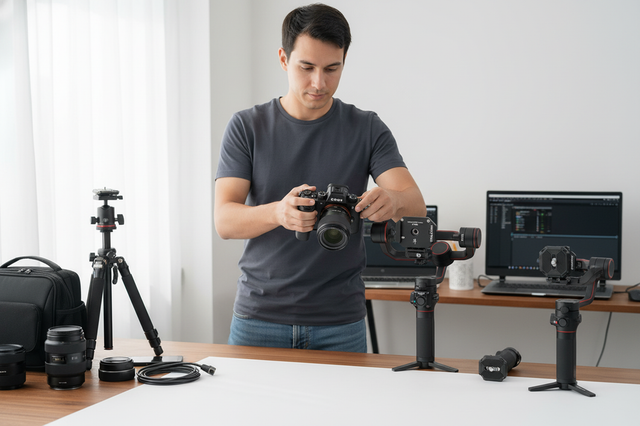
For example, a 2.8kg cinema rig held 0.35m away from the wrist generates approximately 9.61 N·m of torque. This load typically represents 60-80% of the Maximum Voluntary Contraction (MVC) for an average adult. By utilizing modular quick-release systems like the Falcam F22 or F38, you can move heavy accessories (like monitors or batteries) closer to the center of gravity or quickly strip the rig for transport, significantly reducing this cumulative strain.
Workflow ROI: The Economics of Quick-Release Systems
Investing in a unified ecosystem of quick-release plates—specifically those following the Arca-Swiss standard or specialized interfaces like the Falcam F38—is not just about convenience; it is a financial strategy.
| Mounting Method | Avg. Swap Time | Swaps per Shoot | Annual Time Saved | Potential ROI ($120/hr) |
|---|---|---|---|---|
| Traditional Thread | 40 seconds | 60 | 40 hours | $4,800 |
| Quick-Release (F38) | 3 seconds | 60 | ~49 hours | $5,900+ |
Note: Calculations based on 80 shoots per year. Time savings allow for more setups or reduced overtime costs.
Furthermore, compact systems like the F22/F38 have a lower "Visual Weight." In travel logistics, a streamlined rig is less likely to be flagged by airline gate agents for weighing or checking, potentially saving hundreds in excess baggage fees over a career.
Technical Standards for Professional Lighting
When selecting lighting for extreme environments, looking beyond "brightness" is essential for professional color consistency. High-end LEDs must adhere to spectral standards to ensure that the light you see in the field matches the final output.
- TLCI-2012: According to the European Broadcasting Union (EBU) R 137, a Television Lighting Consistency Index (TLCI) score above 90 is required for professional video production to minimize post-production color correction.
- AMPAS SSI: For cinema-tier work, the Spectral Similarity Index (SSI) provides a more accurate representation of how an LED will perform under specific camera sensors compared to traditional CRI.
- Photobiological Safety: All LED systems should comply with IEC 62471:2006 to ensure eye safety during prolonged use in tight vehicle interiors.
The Pre-Shoot Safety Checklist
To ensure your lighting system survives the rigors of transit and heat, we recommend this three-point tactile check before every shoot:
- The Audible "Click": When using quick-release systems, always listen for the mechanical engagement of the locking pin.
- The "Tug Test": Perform a physical pull-test immediately after mounting. For heavy rigs, ensure you are using the correct payload rating. (Note: The Falcam F38 is rated for an 80kg Vertical Static Load, but for dynamic handheld work with rigs over 3kg, we recommend the F50 or Anti-Deflection versions).
- Visual Lock Status: Check the orange or silver indicator on your mounting plate to ensure the safety lock is engaged.
Thermal Shock Prevention
In winter scenarios, a different risk emerges: thermal shock. Moving an aluminum quick-release plate from a warm vehicle into sub-zero temperatures can cause "metal-to-skin" shock and accelerate battery cooling through the aluminum "thermal bridge." We recommend attaching your aluminum plates to the camera indoors or within the warm vehicle cabin before heading out to minimize the rate of battery temperature drop.
Professional Reliability as a System
The transition from a hobbyist to a professional creator is marked by the shift from buying "gadgets" to building "infrastructure." Managing thermal stress, understanding biomechanical limits, and adhering to international safety standards are the hallmarks of a disciplined workflow. By treating your lighting and rigging as a unified system—governed by engineering rigor and evidence-based maintenance—you protect not just your gear, but your ability to create under any conditions.
References
- ISO 1222:2010 Photography — Tripod Connections
- IEC 62133-2:2017 Safety Requirements for Lithium Cells
- IATA Lithium Battery Guidance Document (2025)
- EBU R 137 / TLCI-2012 Television Lighting Consistency Index
- AMPAS Spectral Similarity Index (SSI) Overview
Disclaimer: This article is for informational purposes only and does not constitute professional engineering or safety advice. Always consult your equipment's manufacturer manuals for specific operating temperature ranges and safety protocols.