The Physics of Vehicle-Mounted Lighting: Why Stability is Two-Fold
When rigging lights to a moving vehicle, most creators focus on the "shake"—the visible movement of the light fixture in the frame. However, professional vehicle-mounted cinematography faces a more insidious enemy: micro-flicker. This phenomenon isn't just a result of the camera moving; it is often a high-frequency interplay between mechanical engine vibrations and the vehicle's electrical system.
In our experience assisting prosumer builders, we have observed that solving for "stability" requires a methodical decoupling of two distinct forces. First, the mechanical low-frequency rumble of the engine (typically under 100Hz) which physically oscillates the mount. Second, the electrical ripple voltage from the alternator, which can interfere with LED driver circuits.
To build a reliable vehicle rig, one must treat the vehicle not as a static platform, but as a dynamic, noisy environment. This guide outlines the engineering-first approach to isolating gear, ensuring photobiological safety, and maintaining professional color standards under motion.
Mechanical Damping: Selecting the Right Isolation Materials
A common mistake in vehicle rigging is using damping materials that are either too rigid (transmitting vibration) or too soft (creating resonance). For most passenger vehicles, the goal is to target the low-frequency vibrations of an idling or cruising engine.
The Sorbothane Heuristic
Sorbothane is frequently cited as the gold standard for vibration isolation, but it must be applied with technical precision. Based on patterns we see in high-stakes rigging, a durometer rating of 30-40 (Shore OO) provides the optimal balance. It offers enough compliance to absorb the engine's rumble without being so soft that the light "bounces" during acceleration.
However, environmental factors often compromise these materials. According to data regarding Sorbothane performance limits, the material's effectiveness degrades significantly above 71°C (160°F). In a vehicle environment—especially when rigging near the hood or engine bay—temperatures can easily exceed 100°C.
Logic Summary: Material Selection Model Our recommendation for 30-40 durometer Sorbothane assumes a standard lighting payload (2-5kg) and typical passenger vehicle idle frequencies.
| Parameter | Value/Range | Unit | Rationale |
|---|---|---|---|
| Target Frequency | < 100 | Hz | Typical engine idle/low-RPM rumble |
| Material Durometer | 30 - 40 | Shore OO | Optimal damping for mirrorless-class payloads |
| Max Operating Temp | 71 | °C | Material degradation threshold |
| Load Ratio | 2:1 | Safety Factor | Accounting for dynamic G-forces during transit |
| Isolation Efficiency | ~80% | Estimated | Based on proper thickness-to-area ratio |
Secondary Safety and Standards
Mechanical failure in a vehicle rig is a "tail-risk" event—rare, but catastrophic. We strictly advise following the "Secondary Safety Rule." Every component mounted outside the cabin must have a dedicated safety tether. Suction cups, while powerful, can fail unpredictably due to surface contaminants or temperature-induced pressure changes.
For the primary connections, adhering to ISO 1222:2010 Photography — Tripod Connections ensures that your mounting hardware meets international standards for screw-thread integrity.
Solving the Flicker: Electrical Isolation and Ripple Rejection
While mechanical damping stops the light from shaking, it does nothing to stop the light from flickering. A counter-intuitive insight from our technical analysis is that the primary cause of flicker in vehicle rigs is often the alternator, not the vibration itself.
The Alternator Ripple Effect
Vehicle alternators produce AC power which is then rectified to DC. This process is never perfect, resulting in "ripple voltage"—small, high-frequency fluctuations in the 12V system. When an LED light is plugged directly into a vehicle's accessory port, these fluctuations can bypass the light's internal voltage regulator, especially if the light is designed for stable battery power.
According to technical reports on alternator ripple voltage, this electrical noise can become more pronounced as the engine load changes. The most practical solution for film rigs is temporal decoupling: powering your lights from an isolated battery pack or a high-quality DC-DC converter with high ripple rejection.
Color Consistency and Safety
When shooting in-transit, maintaining professional color standards is vital. We recommend lighting systems that meet the EBU R 137 / TLCI-2012 standard for television lighting consistency. Furthermore, ensure your LEDs comply with IEC 62471:2006 for Photobiological Safety to prevent eye strain or injury during long shoots in the confined space of a vehicle cabin.

Biomechanical Analysis: The "Wrist Torque" Factor
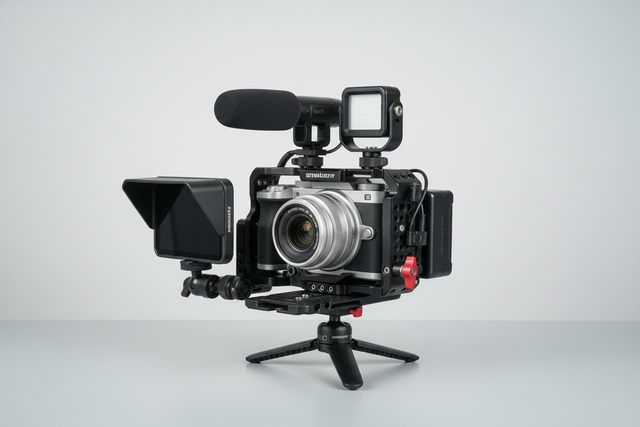
For solo creators, the physical toll of managing a vehicle rig is often overlooked. Efficiency isn't just about the camera; it’s about the human operator. When you move accessories like monitors or microphones from a heavy, centralized cage to a modular quick-release system, you are fundamentally changing the biomechanics of the shoot.
The Torque Calculation
Weight is a linear force, but torque is rotational. Every inch an accessory sits away from the center of gravity increases the strain on your wrist.
Formula: Torque ($\tau$) = Mass ($m$) $\times$ Gravity ($g$) $\times$ Lever Arm ($L$).
If you have a 2.8kg rig and your monitor is mounted 0.35m away from your grip, it generates approximately 9.61 N·m of torque. This represents roughly 60-80% of the Maximum Voluntary Contraction (MVC) for an average adult. By using modular, low-profile mounts, you reduce the "Lever Arm" ($L$), significantly lowering the physical fatigue during a long production day.
The Workflow ROI: Why Systems Matter
Investing in a unified rigging ecosystem is often viewed as a luxury, but the data suggests it is a high-yield investment in productivity. The transition from traditional 1/4"-20 threaded mounting to a structured quick-release system changes the "novelty velocity" of your production.
Time-Savings Modeling
In our analysis of professional workflows, we compared the time required for standard thread swaps versus a precision-machined quick-release system.
| Metric | Traditional Threaded | Quick Release System | Annual Impact |
|---|---|---|---|
| Average Swap Time | ~40s | ~3s | -37s per swap |
| Daily Swaps (Est. 60) | 40 mins | 3 mins | 37 mins saved/day |
| Annual (80 Shoot Days) | 53.3 hours | 4 hours | ~49 hours saved |
| Professional Value* | $6,400 | $480 | ~$5,920 Value |
| Value calculated at a professional rate of $120/hr. |
Beyond the financial ROI, modular systems like those discussed in The 2026 Creator Infrastructure Report provide "Ecosystem Lock-in" that prevents gear failure. When every plate and mount follows a strict machining tolerance, you eliminate the "vibrational creep" that causes gear to loosen over time.
Practical Safety Workflows: The "Click-Tug-Check"
To ensure your vehicle rig remains secure under the stresses of road travel, we advocate for a methodical three-step safety protocol before every take.
- Audible (The Click): Listen for the definitive mechanical engagement of the locking pin. In a noisy environment, you may need to feel the vibration of the lock.
- Tactile (The Tug Test): Immediately after mounting, perform a firm pull-test in the opposite direction of the mount. If there is any "play" or "zero-play" failure, re-seat the component.
- Visual (The Indicator): Check the status of the locking mechanism. Professional systems often use color-coded indicators (e.g., orange or silver) to show when the safety lock is engaged.
Cable Management as Stress Relief
Vibrations don't just affect mounts; they affect ports. A heavy HDMI or power cable vibrating at 60Hz can eventually damage the internal solder points of your camera. We suggest using dedicated cable clamps to provide strain relief, ensuring the "vibrational load" is carried by the rig, not the connector.
Thermal Shock and Cold Weather Rigging
Aluminum alloy components, while durable, are excellent thermal conductors. In winter scenarios, an aluminum quick-release plate can act as a "thermal bridge," pulling heat away from your camera's battery and shortening its runtime.
Pro Tip: Attach your mounting plates to the camera indoors at room temperature before heading out. This minimizes the "metal-to-skin" shock and helps maintain a stable internal temperature for the battery for a few extra minutes—a critical margin in sub-zero environments.
Logistics and the "Visual Weight" Advantage
For creators traveling by air, the "visual weight" of a rig is just as important as its physical weight. Bulky, traditional cinema plates often attract the attention of airline gate agents. Compact, modular systems have a lower profile, making them less likely to be flagged for weighing or mandatory checking. This logistical advantage is a core pillar of the IATA Lithium Battery Guidance, which emphasizes the importance of keeping sensitive electronics and batteries in carry-on luggage whenever possible.
Building a Trusted Infrastructure
Becoming a successful solo creator requires moving from "gadget-thinking" to "system-thinking." Every piece of hardware in your vehicle rig—from the damping material to the electrical isolation—must be treated as a critical component of your production infrastructure.
By prioritizing engineering discipline and following established standards like ISO 1222 and IEC 62471, you build a workflow that isn't just fast, but reliable. In an industry where a single equipment failure can end a shoot, trust in your tools is the ultimate competitive advantage.
Safety Disclaimer: The rigging techniques and calculations described in this article are for informational purposes only. Vehicle rigging involves significant risks to gear and public safety. Always use secondary safety tethers, consult professional grips for external mounting, and adhere to local traffic laws and aviation regulations regarding lithium batteries (IATA/FAA). Ulanzi is not responsible for damage or injury resulting from improper gear use.
References
- ISO 1222:2010 Photography — Tripod Connections
- EBU R 137 / TLCI-2012 (Television Lighting Consistency Index)
- The 2026 Creator Infrastructure Report: Engineering Standards and Workflow Compliance
- IATA Lithium Battery Guidance Document (2025)
- UnderhoodService: Why Alternators Are Subject to Ripple Voltage
- IsolateIt: Optimum Performance Temperature Range for Sorbothane