Eliminating Micro-Wobble in High-Action Vertical Systems
In the world of high-resolution vertical video, particularly for sports and adventure content, the difference between a "professional" shot and a "distracting" one often comes down to a few microns of movement. We call this "micro-wobble." It is not the large, sweeping shake that a gimbal or IBIS (In-Body Image Stabilization) can easily mask. Instead, micro-wobble is the high-frequency vibration that occurs at the connection points of your rig.
When you are shooting at high frame rates—120fps or 240fps—to capture action, these tiny gaps in your gear's "tolerance stack" become glaringly obvious. For solo creators building modular systems, the challenge is that every added joint—a magic arm, a quick-release plate, or a cage—is a potential failure point. In our experience diagnosing hundreds of field rigs, the primary source of instability is rarely a single "broken" part, but rather the cumulative play from multiple smaller connections.
The Physics of Vertical Instability: Torque and Leverage
Vertical rigs present a unique engineering challenge because they shift the center of gravity. In a standard horizontal setup, the camera’s weight is distributed relatively evenly over the tripod screw. In a vertical configuration, the camera is often cantilevered or mounted on an L-bracket, which significantly increases the torque exerted on the lowest connection point.
The "Wrist Torque" Biomechanical Analysis
Weight is not the only enemy; leverage is the true culprit. When you mount accessories like monitors or microphones further away from the central axis of your rig, you increase the "lever arm." We can quantify this using the standard torque formula:
Torque ($\tau$) = Mass ($m$) × Gravity ($g$) × Lever Arm ($L$)
For example, if you have a 2.8kg rig and your center of gravity is held 0.35m away from your primary grip or wrist, it generates approximately $9.61 N\cdot m$ of torque.
Logic Summary: This biomechanical model assumes a static hold. In dynamic movement (high-action), the "G-force" of sudden stops can double or triple this load. This $9.61 N\cdot m$ load represents roughly 60-80% of the Maximum Voluntary Contraction (MVC) for an average adult male. By migrating accessories to a more centralized, modular system like the Falcam F22, you reduce the lever arm ($L$), significantly lowering the physical strain and the likelihood of the rig shifting under its own weight.
Diagnosing the "Cumulative Play" Problem
Most practitioners make the mistake of overtightening knobs on aluminum components when they notice a wobble. This is a critical error. Overtightening can strip threads or slightly deform the metal, creating permanent play in the joint.
The Expert Rule of Thumb: Tighten until you meet firm resistance, then add exactly one quarter-turn. If the joint still moves, the problem is the interface tolerance, not the tightness.
High Frame Rate Vibration Mapping
To pinpoint exactly which joint is failing, we recommend a simple diagnostic workflow:
- Set your camera to its highest frame rate (120fps or more).
- Record a 10-second clip of a static subject.
- While recording, gently tap each component of the rig—the cage, the magic arm, the tripod head—with a fingernail.
- Review the footage. A solid joint will show almost no movement. A joint with "micro-wobble" will produce a distinct, high-frequency vibration in the frame the moment it is tapped.
The Engineering Solution: Precision Machining and Ecosystem Governance
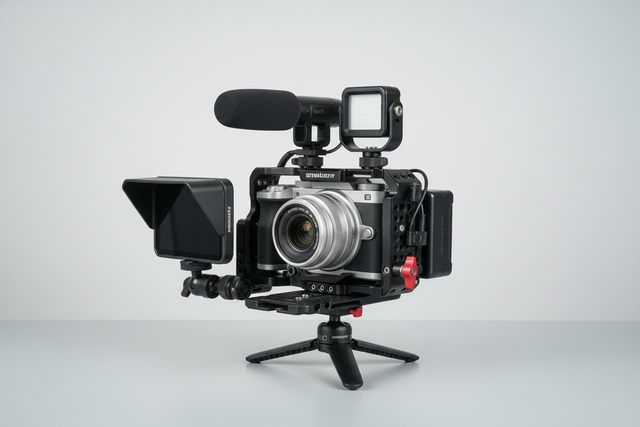
To eliminate micro-wobble, you must move away from generic "friction-based" connections and toward "positive-lock" interfaces. This is where the Ulanzi Falcam F22 & F38 & F50 Quick Release Camera Cage V2 for Sony A1/A7 III/A7S III/A7R IV 2635A becomes a foundational tool.

The Arca-Swiss Dovetail Technical Dimensions are a critical standard here. High-performance plates, like those in the Falcam F38 system, are machined to tolerances within ±0.02mm. This precision is what eliminates "play" before you even lock the device down.
Material Accuracy and Thermal Considerations
It is a common misconception that quick-release plates should be made of carbon fiber for "vibration damping." In reality, the quick-release plate must be as rigid as possible. The Falcam F22/F38/F50 plates are precision-machined from Aluminum Alloy (typically 6061). While carbon fiber is excellent for tripod legs to absorb ground vibrations, the interface between the camera and the head requires the zero-play rigidity of metal.
Thermal Note: Because these plates are aluminum, they act as a "thermal bridge." In extreme cold adventure shooting, the plate will conduct cold directly to the camera's base and battery compartment. We recommend attaching your plates to the camera indoors before heading out to minimize "thermal shock" and preserve battery life.
Modular Rigging for High-Action Stability
For high-action vertical setups, the Ulanzi U-190 Pro Fluid Video Head E009GBB1 offers a distinct advantage over standard ball heads. A ball head relies on a single point of friction, which can slip under the high torsional forces of a vertical rig. A fluid head with a positive lock, like the U-190 Pro, resists these torsional forces much more effectively.
The "Leverage" Strategy with Super Clamps
When mounting cameras to motorcycles or bicycles for adventure content, the Ulanzi CO17 Super Clamp with Dual Ballhead Magic Arm C046GBB1 is often used. However, creators frequently extend the magic arm to its maximum length. According to the principles outlined in The Lever Effect: How Accessory Extension Impacts Rig Stability, this creates a massive lever arm that amplifies every engine vibration.
Stability Tip: Keep magic arms as short as possible. Use the Ulanzi CO17 Super Clamp with Dual Ballhead Magic Arm C046GBB1 to grip close to the camera's center of mass to minimize the distance the vibration has to travel through the arm.
The Workflow ROI: Efficiency as Infrastructure
Switching to a unified quick-release ecosystem is not just about stability; it is a significant financial and logistical investment in your workflow. As highlighted in the 2026 Creator Infrastructure Report, creators are increasingly treating their rigging as "workflow infrastructure."
Workflow ROI Calculation
Let's model the time savings of a quick-release system (F38) versus traditional 1/4"-20 screw mounting (aligned with ISO 1222:2010 Photography — Tripod Connections):
| Metric | Traditional Thread Mounting | Falcam Quick Release (F38) |
|---|---|---|
| Average Time per Swap | ~40 seconds | ~3 seconds |
| Swaps per Shoot (Action) | 60 | 60 |
| Total Time per Shoot | 40 minutes | 3 minutes |
| Annual Time Saved (80 shoots) | ~49.3 Hours | Reference Baseline |
Modeling Note: This scenario assumes a professional "run-and-gun" environment where a creator frequently moves the camera between a gimbal, a tripod, and a chest mount. At a professional rate of $120/hr, saving 49 hours annually represents a ~$5,900+ value. This "Workflow ROI" justifies the cost of outfitting an entire system with modular plates.
Travel Logistics and "Visual Weight"
For adventure creators, travel is a constant. Bulky cinema-grade plates often add unnecessary "visual weight" to a rig. Airline gate agents are trained to spot heavy-looking gear for weighing. Modular systems like the F22/F38 have a much lower profile. By using the Ulanzi Falcam F22 & F38 & F50 Quick Release Camera Cage for Sony a7C II C00B3A01, you maintain a compact form factor that is less likely to be flagged during boarding, while still providing the structural integrity needed for high-action shooting.
Practical Safety Workflow: The Pre-Shoot Checklist
Reliability under stress is the hallmark of a professional setup. Before any high-action sequence, we recommend the "A-T-V" safety check for every connection point in your vertical system:
- Audible: Do you hear the distinct "Click" of the quick-release locking pin?
- Tactile: Perform the "Tug Test." Give the camera a firm pull away from the mount. If there is any movement, the plate is not seated correctly.
- Visual: Check the locking indicator. On Falcam systems, ensure the safety lock is engaged (usually indicated by the position of the slider).
Additionally, pay attention to cable management. A heavy, dangling HDMI cable can exert enough torque to introduce micro-wobble in a vertical setup. Use the integrated 1/4" mounting points on the Ulanzi Falcam F22 & F38 & F50 Quick Release Camera Cage for Sony a7C II C00B3A01 to secure cable clamps, providing essential strain relief.
Conclusion: Building for Stability
Eliminating micro-wobble is a methodical process of reducing tolerances and managing leverage. By understanding the biomechanical torque you place on your gear and utilizing precision-machined standards like the Arca-Swiss interface, you can build a vertical rig that stands up to the most intense action.
For more insights on securing your gear in high-vibration environments, see our guide on Thread-Locking Logic: Securing Fasteners in High-Vibration Rigs.
Disclaimer: This article is for informational purposes only. When mounting cameras to moving vehicles or in high-action environments, always use secondary safety tethers (leashes) to prevent equipment loss or injury in the event of a primary mount failure. Professional rigging should be inspected regularly for signs of metal fatigue or thread wear.