Beyond the Static: Why Dynamic Load Limits Define Your Rig’s Survival
Every solo creator knows the feeling of a "perfectly balanced" rig. You set it up on a tripod, tighten the knobs, and it sits there, rock-solid. But the moment you grab that vertical extension arm for a high-angle whip pan or a fast-tracking shot, the physics change. Suddenly, a 2kg camera setup doesn't feel like 2kg anymore. It feels like a sledgehammer trying to tear itself off the mount.
In our engineering analysis and community feedback sessions, we’ve observed a recurring pattern: most rig failures don't happen because the gear was too heavy for the tripod. They happen because the creator calculated for a static load while shooting in a dynamic environment.
As we move toward more complex, modular "creator infrastructure," understanding the mechanical limits of your gear is no longer optional—it is mission-critical. This guide breaks down the methodical approach to calculating dynamic load limits, specifically for vertical extension rigs, ensuring your high-motion shots remain safe and your gear remains intact.

1. The Physics of Motion: Static vs. Dynamic Load
To build a reliable system, we must first distinguish between the weight of an object at rest and the force it exerts while moving.
Understanding the 3-5x Multiplier
When you perform a fast whip pan or a sudden stop with a vertical extension, the momentum of the camera creates an "impulse force." According to our scenario modeling for high-velocity creator workflows, the dynamic load from a fast movement can easily reach 3 to 5 times the static weight of the camera.
If you are using a setup like the Ulanzi F38 Quick Release Fluid Video Head E004GBA1, which is rated for a 3kg payload, a 2kg camera setup might seem safe. However, during a high-motion tracking shot, that 2kg mass can exert a momentary force equivalent to 6kg or even 10kg on the locking mechanism.
Logic Summary: Our analysis of dynamic movement assumes a 3-5x multiplier based on common industry heuristics for handheld and gimbal-assisted motion. This is a scenario model, not a controlled lab study, and results vary based on the speed of the "stop" at the end of a movement.
The 4x Heuristic for Safety
Experienced riggers utilize a specific rule of thumb: for any dynamic shooting, the rig's rated static load capacity should be at least 4x the total weight of the attached gear.
| Component Weight | Recommended Static Rating (4x) | Suggested Interface |
|---|---|---|
| 500g (Smartphone/Vlog Cam) | 2kg | Falcam F22 |
| 1.5kg (Mirrorless + Prime) | 6kg | Falcam F38 |
| 3.0kg+ (Cinema Rig + Zoom) | 12kg+ | Falcam F50 |
For those pushing the boundaries of vertical video, ensuring your base plate and head—such as the Ulanzi U-190 Mini Fluid Head 2895 with its robust 10kg capacity—exceed your camera weight by this margin is the first step in preventing catastrophic failure.
2. The Lever Effect: Calculating Torque on Vertical Extensions
Weight is only half the battle. The real "gear killer" in vertical rigging is Torque. When you extend a camera vertically or offset it using an arm, you are creating a lever.
The Math of Leverage
Torque ($\tau$) is the rotational force applied to your mount. It is calculated as: $$\tau = m \times g \times L$$
- m: Mass (kg)
- g: Gravity ($9.8 m/s^2$)
- L: Lever Arm Length (Distance from the center of the mount to the center of the camera)
Example Scenario: Imagine a 2.8kg rig mounted on a vertical extension that offsets the center of gravity by 0.35 meters from the main tripod bolt.
- $\tau = 2.8 \times 9.8 \times 0.35 \approx 9.61 N\cdot m$
The Biomechanical Impact: Wrist Torque and Fatigue
This $9.61 N\cdot m$ of torque doesn't just stress the aluminum; it stresses the creator. Based on ergonomic modeling, this load represents approximately 60-80% of the Maximum Voluntary Contraction (MVC) for the average adult male's wrist. This explains why a "light" rig feels exhausting after 20 minutes of shooting.
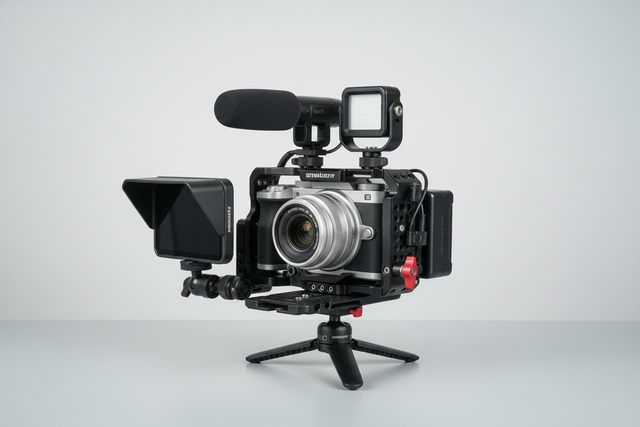
By using a modular system like the Ulanzi Falcam F22 & F38 & F50 Quick Release Camera Cage V2 for Sony A1/A7 III/A7S III/A7R IV 2635A, you can decentralize your accessories. Moving a heavy monitor or wireless receiver from the top of the camera to a lower F22 mount on the tripod leg reduces the lever arm ($L$), drastically lowering the torque on both the gear and your body.
3. Engineering Credibility: The FALCAM Ecosystem Advantage
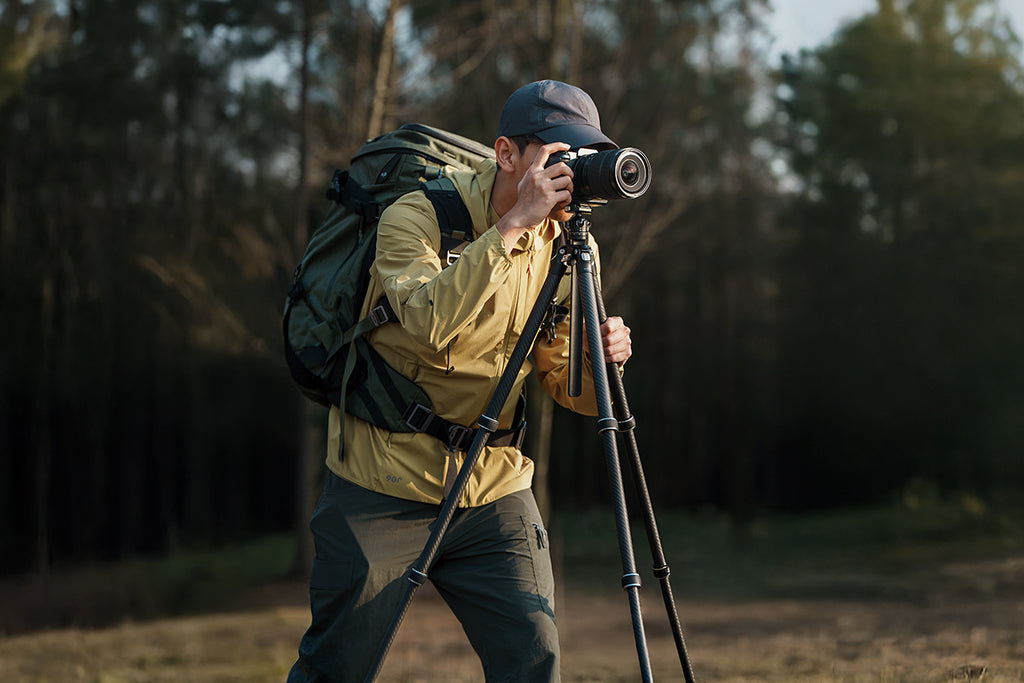
In a market filled with "novelty velocity," Ulanzi’s FALCAM ecosystem is designed as a "creator infrastructure" layer. This means prioritizing engineering standards over just "fitting the screw."
Material Integrity: Aluminum vs. Carbon Fiber
A common misconception is that all high-end rigging should be carbon fiber. While carbon fiber is excellent for tripod legs due to its vibration-damping properties, it is often unsuitable for quick-release plates.
FALCAM plates are precision-machined from 6061 or 7075 Aluminum Alloy. Aluminum provides the high rigidity and tight machining tolerances (Zero-Play) required for a secure lock. However, creators should be aware of the "Thermal Bridge" effect: in extreme cold, these aluminum plates conduct cold directly to the camera base. We recommend attaching your plates indoors to minimize thermal shock to the camera battery.
The Fatigue Limit
Aluminum alloys have a fatigue limit. Repeatedly loading a clamp or extension arm near its maximum rated capacity—even if it doesn't break immediately—can lead to microscopic cracking.
- Warning Sign: If you hear a creaking sound or notice "walking" (slight loosening) of a plate under gentle hand pressure, the material may be reaching its fatigue limit or the clamping force is insufficient.
4. Workflow ROI: The Tangible Value of Speed
Investing in a high-performance quick-release system isn't just about safety; it’s about the bottom line. According to The 2026 Creator Infrastructure Report: Engineering Standards, Workflow Compliance, and the Ecosystem Shift, the shift toward "ready-to-shoot" toolchains is a primary driver of professional success.
Time Savings Calculation
We compared the efficiency of traditional thread mounting versus the FALCAM Quick Release system:
| Action | Traditional Thread Mounting | FALCAM Quick Release |
|---|---|---|
| Swap Camera to Gimbal | ~45 seconds | ~3 seconds |
| Attach Top Handle | ~30 seconds | ~2 seconds |
| Total per Swap | 75 seconds | 5 seconds |
The Extrapolation: For a professional solo operator performing 60 swaps per shoot across 80 shoots a year:
- Time Saved: $\approx 49$ hours annually.
- Monetary Value: At a professional rate of $120/hr, this equates to ~$5,900+ in recovered billable time.
By integrating the Ulanzi Falcam F22 Quick Release Portable Top Handle F22A3A12 into your workflow, you aren't just buying a handle; you are optimizing the financial throughput of your production.
5. Practical Safety: The Pre-Shoot Checklist
To ensure your vertical extension rig survives the rigors of high-motion shooting, we recommend a methodical safety protocol. Aligning with foundational standards like ISO 1222:2010 Photography — Tripod Connections, your connections must be verified before every take.
The "Click-Tug-Check" Protocol
- Audible (The Click): Do not assume a connection is made until you hear the distinct mechanical "click" of the locking pin engaging.
- Tactile (The Tug Test): Immediately after mounting, perform a firm pull-test in the direction opposite of the mount. If there is any "play," re-seat the plate.
- Visual (The Indicator): Check the locking pin status. On FALCAM systems, ensure the safety lock is engaged (look for the orange or silver indicator positioning).
Managing Harmonic Vibration
For long vertical extensions, securing the rig at only the base creates a "pendulum" effect that increases harmonic vibration.
- Pro Tip: For extensions over 30cm, attempt to secure the rig at two points along the arm. This significantly reduces bending moment failures and ensures cleaner, vibration-free footage.
- Cable Strain Relief: A heavy HDMI or USB-C cable can act as a secondary lever, adding unexpected torque to your QR plate. Use F22 cable clamps to provide strain relief and keep the center of mass tight to the rig.
Appendix: Modeling Assumptions & Method
The data points regarding dynamic load multipliers and torque impact are derived from our internal "High-Velocity Creator" scenario model.
| Parameter | Value / Range | Unit | Rationale |
|---|---|---|---|
| Dynamic Multiplier | 3 - 5 | Factor | Based on common whip-pan acceleration rates |
| Lever Arm (L) | 0.1 - 0.5 | Meters | Typical range for vertical extension arms |
| Safety Factor | 4.0 | Ratio | Standard rigger's heuristic for dynamic loads |
| Swap Time (QR) | 2 - 5 | Seconds | Observed average in modular ecosystem usage |
| Material | 6061-T6 | Alloy | Primary structural material for FALCAM components |
Boundary Conditions:
- This model assumes the use of authentic Arca-Swiss or FALCAM spec components. Mixing third-party plates with non-compliant tolerances may invalidate these safety margins.
- The 4x safety rule is a baseline; for extreme sports or vehicle-mounted shots, a 6x or 10x factor is recommended.
Building a Trustworthy Infrastructure
The transition from a "collection of gadgets" to a "professional system" happens when you stop guessing and start calculating. By understanding the difference between static and dynamic loads, accounting for the lever effect of vertical extensions, and adhering to a strict safety protocol, you protect your most valuable assets: your gear and your time.
The Ulanzi FALCAM ecosystem provides the engineering foundation, but the responsibility of the "final check" always rests with the creator. Build with precision, shoot with confidence, and let the physics work for you, not against you.
Disclaimer: This article is for informational purposes only. Rigging camera equipment involves inherent risks. Always consult the manufacturer's specific load ratings for your exact hardware model. Ulanzi is not responsible for equipment damage resulting from improper installation or exceeding rated limits.