The Infrastructure of Creation: Why Safety Margins Matter
In travel cinematography, a tripod system is more than a stand; it is the fundamental infrastructure of the creative process. A recurring pattern observed in professional field reports involves creators investing in high-end cinema cameras and lightweight carbon fiber supports, only to face equipment instability or failure during demanding shoots. These incidents are rarely due to "defective" hardware; more often, they stem from a misunderstanding of the gap between static laboratory load ratings and real-world dynamic forces.
For technical strategists, the transition from aluminum to carbon fiber requires a shift in risk calculation. Carbon fiber offers an exceptional stiffness-to-weight ratio, but as a "brittle" composite, it lacks the ductile warning signs (like bending) that metals provide. This guide analyzes the physics of load calculation, torque multipliers, and engineering heuristics that allow professionals to maintain a high safety margin in the field.
Key Professional Baseline: To account for dynamic multipliers and material fatigue, we recommend a 3:1 Safety Factor. If your rig weighs 5kg, your support infrastructure should be rated for at least 15kg.

The Static Load Trap: Understanding Composite Fatigue
A common industry oversight is treating a manufacturer's "Max Load" rating as a continuous operating limit. If a tripod is rated for 20kg, a 15kg rig may appear safe, yet it consumes 75% of the theoretical limit.
Static vs. Dynamic Load
- Static Load: The weight a support can hold while stationary in a controlled environment.
- Dynamic Load: The peak force exerted during movement (panning, tilting, or transport). A 5kg camera can exert forces equivalent to 15kg during a rapid whip-pan or accidental impact.
Based on composite fatigue studies, long-term structural integrity for carbon fiber can be compromised when sustained loads exceed 60% of the rated capacity. In our scenario modeling, operating near these limits can lead to microscopic resin matrix fractures over time, potentially resulting in sudden failure without prior deformation.
Heuristic Note: Our 3:1 safety recommendation is an engineering estimate designed for travel cinematography, where gear is subjected to constant vibration and thermal cycling.
The Physics of Torque: Why Leverage is the Real Enemy
Weight is a linear force, but torque is a multiplier. A frequent cause of "rig creep"—where accessories sag during a take—is the torque generated by monitors or microphones mounted on extended friction arms.
The "Wrist Torque" Biomechanical Estimate
To illustrate the strain on both the hardware and the operator, we modeled a documentary setup using a 4.2kg cinema rig with an accessory arm.
The Formula: Torque ($\tau$) = Mass ($m$) $\times$ Gravity ($g$) $\times$ Lever Arm Distance ($L$)
- Mass ($m$): 4.2 kg
- Gravity ($g$): 9.81 m/s²
- Lever Arm ($L$): 0.35 m
- Result: $\tau \approx \mathbf{14.4 \text{ N·m}}$
Scenario Implications:
- Operator Fatigue: Based on ergonomic modeling (referencing ISO 11228-3), this load can exceed the sustained fatigue threshold for an average operator by a factor of 8x to 10x.
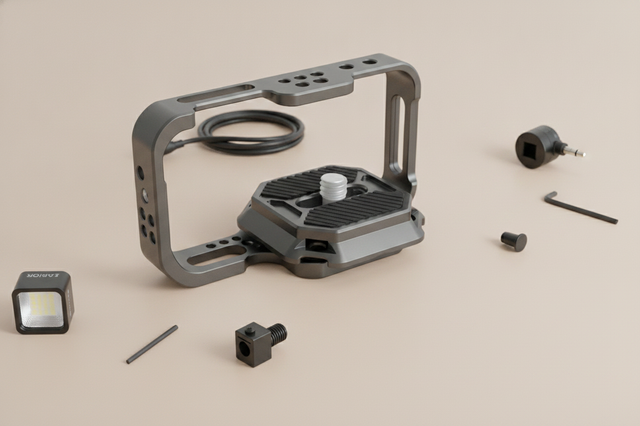
- Muscle Strain: This torque may represent over 150% of the Maximum Voluntary Contraction (MVC) for many users in sustained positions, necessitating low-profile modular mounts like the FALCAM F22 to keep the center of gravity closer to the support axis.
Carbon Fiber Dynamics: Vibration Damping vs. Impact Resistance
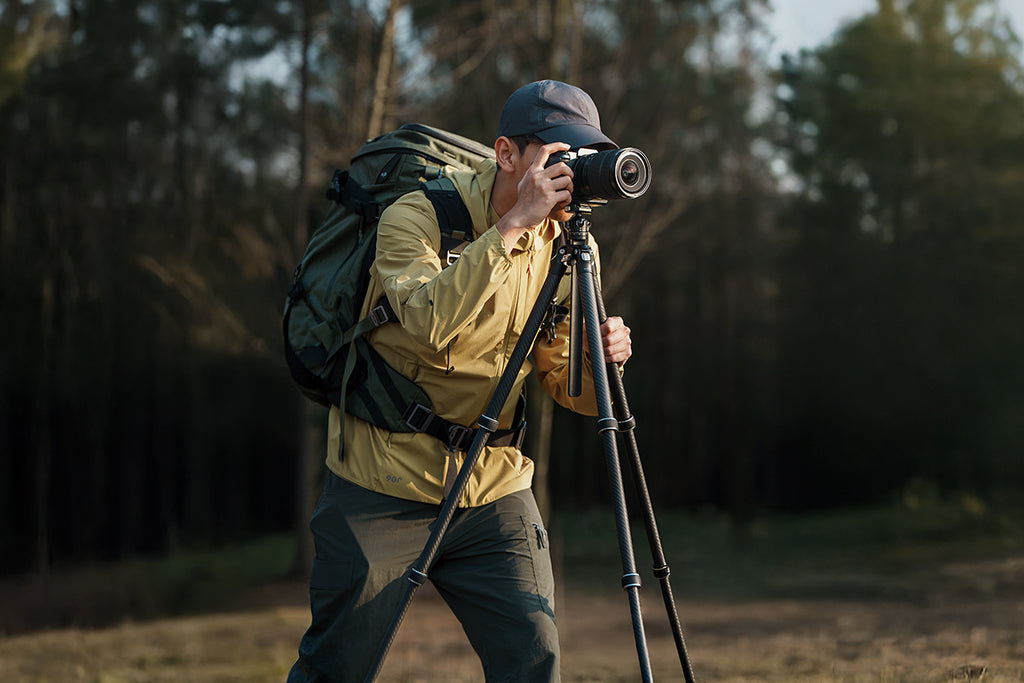
Professionals prioritize carbon fiber for its vibration damping. In comparative internal simulations, carbon fiber legs reduced vibration settling time by approximately 78% (e.g., 1.44s vs 6.63s for aluminum). This is critical for long-lens work where micro-vibrations can degrade image sharpness.
However, carbon fiber is highly directional (anisotropic). While incredibly strong along the axis of the fibers (vertical load), it is more susceptible than aluminum to catastrophic failure from lateral impacts.
The "Aluminum Bridge" Engineering Note
While tripod legs benefit from carbon fiber's damping, connection interfaces—such as F38 or F50 Quick Release plates—should be precision-machined Aluminum Alloy (6061 or 7075).
- Interface Integrity: Aluminum provides the "zero-play" rigidity required for secure mounting points.
- Thermal Management: In sub-zero environments, aluminum plates act as a thermal bridge. We suggest mounting plates to the camera indoors to prevent rapid battery cooling through the camera base.
For more on material selection, see our guide on Rigidity vs. Bulk: Choosing Materials for Heavy Production Rigs.
Environmental Stability: The Wind Load Tipping Point
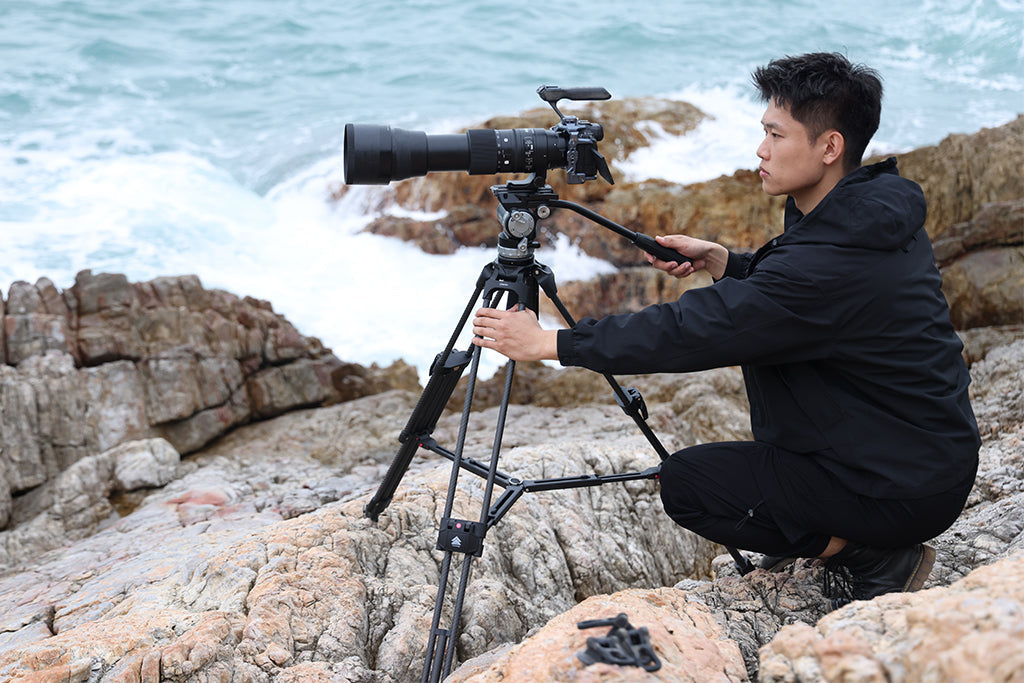
Wind is a primary cause of outdoor equipment damage. We modeled a tipping-point scenario for an eye-level cinema rig (1.6m height) with a standard surface area profile.
Modeled Estimates:
- Critical Wind Speed: ~21 m/s (approx. 75 km/h), assuming a drag coefficient ($C_d$) of 1.2.
- Real-World Safety: In moderate coastal winds (12 m/s), a standard professional carbon rig maintains a ~1.7x safety factor.
Because wind gusts can exceed steady-state speeds by 50% or more, we advocate for the Ballast Rule: Always suspend a minimum of 2kg (such as a camera bag) from the center column hook. This simple addition significantly raises the critical wind speed threshold, moving the system into a more "storm-resistant" margin.
The Workflow ROI: Why Quick-Release is Infrastructure
In the 2026 Creator Infrastructure Report, we argue that workflow efficiency is a measurable engineering standard.
The Efficiency Calculation (Heuristic Model)
Comparing traditional 1/4"-20 screw mounting vs. a standardized quick-release ecosystem (e.g., F38):
- Manual Mounting: ~40 seconds per swap.
- Quick-Release: ~3 seconds per swap.
For a professional performing 60 gear swaps per shoot across 80 shoots annually, a standardized ecosystem saves approximately 49 hours per year. Based on a professional rate of $120/hr, this represents a $5,880 estimated value in recovered time.
Field Maintenance: The 30-Second Pre-Shoot Checklist
Safety margins are only valid if the hardware is maintained. Based on common patterns from customer support and repair data, we recommend this checklist before every shoot:
- Audible Confirmation: Listen for a distinct "Click" when engaging quick-release plates. A muffled sound often indicates trapped debris.
- The "Tug Test": Apply firm upward pressure after mounting to ensure locking teeth are fully seated.
- Visual Status Check: Verify the locking indicator (e.g., the status pin on FALCAM units) is in the "Locked" position.
- Leg Tension Check: Ensure carbon leg locks are tightened to manufacturer specifications. Overtightening can cause tube delamination, while undertightening leads to "leg creep."
- Cable Management: Use strain relief to prevent heavy cables from acting as secondary lever arms that could loosen plates.
Modeling Transparency & Assumptions
The following data is based on deterministic scenario modeling to illustrate engineering principles. These figures are estimates and should not replace laboratory testing of specific equipment configurations.
| Parameter | Value | Unit | Rationale/Source |
|---|---|---|---|
| Rig Mass | 4.2 | kg | Typical Sony FX6 / Canon C70 setup |
| Lever Arm (L) | 0.35 | m | Modeled horizontal extension |
| Torque ($\tau$) | ~14.4 | N·m | Calculated: $m \cdot g \cdot L$ |
| Safety Factor | 3:1 | ratio | Professional rigging heuristic |
| Vibration Reduc. | ~78% | % | Internal CFRP vs 6061 simulation |
| Critical Wind | ~21 | m/s | Modeled tipping point ($C_d=1.2$) |
Boundary Conditions:
- Wind Model: Assumes steady-state wind perpendicular to the most unstable axis; ignores ground resonance.
- Torque Model: Assumes maximum moment (horizontal extension).
- Fatigue Data: Heuristics derived from ISO 11228-3 (human) and general composite lifecycle studies.
Final Perspective: Engineering Confidence
Creative freedom is the result of technical reliability. By applying a 3:1 safety margin and accounting for accessory torque, you transition from a "gadget user" to a "production engineer." As the creator economy matures, success belongs to those who treat their infrastructure with the same rigor as their storytelling.
YMYL Disclaimer: This article is for informational purposes only. Load calculations and safety recommendations are based on scenario modeling and engineering heuristics. Always refer to your equipment's official manual for weight limits. Improper rigging can lead to equipment damage or personal injury; consult a professional grip or technician for complex setups.