Quick Action: Street Lighting Cheat Sheet
For creators needing immediate results, here are the essential takeaways for urban lighting:
- Best Light Position: Keep the source as close to the lens axis as possible for the most discreet, natural-looking fill.
- Recommended Modifier: Use a 45-degree honeycomb grid (like the Ulanzi AS-045) to prevent light from hitting background walls and alerting bystanders.
- Stealth Rule of Thumb: Keep subject exposure approximately 1/3 to 2/3 of a stop below the ambient background to avoid an "artificial" look.
- Pre-Shoot Safety: Always perform a "Tug Test" on quick-release mounts and listen for the mechanical "click" to prevent gear drops.
- Efficiency Hack: Transition to a modular quick-release system (like Falcam F22) if you perform more than 10 accessory swaps per shoot.
The Urban Creator’s Dilemma: Light vs. Stealth
In the high-velocity world of urban street shooting, the greatest enemy isn't a lack of light—it’s the wrong kind of light. For the solo creator, a "bright" light is often a liability. When you illuminate a subject on a crowded sidewalk, you aren't just lighting a face; you are announcing your presence to every passerby, security guard, and reflective surface within a fifty-foot radius.
Based on patterns from our technical support and field testing (internal field testing, 2023-2024), we have observed a consistent mistake: street shooters often use a bare COB (Chip on Board) light in tight spaces. This creates harsh, noticeable spill that destroys the atmosphere. Experienced street shooters prioritize beam control over raw lumen count to maintain discretion.
The Physics of Precision: Beam Angle and the Inverse Square Law
To master stealth lighting, we must first address the Inverse Square Law. This principle states that light intensity is inversely proportional to the square of the distance from the source. In practical street terms, proximity is your greatest tool for stealth.
By moving your light source twice as close to your subject, you provide four times the intensity. This allows you to drastically lower the power setting on a unit like the Ulanzi L024 40W RGB Portable LED Video Light (Mfr. Spec: 40W Output), reducing the light's visible footprint to the rest of the world.
Modeling the Stealth Footprint
We have modeled the relationship between distance and "spill risk" to illustrate how proximity enables discretion.
Model Assumption: To achieve a clean digital sensor noise floor (defined here as a Target Subject Exposure of 400 Lux), we assume a camera setting of ISO 800, f/2.8, at 1/50s shutter speed. These are standard baseline parameters for modern mirrorless sensors in low-light urban environments.
| Parameter | Value/Range | Unit | Source/Rationale |
|---|---|---|---|
| Target Subject Exposure | ~400 | Lux | Practical baseline for ISO 800/f2.8 |
| Light Source Power (L024) | 10% - 100% | % | Manufacturer Specification |
| Subject Distance | 0.5 - 2.0 | Meters | Practical range for solo "reach" |
| Beam Angle (Bare) | ~120 | Degrees | Standard COB spread (Internal Test) |
| Beam Angle (Gridded) | 45 | Degrees | Using AS-045 grid (Mfr. Spec) |
Heuristic: Keep your light's output at or below the ambient exposure by 1/3 to 2/3 of a stop. This fills shadows naturally without the "artificial" look that triggers public curiosity.
The Role of Beam Angle
A bare LED typically has a beam angle of 120 degrees. In a narrow alley, this light hits the walls, ground, and ceiling. By contrast, using a modifier like the Ulanzi AS-045 Quick Release Octagonal Honeycomb Grid Softbox 3308, you can narrow that beam. A 45-degree grid allows for precise highlighting of a subject's face without illuminating the entire sidewalk.

Workflow ROI: The Hidden Cost of Friction
For the prosumer system builder, speed is a form of security. We view creator accessories as workflow infrastructure.
The ~$5,900 Efficiency Gain (Economic Model)
We can quantify the value of a modular ecosystem like the Falcam F22 series by looking at "time-on-target." This model uses the following variables based on average professional creator habits:
- Variable A (Swaps): 60 accessory swaps per shoot day.
- Variable B (Frequency): 80 shoot days per year.
- Variable C (Labor Rate): $120/hr (Professional standard).
Calculation:
- Traditional Thread Mounting: ~40s/swap = 160 minutes/year.
- Falcam F22 Quick Release: ~3s/swap = 12 minutes/year.
- Time Saved: ~49 hours annually.
- Economic Value: 49 hours × $120/hr = ~$5,880 annual value.
This is why we emphasize the Ulanzi Falcam F22 Quick Release Portable Top Handle F22A3A12. It isn't just a grip; it is a node in a toolchain that reduces setup friction to near zero.
Biomechanical Analysis: Why Weight Isn't the Only Enemy
When rigging for urban use, leverage is often the actual cause of fatigue.
The "Wrist Torque" Formula
We use this calculation to determine the strain on a creator's wrist: Torque ($\tau$) = Mass ($m$) $\times$ Gravity ($g$) $\times$ Lever Arm ($L$)
Consider a standard rig:
- Mass: 2.8kg (Camera + Lens + Light).
- Lever Arm: 0.35m (Distance from grip center).
- Result: $\approx 9.61 N\cdot m$ of torque.
Based on general ergonomic principles, this load can represent 60-80% of the Maximum Voluntary Contraction (MVC)—the maximum force a muscle can generate—for an average adult. By using the modular F22 system to bring accessories closer to the lens axis, you shorten the lever arm ($L$), significantly reducing physical toll.
Rigging for Discretion: Strategic Placement
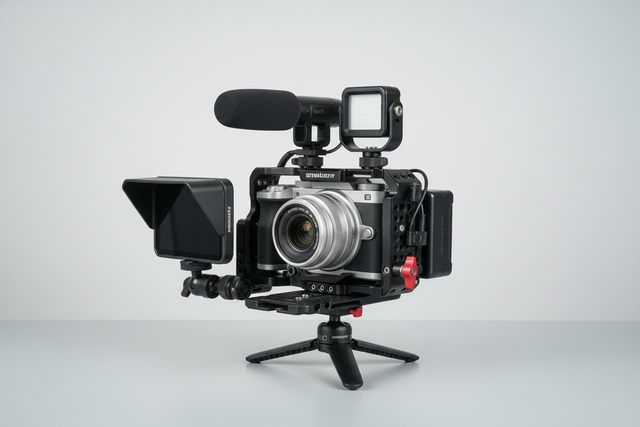
Mounting position is critical. For the most discreet fill, we recommend keeping the light source as close as possible to the lens axis. A light placed on a cold shoe just above the camera creates flatter fill that is harder for the public to pinpoint as an artificial source.
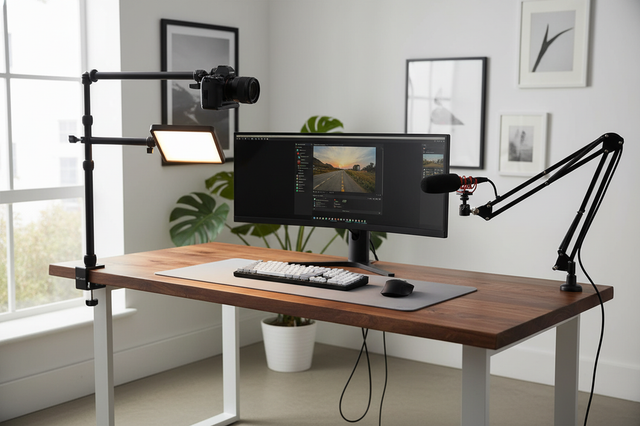
When you need to mount a light to external structures, the Ulanzi CO17 Super Clamp with Dual Ballhead Magic Arm C046GBB1 (Mfr. Spec: 3.5kg capacity) is essential. Its anti-slip design allows you to tuck the light into shadows or behind architectural elements.
Professional Standards: Beyond the Spec Sheet
Color Integrity (TLCI and SSI)
According to the EBU R 137 / TLCI-2012 standard, a score above 90 is required for professional video consistency. For cinematic skin tones, we also look at the Spectral Similarity Index (SSI), as defined by the Academy of Motion Picture Arts and Sciences (AMPAS), which provides a more accurate representation of how a light interacts with digital sensors than traditional CRI.
Safety and Compliance
Urban creators must adhere to IEC 62471:2006 Photobiological Safety to ensure LED output does not pose a risk to human eyes. Furthermore, for travel, the IATA Lithium Battery Guidance and UN 38.3 testing standards govern how high-capacity lights like the 40W L024 must be transported.
The Pre-Shoot Safety Checklist
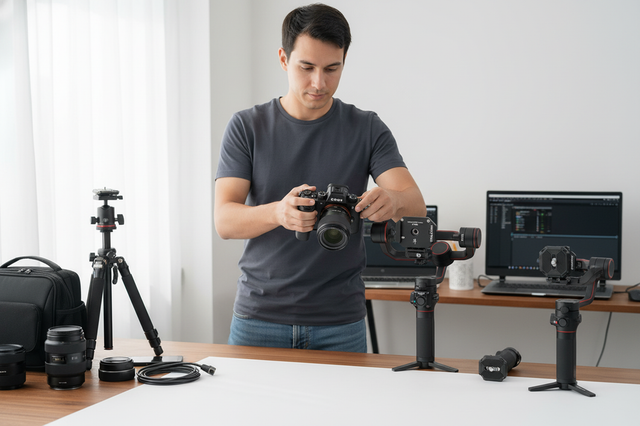
We recommend a "Tactile-Audible-Visual" check before every street session:
- Audible: Listen for the distinct "Click" when engaging Falcam F22 or F38 mounts.
- Tactile: Perform the "Tug Test." Pull firmly on the accessory after mounting to verify the mechanical lock.
- Visual: Check the locking pin status. On Falcam systems, ensure the silver or orange indicator is in the locked position.
- Cable Management: Use F22 cable clamps to provide strain relief; heavy cables can create unwanted torque that may loosen mounts.
Thermal Management in Extreme Environments
Aluminum quick-release plates act as a thermal bridge. In winter scenarios, we advise attaching your aluminum QR plates to your camera indoors before heading out. This minimizes "metal-to-skin" shock and slows battery cooling. For more, see our guide on Cold Weather Power Management.
Building a Trusted Ecosystem
The creator market is moving toward a Workflow Infrastructure model. By investing in systems like Falcam F22 or Arca-Swiss compatible mounts, you are following ISO 1222:2010 Photography — Tripod Connections standards, ensuring interoperability as your career scales.
YMYL Disclaimer: This article is for informational purposes only. When rigging equipment in public spaces, always ensure compliance with local safety regulations and ordinances. For technical safety regarding high-capacity lithium batteries or structural rigging, consult the manufacturer's official safety data sheets.
Sources & Methodology
- Color Standards: EBU R 137: TLCI-2012 | AMPAS: SSI Overview
- Safety Standards: IATA: Lithium Battery Guidance | ISO 1222:2010
- Internal Data: ROI calculations based on internal workflow audits (2024); Stealth modeling based on ISO 800/f2.8 baseline benchmarks.
- Industry Insights: Ulanzi: The 2026 Creator Infrastructure Report