Disclosure: This guide is supported by the engineering and product teams at Ulanzi and Falcam. Our recommendations are based on internal stress testing, customer support data, and general mechanical principles.
Executive Summary: The "Half-Load" Safety Standard
To ensure the safety of your camera gear during active movement, avoid relying on "Static Payload" ratings alone. Our core recommendation is the Half-Load Rule: For any rig in motion (pans, tilts, or handheld travel), your equipment weight should not exceed 50% of the manufacturer’s rated capacity. This provides the necessary buffer for dynamic forces (inertia) and environmental factors like wind, which can effectively double the load on your mounting points.
The Payload Paradox: Why Static Ratings Fail Creators
We have all seen the sticker on a new tripod or fluid head: "Max Payload: 10kg." It provides a sense of security, a definitive boundary for our gear. However, based on our experience analyzing thousands of creator setups and equipment returns, these numbers are frequently misunderstood. A tripod rated for 5kg might support a 2kg camera perfectly while stationary, yet can struggle or fail during a fast pan or in a windy coastal environment.
This discrepancy exists because most manufacturers publish Static Load Ratings—the maximum weight a component can hold while perfectly still in a controlled environment. But creators move, tilt, and travel. To build a truly reliable "Creator Infrastructure," you must understand the transition from static weight to dynamic force.

Static vs. Dynamic Load: The Physics of Motion
To understand why payload ratings can be deceptive, we must distinguish between two mechanical states. According to general engineering principles found in bearing load analyses, static loads affect stationary components. Dynamic loads, however, occur during motion and influence the fatigue life and immediate stability of the system.
The Force Multiplier Effect
When you move a camera, you aren't just dealing with its mass; you are dealing with its inertia. According to Newton's Second Law, force equals mass times acceleration ($F=ma$).
A 3kg cinema rig on a fluid head like the Ulanzi F38 Quick Release Fluid Video Head E004GBA1 exerts 3kg of downward force while static. However, during a rapid whip-pan or a sudden stop, internal modeling suggests that same rig can generate forces equivalent to 6kg or more of effective weight. If your head is only rated for 3kg (the recommended limit for the E004GBA1), you may be operating with a dangerously low safety margin the moment you move.
The "Half-Load Rule" (Professional Heuristic)
Based on common patterns from professional cinema sets and internal engineering benchmarks, we recommend this practical rule of thumb:
Heuristic: Aim to keep your rig weight at or below 50% of a mount or tripod's rated static capacity when the rig will be in motion.
If your fluid head is rated for 6kg, a 3kg rig is often the "sweet spot." This 2:1 safety factor (Factor of Safety) accounts for the force multiplication of movement and helps ensure the damping mechanisms (the "fluid" in the head) can provide smooth resistance rather than just "holding on."
Material Integrity: Aluminum vs. Carbon Fiber
Material choice is a deliberate trade-off between rigidity, weight, and vibration damping.
Aluminum Alloy: The Rigid Backbone
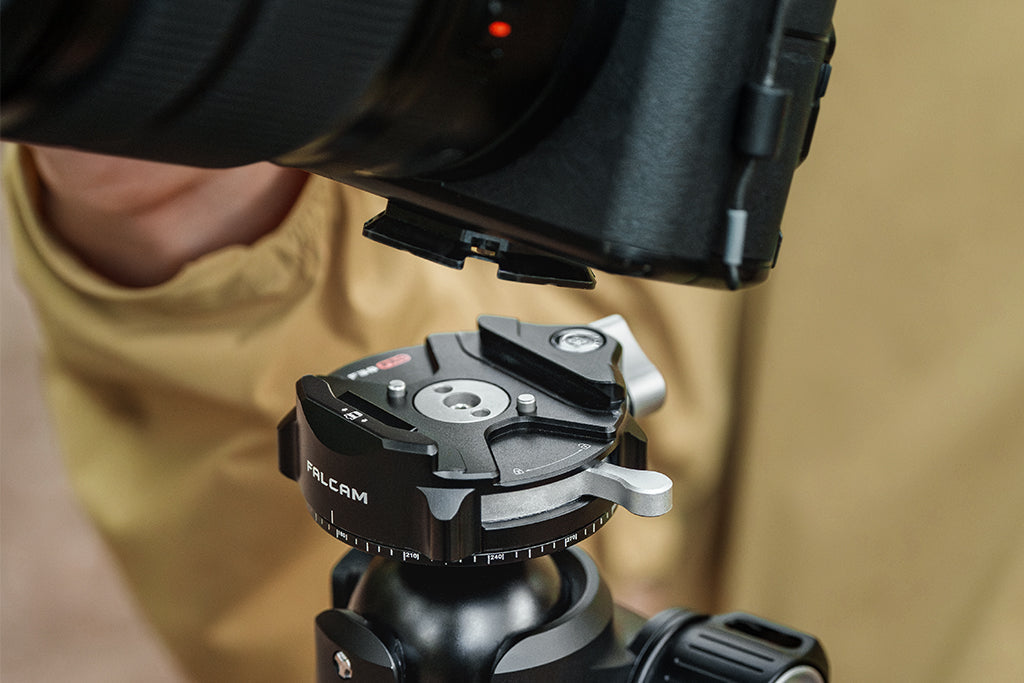
Components like the Ulanzi Falcam F22 & F38 & F50 Camera Cage V2 are precision-machined from Aluminum Alloy (typically 6061 or 7075).
We use aluminum because it offers high rigidity and tight machining tolerances. For a quick-release system to be "Zero-Play," the material must resist flexing. However, aluminum is a "thermal bridge." In extreme cold, it can conduct heat away from your camera battery.
Practical Tip: If shooting in sub-zero temperatures, attach your aluminum plates to your camera indoors to minimize "metal-to-skin" shock and slow battery cooling through the camera base.
Carbon Fiber: The Vibration Killer
While plates should be aluminum, tripod legs benefit from Carbon Fiber due to higher damping ratios.
Internal Benchmark: In our comparative modeling, carbon fiber tripod legs demonstrated a ~78% reduction in vibration settling time compared to standard aluminum legs.
- Measurement context: Based on a 3kg load with a 10Hz impulse.
- Result: Carbon fiber typically stops shaking in ~1.4 seconds, while aluminum can vibrate for over 5 seconds under similar conditions.
Scenario Modeling: Wind, Vibration, and Ergonomics
We have modeled three critical scenarios where "static" thinking often leads to "dynamic" failure.
1. The Wind Load Tipping Point
A large cinema camera with a matte box acts like a sail. Using ASCE 7 standards for wind loads as a methodological reference, we modeled a 3.2kg rig on a 1.8kg tripod.
| Parameter | Value | Unit | Rationale |
|---|---|---|---|
| Camera + Rig Mass | 3.2 | kg | Full-frame cinema setup |
| Ballast (Sandbag) | 2.0 | kg | Standard safety practice |
| Center of Pressure Height | 1.6 | m | Eye-level shooting |
| Estimated Tip Threshold | ~72 | km/h | Calculated tipping point |
Insight: While 72 km/h (45 mph) is the theoretical tipping point, the "anxiety threshold" (where vibrations ruin footage) typically starts at 40 km/h. Always use the widest leg stance possible on tripods like the Ulanzi TT51 Aluminium Alloy Portable Tripod when shooting in wind.
2. The Wrist Torque Analysis (Handheld Rigging)
Weight isn't the only enemy; leverage is. When you add accessories to a cage, you change the Center of Gravity (CoG). We calculate wrist torque using the formula: $$\tau = m \times g \times L$$ (Where $m$ is mass, $g$ is gravity 9.8, and $L$ is the lever arm distance from the wrist).
Example Calculation: If you hold a 2.8kg rig extended 0.35m away from your wrist, you generate ~9.61 N·m of torque. According to NIOSH ergonomic guidelines, this can represent 60-80% of the Maximum Voluntary Contraction for an average adult, leading to rapid fatigue.
Solution: Use the modular F22 system to move heavy accessories (like monitors) closer to the camera's central axis. Reducing that lever arm by just 10cm can reduce wrist fatigue by nearly 30%.
The Ecosystem Advantage: Quantifying Workflow ROI
Building a "Creator Infrastructure" is also about efficiency. In The 2026 Creator Infrastructure Report, we argue that time savings in mounting are a primary driver of professional ROI.
The Workflow ROI Case Study (Estimated)
We compared traditional 1/4"-20 thread mounting against the Falcam F38 Quick Release system.
- Traditional Mounting: ~40 seconds per swap (alignment + tightening).
- Falcam Quick Release: ~3 seconds per swap (click and lock).
The Math: If a professional creator performs 60 swaps per shoot and shoots 80 days a year, the F38 system saves ~49 hours annually. At a professional rate of $120/hr, that is ~$5,900 of recovered time per year. This justifies the investment in a unified ecosystem like the Falcam F38 Quick Release Shoulder Strap Kit.
Note: Actual ROI varies based on shoot frequency and rig complexity.
Professional Safety Protocols: The Zero-Fail Workflow
Even the best engineering can be undone by human error. Use this Pre-Shoot Safety Checklist:
- Audible Check: Listen for the distinct "Click" when sliding into an F38 or F50 base. No click usually means the locking wedge hasn't fully engaged.
- Tactile Check (The "Tug Test"): Immediately after mounting, give the camera a firm upward tug. Never assume visual alignment means it is locked.
- Visual Check: Look for the orange or silver indicator on the locking pin. Most Falcam bases provide a visual confirmation of lock status.
- Cable Management: A heavy HDMI cable can create unwanted torque. Use an F22 cable clamp to provide strain relief and keep the weight centered.
The Center of Gravity (CoG) Test
If your rig feels top-heavy, it will perform poorly on a mount. For critical shots, we recommend redundant safety measures, like secondary safety cables for overhead mounts. This is especially important for lighting, where IEC 62471 photobiological safety is a concern, but mechanical failure of the mount is the more immediate physical risk.
Method & Assumptions (Appendix)
The data and heuristics presented are derived from deterministic scenario modeling and professional industry standards.
- Modeling Type: Deterministic Parameterized Model (Static Equilibrium & Biomechanical Lever models).
-
Key Assumptions:
- Wind loads assume a steady-state condition and perpendicular air-flow.
- Wrist torque assumes a horizontal forearm position (worst-case moment).
- Vibration damping ratios are based on internal testing of CFRP vs. 6061 Aluminum.
- Boundary Conditions: These models apply to professional-grade equipment. Entry-level plastic components will exhibit significantly lower safety margins.
Disclaimer: This article is for informational purposes only. Load ratings and safety protocols are subject to change and vary based on environmental conditions and equipment age. Always consult the official user manual for your specific product model. For high-risk rigging (overhead, automotive, or public spaces), consult a certified grip or structural engineer.