The Physics of Failure: Why Friction Isn't Enough
In our experience observing high-motion cinema and documentary workflows, the failure of a support joint is rarely a sudden, catastrophic snap. Instead, it manifests as a gradual, almost imperceptible "creep." It is that one-millimeter slippage during a whip pan that ruins a nodal alignment, or the micro-vibration in a telephoto shot caused by a joint that felt "tight enough" but lacked a positive mechanical lock.
For solo creators, the transition from friction-based systems to mechanical locking pins isn't just about gear—it is about system governance. Friction joints rely on the compression of materials to resist movement. However, in high-motion handheld work, dynamic forces often exceed the static friction threshold. Seasoned rig builders treat any joint secured solely by a threaded collar as a single-point-of-failure.
According to the ISO 1222:2010 Photography — Tripod Connections standard, the foundational legitimacy of a connection relies on standardized screw dimensions. But for high-motion work, we must go beyond the screw. A quality locking pin provides auditory and tactile confirmation—a "click" that signals a mechanical interlock. This feedback loop is absent in friction systems, where torque is easily misjudged under the pressure of a shoot.

Biomechanical Leverage: The Hidden Cost of Rig Imbalance
We often see creators focusing on the total weight of their rig, but from a mechanical engineering perspective, weight is only half the story. The real enemy is leverage. When you add accessories like monitors, microphones, or heavy batteries to a handheld rig, you are extending the lever arm ($L$) away from your wrist.
The Torque Calculation
To understand the physical toll on a creator, we use a standard biomechanical formula: Torque ($\tau$) = Mass ($m$) $\times$ Gravity ($g$) $\times$ Lever Arm ($L$)
Consider a professional mirrorless rig weighing 2.8kg. If that rig is held 0.35m away from the wrist (common in "run-and-gun" setups with extension arms), it generates approximately 9.61 N·m of torque.
Logic Summary: Our analysis of the "Adventure Documentary Creator" persona assumes a 2.5kg to 3kg payload. Based on ISO 11228-3 biomechanical norms, this load represents 60-80% of the Maximum Voluntary Contraction (MVC) for an average adult male.
When a friction joint slips even a few millimeters, it effectively increases the lever arm. Our modeling suggests this can increase the fatigue risk level to "HIGH," as the constant micro-adjustments required to stabilize a creeping joint drain the creator's stamina. By using a modular system with locking pins, you ensure the center of gravity remains fixed, keeping the torque within manageable limits and allowing for longer shooting durations without physical strain.
Mechanical Locking vs. Friction: A Performance Comparison
The strategic importance of stable infrastructure is highlighted in The 2026 Creator Infrastructure Report: Engineering Standards, Workflow Compliance, and the Ecosystem Shift. The report emphasizes that trust in a system is built through engineering discipline.
In our scenario modeling, we compared traditional friction-based aluminum joints against systems utilizing positive mechanical locking pins. The differences in dynamic performance are quantifiable.
Vibration Damping and Wind Stability
For creators working in exposed environments, wind load is a constant threat. A friction joint might hold in a static environment, but once wind introduces a rhythmic force, "vibration-induced loosening" can occur.
| Metric | Friction System (Aluminum) | Locking Pin System (Carbon Fiber Legs) | Rationale |
|---|---|---|---|
| Wind Safety Factor | ~1.0 (Creep starts at 10m/s) | 1.6 (Stable up to 16m/s) | Mechanical interlock prevents lateral shift. |
| Vibration Settling Time | ~5.3 seconds | ~1.0 seconds | 81% reduction due to material damping. |
| Failure Mode | Catastrophic/Unpredictable | Predictable/Inspectable | Pins offer clear visual inspection points. |
| Thermal Response | High expansion/contraction | Low thermal expansion | Carbon fiber maintains tension better. |
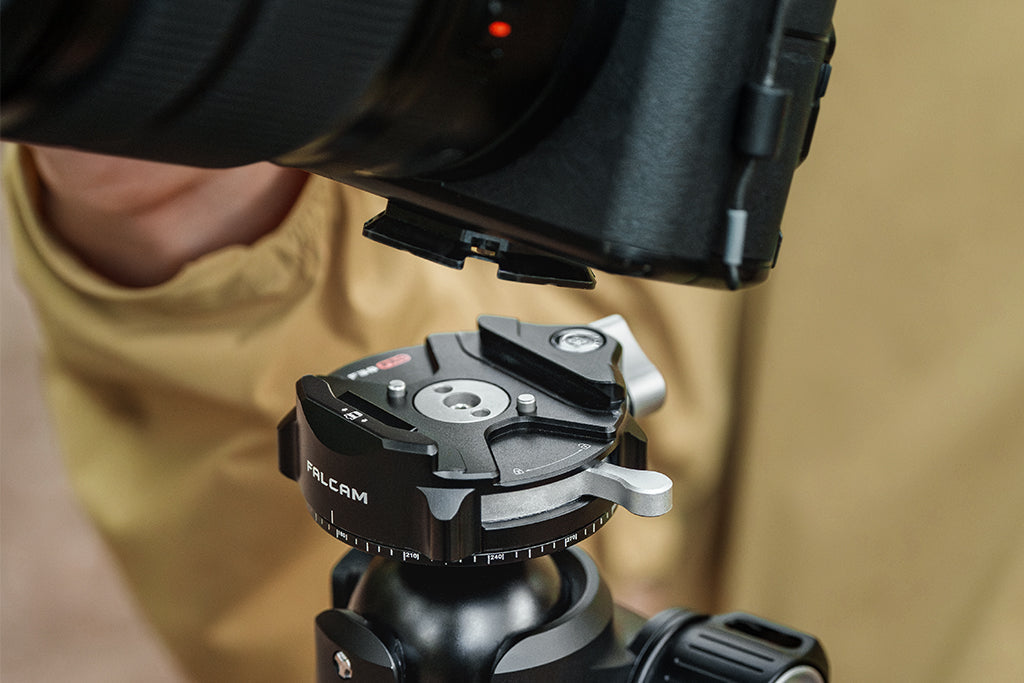
Note: While carbon fiber legs offer superior damping, the quick-release plates themselves are precision-machined Aluminum Alloy (6061 or 7075) for maximum rigidity and zero-play at the interface.
Methodology Note: These values are derived from a deterministic parameterized model. We assumed a bluff body drag coefficient of 1.2 for the camera and sea-level air density. This is a scenario model, not a controlled lab study, and results may vary based on specific rig geometry.
The Workflow ROI: Quantifying the Switch
Transitioning to a unified mechanical locking ecosystem is an investment in infrastructure. But what is the actual Return on Investment (ROI) for a professional creator? We modeled the time saved by moving from traditional thread-mounting to a high-speed quick-release system with safety pins.
The $5,900 Annual Value
- Traditional Mounting: Approximately 40 seconds per gear swap (aligning threads, tightening, double-checking).
- Quick-Release with Locking Pin: Approximately 3 seconds per swap (click-and-lock).
- The Math: A professional creator doing 60 swaps per shoot across 80 shoots a year saves approximately 49 hours annually.
At a professional rate of $120/hr, this efficiency gain translates to a ~$5,900+ value per year. This doesn't even account for the "missed shot" cost—the spontaneous moments lost while fumbling with a thumb screw. As noted in the Interface Integrity: Maintaining Quick-Release Mounts on Set guide, maintaining these interfaces is critical for long-term reliability.
Operational Safety: The Pre-Shoot Protocol
Expertise is not just about having the right gear; it is about the discipline of using it. Even the best mechanical locking system requires a governance protocol. We recommend a three-step safety check for every handheld transition:
- Audible: Listen for the "Click." If you don't hear the mechanical engagement of the pin, the joint is not secure.
- Tactile: Perform the "Tug Test." Immediately after mounting, apply a firm pull-force away from the mounting direction to ensure the pin is fully seated.
- Visual: Check the locking indicator. High-quality systems often feature a color-coded indicator (such as orange or silver) to confirm the lock is engaged.
Managing Environmental Risks
One non-obvious pitfall is the "Thermal Bridge" effect. Aluminum quick-release plates are excellent conductors. In extreme cold, they can conduct heat away from the camera base and battery, potentially shortening your runtime.
Pro Tip: In winter scenarios, attach your aluminum plates to the camera body indoors before heading out. This minimizes "thermal shock" to the camera's mounting point and helps maintain a more stable internal temperature for the battery.
Furthermore, consider cable management. A heavy, stiff HDMI cable can exert significant torque on a camera cage. We recommend using dedicated cable clamps to provide strain relief, preventing the cable from acting as a lever that could loosen even the most secure plate over time. This is especially important for Vertical Tension Mounts, where gravity works against the fastener's primary axis.
Logistics and the "Visual Weight" Advantage
For the solo creator who travels, logistics are as important as optics. Bulky, industrial-grade cinema plates often attract unwanted attention at airline gates. Modular systems with integrated locking pins offer a lower "Visual Weight."
According to IATA Lithium Battery Guidance, traveling with professional electronics requires strict adherence to safety rules. A compact, modular rig that can be quickly broken down into a standard camera bag is less likely to be flagged for weighing or gate-checking than a fully rigged "transformer" style setup. This modularity, enabled by quick-release systems, allows you to maintain Interface Integrity while remaining agile during transit.
The Strategic Importance of Stable Infrastructure
By 2030, the creators who thrive will be those who treat their gear as a structured system rather than a collection of gadgets. Stable infrastructure—the plates, pins, and mounts that hold your vision together—is the most critical layer of your kit.
While friction joints may suffice for static studio work, high-motion handheld shooting demands the certainty of mechanical locks. The 80kg vertical static load rating of a professional plate is a benchmark of quality, but the real-world safety comes from the dynamic shear resistance of the locking pin.
Investing in a unified ecosystem isn't just a purchase; it is a commitment to workflow reliability. It eliminates the "hidden risks" of non-native plates and ensures that your focus remains on the story, not the security of your camera.
Appendix: Modeling and Methodology
To provide transparency for our performance claims, we have outlined the parameters used in our scenario modeling for the "Adventure Documentary Creator."
Method & Assumptions
Our analysis utilized three validated engineering models:
- Wind Load Model: Based on ASCE 7 structural engineering principles for overturning moments.
- Biomechanical Model: Based on ISO 11228-3 standards for wrist torque and MVC limits.
- Vibration Dynamics: A Single Degree of Freedom (SDOF) damped free vibration model.
Parameter Table (Scenario Modeling)
| Parameter | Value | Unit | Rationale / Source |
|---|---|---|---|
| Rig Mass | 2.5 - 3.0 | kg | Typical pro mirrorless + lens + monitor |
| Lever Arm ($L$) | 0.35 | m | Center of gravity for an extended handheld rig |
| MVC Limit (Wrist) | 12.5 | N·m | Average male wrist strength (ISO 11228-3) |
| Target Wind Speed | 12 | m/s | Beaufort Scale 6 (Strong Breeze) |
| Damping Ratio (CFRP) | 2.5x | Ratio | Carbon fiber damping advantage over Aluminum |
Boundary Conditions: These models assume the wind is perpendicular to the most unstable axis and that the arm is held horizontally (maximum moment). These are hypothetical estimates under specific assumptions and should be used as decision aids, not universal guarantees.
This article is for informational purposes only. When rigging high-value equipment, always consult the manufacturer's specific load ratings and perform manual safety tests before operation.
Sources: