Quick Guide: 3 Steps to Protect Your Carbon Fiber Kit
If you are in the field and need a fast assessment, follow this Answer-First Protocol (based on common heuristics for standard travel gear):
- The "Lateral Rule": Avoid strapping heavy accessories (like a large V-mount battery) directly to the center of a tripod leg. Carbon fiber is engineered for vertical loads but can be vulnerable to side-on "crushing" pressure.
- The Wind Threshold: In many standard configurations, wind speeds reaching ~16 m/s (approx. 35 mph) can pose a significant tipping risk. Under these conditions, consider adding ballast equal to roughly 2x the tripod's own weight to improve stability.
-
The Replacement Logic:
- Hairline scratch in resin? Generally safe (cosmetic).
- "Thud" sound when tapped? Potential internal delamination; high risk of buckling.
- Visible splintering? Stop use immediately; the structure is compromised and splinters can cause injury.
The Carbon Fiber Paradox: Strength, Direction, and the Geometry of Failure
You invest in a carbon fiber tripod for its superior strength-to-weight ratio. On a grueling hike, every gram saved feels like a victory. However, based on patterns often observed in repair workshops and customer support, many creators discover a painful reality: a tripod that supports a 20kg cinema rig vertically can occasionally be damaged by a single poorly placed clamp or a careless packing job.
This is the "carbon fiber paradox." To master your gear, it helps to understand that carbon fiber is an engineered composite with highly specific mechanical priorities. For the adventure filmmaker, the key is distinguishing between longitudinal strength and hoop stress.
Directional Strength: Why Your Tripod is Anisotropic
Most metals, like the aluminum in your quick-release plates, are isotropic—they exhibit similar physical properties in all directions. Carbon fiber is anisotropic. Its strength is derived from the specific orientation of the fibers within the resin matrix.
Longitudinal Strength vs. Hoop Stress
- Longitudinal (Axial) Strength: Tripod legs are primarily engineered to resist the compression forces of your camera's weight. The fibers are aligned parallel to the tube to maximize this vertical stiffness.
- Hoop Stress (Radial Loading): This is the force acting on the circumference of the tube. Imagine squeezing a soda can in the middle; that is radial pressure.
Because primary fibers run vertically, there is often less structural reinforcement to prevent the tube from "ovaling" or crushing inward when subjected to point-pressure from clamps or side impacts. While clean breaks from vertical overloading are statistically rare, "crush" failures from lateral pressure are a primary factor in equipment retirement.
Manufacturing Realities: Pultrusion vs. Filament Winding
The method used to manufacture your tripod legs influences how they handle directional stresses.
- Pultrusion: The standard method for many consumer-grade tubes. Fibers are pulled through a resin bath and a heated die. This maximizes vertical stiffness but may leave the "hoop" (the circumference) more vulnerable to side impacts.
- Filament Winding: Found in higher-end adventure kits, fibers are wound around a mandrel at varying angles (e.g., 45 or 90 degrees). This "cross-hatch" pattern offers improved resistance to crushing.
While filament winding provides better multi-axial protection, it is often more expensive due to slower production speeds. According to US Patent 20110104364A1, high-speed pultrusion remains a common industry standard. As a practical rule, creators should assume their tripod is optimized for vertical loads and avoid applying heavy lateral clamping forces.
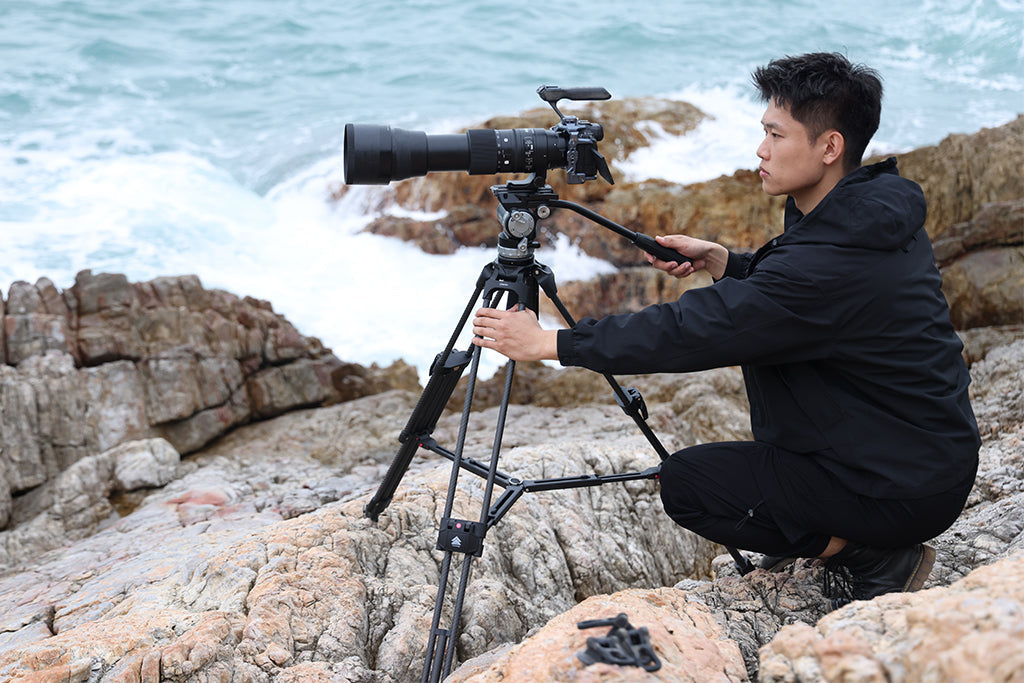
Scenario Modeling: The Adventure Documentary Filmmaker
To help you judge risk in the field, we modeled a typical filming scenario using standard physics assumptions.
1. Wind Load Stability: When to Add Ballast
A lightweight carbon fiber tripod is easy to carry but can be prone to toppling in high winds. We modeled a standard setup to find the approximate tipping point.
| Parameter | Value | Unit | Model Assumptions |
|---|---|---|---|
| Tripod Mass | 1.1 | kg | Standard travel carbon tripod |
| Camera Payload | 2.5 | kg | Mirrorless + Telephoto lens |
| Center of Pressure Height ($h$) | 1.4 | m | Typical eye-level setup |
| Frontal Area ($A$) | 0.04 | m² | Projected area of the rig |
| Drag Coefficient ($C_d$) | 1.2 | - | Standard bluff body for camera |
| Air Density ($\rho$) | 1.225 | kg/m³ | Sea level, 15°C |
The 16 m/s Threshold: The tipping point occurs when the wind force creates a moment that exceeds the restoring moment of the tripod's footprint.
- Result: Under these specific parameters, the critical wind speed for tipping is approximately 16 m/s (58 km/h).
- Actionable Heuristic: If you anticipate 20 m/s gusts (common in mountain or coastal areas), adding roughly 2.3kg of ballast to the center column can help lower the center of gravity and stabilize the rig.
Simple Field Test: If you can feel the tripod "chattering" or see the legs lifting slightly during gusts, you have likely reached the safety limit of your current weight distribution.
2. Biomechanical Cost: Wrist Torque and Fatigue
Weight isn't the only enemy; leverage can significantly impact your workflow. When using extension poles, the distance of the weight from your wrist creates torque.
The Example: A 1.5kg camera rig on a 1-meter extension pole held at a slight angle.
- Estimated Torque: ~4.4 N·m.
- The Impact: This can represent over 35% of the Maximum Voluntary Contraction (MVC) for an average adult's wrist.
According to ergonomic principles (referencing ISO 11228-3), sustained static loading should ideally remain below 20% of MVC to minimize the risk of long-term tendon strain. If your setup feels "heavy" after 5 minutes, you are likely exceeding this threshold.
Field Diagnostics: The "Fingernail Tap Test"
In the field, a common failure mode is internal delamination, where the layers of carbon and resin begin to separate.
Quick Diagnostic Checklist
| Test Method | Healthy Sign | Warning Sign | Action |
|---|---|---|---|
| Tap Test | Sharp, high-pitched "ping" | Dull, flat "thud" | Replace (Internal damage) |
| Visual Check | Uniform surface | White/cloudy "ghosting" | Monitor (Possible resin fatigue) |
| Flex Test | Rigid, no noise | Creaking or "crunching" | Retire (Structural failure) |
Limitations: The tap test is a reliable heuristic for surface and mid-wall issues but may not detect deep-core fractures in very thick-walled tubes. If you hear a "thud," the leg's load-bearing capacity is likely compromised.
Tactical Packing: Protecting Your Infrastructure
Packing a carbon tripod loose in a duffel bag increases the risk of "radial crush" failures from shifting gear or airport handling.
The "Frame Edge" Protocol
- The Rigid Boundary: Pack your tripod along the rigid frame or stay of your backpack. This shields the tubes from external compression.
- The DIY Armored Tube: For checked luggage, consider sliding individual tripod legs into thin-walled PVC pipes. This converts lateral "crush" energy into longitudinal resistance.
- The Thermal Bridge: Quick-release plates (like the FALCAM F38 series) are often made of 6061 Aluminum Alloy. In extreme cold (below -10°C), these act as thermal bridges. Attach plates to the camera indoors to maintain a thermal buffer and prevent battery drain.
Workflow ROI: The Economics of Quick Release
Based on observations of professional patterns, transitioning to a modular ecosystem is often a sound financial decision.
- Time Saved: ~30 seconds per swap compared to thread mounting.
- Annual Volume: 50 shoots/year, 40 swaps per shoot.
- Potential Gains: This can save approximately 16–17 hours of "dead time" annually. For a professional, this recovered productivity often outweighs the initial cost of the quick-release hardware within the first year.
Trust, Safety, and Engineering Standards
When selecting gear, look for adherence to these foundational industry markers:
- ISO 1222:2010: Standardizes tripod connections and screw threads.
- Arca-Swiss Standard: The industry-standard dovetail dimension for professional rigging.
- IEC 62133-2: Important if your support gear includes integrated lithium batteries; this standard addresses safety against thermal runaway.
For more on the evolution of these standards, refer to The 2026 Creator Infrastructure Report.
Building a Resilient System
Understanding the material science of your gear helps you transition from a consumer to a more informed technician. By respecting the directional strength of carbon fiber and managing the biomechanical leverage of your rig, you can significantly reduce the risk of equipment failure. Treat your tripod as a precision instrument, pack it as a vulnerable one, and use the "fingernail tap" to ensure it’s ready for your next mission.
Disclaimer: This article is for informational purposes. Engineering calculations and scenario models are based on general heuristics and specific assumptions (e.g., standard air density and bluff body drag coefficients); they do not guarantee performance in all real-world conditions. Always consult your equipment's manual for specific load ratings and safety warnings.