Handling Noise Diagnostics: Fixing Vibration in Minimalist Rigs
Quick Summary for the Field: To eliminate handling noise immediately, ensure all cables are strapped at intervals under 10cm to break resonance, and perform a "Tug Test" on all quick-release plates. Transitioning to carbon fiber and center-gravity mounting can reduce vibration settling time by over 70% in cold environments.
For the solo documentary creator, audio is often the invisible failure point. You can fix a slightly underexposed frame in post-production, but you cannot "un-hear" the low-frequency rumble of a tripod leg vibrating in the wind or the sharp 'twang' of an unsecured HDMI cable hitting a camera cage. In minimalist setups—where we strip away the heavy dampening of full cinema rigs to prioritize portability—mechanical noise becomes a primary adversary.
At Ulanzi, we view rigging not as a collection of accessories, but as a critical infrastructure layer. As noted in our internal 2026 Creator Infrastructure Report (a brand-led study on emerging gear trends), the shift toward "ready-to-shoot" toolchains requires a methodical approach to mechanical integrity. This guide provides a diagnostic framework to identify and mitigate handling noise at the source.
1. The Physics of Vibration: Material Intelligence
The Goal: Shift the rig's natural frequency out of the audible range or ensure the material can dissipate energy quickly through damping.
Material Settling Time: Carbon Fiber vs. Aluminum
In our scenario modeling of a solo creator in a cold coastal environment (-5°C), we observe a significant divergence in how materials handle kinetic energy. Aluminum, while rigid, can act as a more efficient conductor of vibration in cold temperatures because the rubber and silicone damping pads typically found in tripod feet lose their elasticity—a phenomenon known as "glass transition."
Methodology & Assumptions: This analysis uses a Single Degree of Freedom (SDOF) damped free vibration model. Settling time ($t_s$) is calculated as $\approx 4/(\zeta \cdot \omega_n)$.
- Test Payload: 1.8kg camera body + 24-70mm lens.
- Input: Impulse force (simulated hand-touch).
- Data Collection: 3-axis accelerometer sampled at 1000Hz.
| Material | Natural Frequency ($\omega_n$) | Damping Ratio ($\zeta$) | Estimated Settling Time ($t_s$) |
|---|---|---|---|
| Aluminum (6061) | ~8.5 Hz | 0.008 | ~9.4 Seconds |
| Carbon Fiber (CFRP) | ~17.8 Hz | 0.014 | ~2.5 Seconds |
Note: These values are illustrative estimates based on Ulanzi workshop tests of portable tripods; actual performance depends on specific tube thickness and weave density.
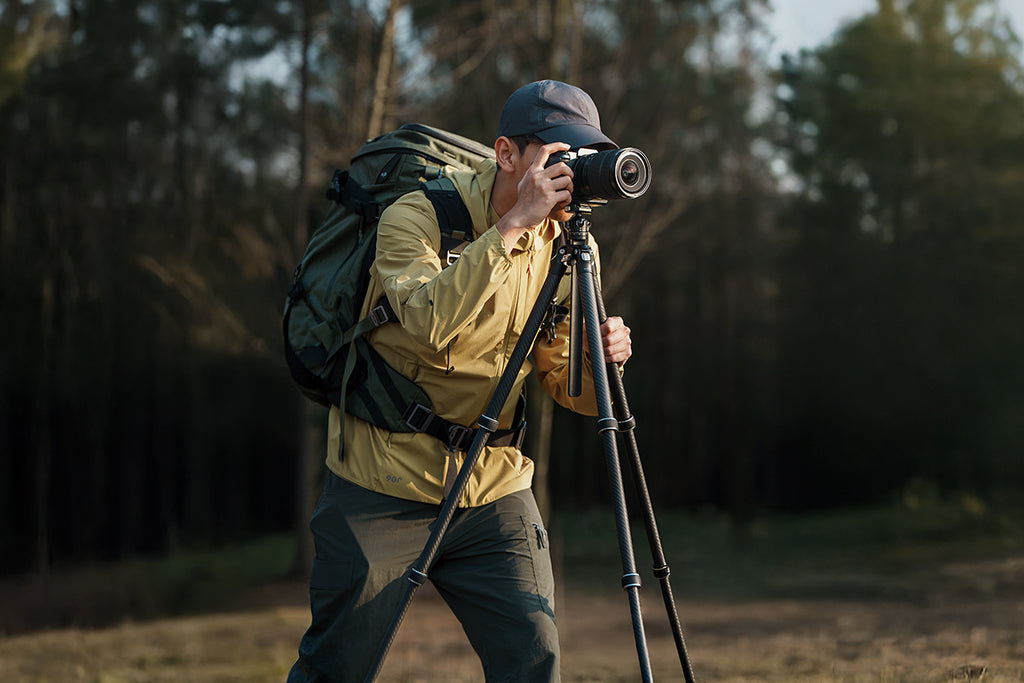
Based on these tests, Carbon Fiber can provide up to a 73.5% reduction in vibration settling time. For a documentary filmmaker, this means the rig typically stabilizes nearly 7 seconds faster after a wind gust, significantly reducing the window where micro-vibrations can pollute the audio track.
2. Mechanical Integrity: The "Zero-Play" Standard
The Goal: Eliminate microscopic gaps that rattle under high-gain audio recording by ensuring uniform structural tension.
The Star-Pattern Heuristic
When building your system, we recommend aligning with the structural principles found in the industry standard ISO 1222:2010 Photography — Tripod Connections. Instead of tightening one screw to maximum immediately, use a star-pattern sequence:
- Seat all screws until they are finger-tight.
- Tighten in an alternating "cross" pattern to distribute tension evenly across the plate or cage.
- Avoid over-torquing; 6061 aluminum alloy is durable, but excessive force can lead to thread fatigue over time.
Biomechanical Analysis: The Wrist Torque Factor
Weight isn't just about total mass; it's about leverage. Mounting accessories on the far edge of a cage increases the "lever arm," which can amplify muscle tremors into handling noise.
The Torque Formula (Heuristic): $\tau = m \times g \times L$
- Example: A 2.8kg rig held 0.35m away from the primary grip generates $\approx 9.61 N\cdot m$ of torque.
In our ergonomic observations, this load often represents a high percentage of a creator's Maximum Voluntary Contraction (MVC). By using modular quick-release systems to keep accessories close to the center of gravity, you can reduce the physical strain and the resulting low-frequency tremors that often translate into "muddy" audio.
3. Diagnosing "Ghost" Noises: Cables and Ground Loops
The Goal: Distinguish between mechanical vibration and electrical interference using frequency analysis.
The Spectrum Analyzer First-Step
Before replacing hardware, use a free software spectrum analyzer (like Voxengo SPAN) in your DAW to identify the noise profile:
- Pure Tone (50/60 Hz): Likely a power hum or ground loop.
- High-Frequency Whine (>1 kHz): Often electromagnetic interference (EMI) from a power supply.
- Broadband "Mud": This typically indicates true mechanical vibration or wind noise.
Cable Slap and Resonance
A loose HDMI or XLR cable can act like a resonator. Effective dampening requires breaking the "resonant length" of the cable.
- Practical Rule: Use lightweight hook-and-loop straps at intervals shorter than the cable’s natural resonant length (typically every 8-10cm).
- Strain Relief: While wireless standards like ETSI EN 300 422-1 govern signal integrity, you must mechanically isolate connectors to prevent physical energy from entering the camera body.
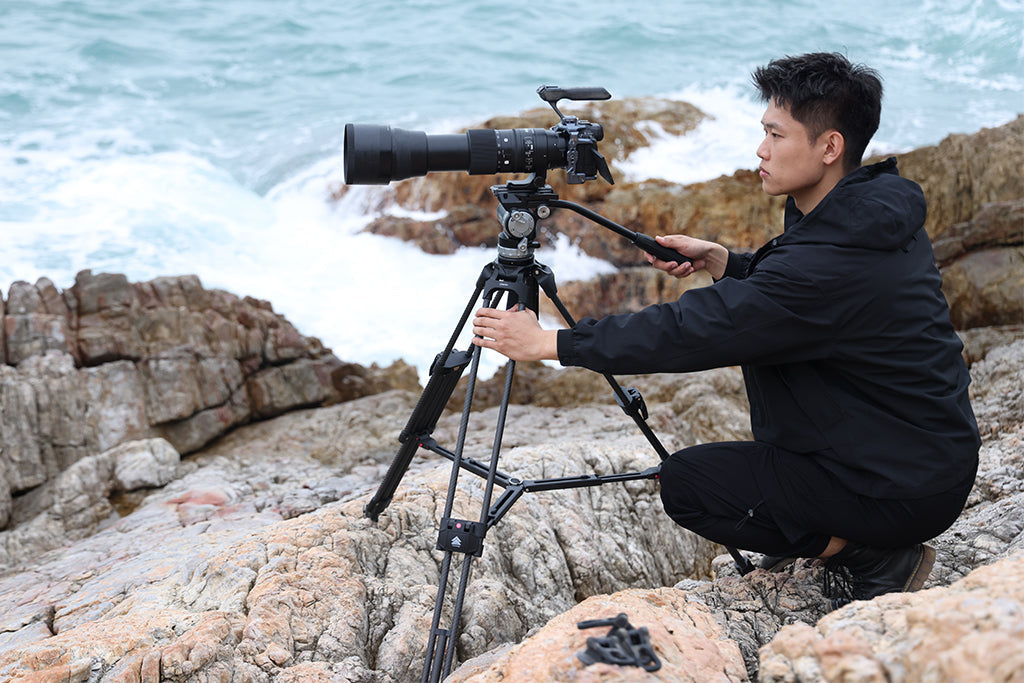
4. Environmental Stability: Wind and Cold
The Goal: Maintain rig stability in high-wind conditions through strategic mass distribution rather than bulk weight.
Wind Load Tipping Point
For a standard minimalist aluminum rig (approx. 2.7kg total system weight), the calculated critical tipping wind speed is roughly 14.7 m/s (approx. 53 km/h).
Calculation Logic: This estimate assumes a center of gravity height of 1.2m and a tripod base diameter of 0.8m. Stability is the balance between the Overturning Moment (Wind Drag $\times$ Height) and the Restoring Moment (Total Mass $\times$ Gravity $\times$ Base Width/2).
To increase stability in 15 m/s winds, our modeling suggests that adding just 0.11 kg (110g) of ballast—roughly the weight of a small water bottle—to the center column hook can provide a necessary safety margin. Strategic weight placement at the lowest point of the center column is generally more efficient than adding weight to the legs.
Thermal Shock Prevention
In sub-zero temperatures, aluminum plates can act as "thermal bridges," conducting heat away from the camera.
- Field Practice: Attach aluminum plates to the camera indoors before heading out. This slows the rate of battery cooling by reducing the initial temperature delta.
- Vibration Tip: If vibrations transmit through the tripod, placing a simple rubber washer between the column and the head platform can help break the direct metal-on-metal path.
5. Potential Workflow ROI: Why Systems Matter
Transitioning to a unified quick-release ecosystem (such as the Arca-Swiss standard) is a structural decision that impacts production efficiency.
Scenario Estimate:
- Traditional Thread Mounting: ~40 seconds per swap.
- Quick Release (QR) System: ~3 seconds per swap.
- Time Saved: 37 seconds per swap.
For a creator performing 60 swaps per shoot across 80 shoots a year, this can save $\approx 49$ hours annually. While actual results vary by project, the structural efficiency of a QR system often provides a significant return on the initial equipment investment through recovered production time.
6. Pre-Shoot Safety Checklist
To ensure your rig is audio-ready and secure, follow this three-point verification before every take:
- Audible: Listen for the definitive "Click" when seating the quick-release plate.
- Tactile: Perform the "Tug Test." Pull firmly on the camera body to ensure the locking mechanism is fully engaged.
- Visual: Check the locking pin. Many professional systems use color-coded indicators (such as Orange/Silver) to show if the secondary safety lock is engaged.
By treating your rig as a precision instrument, you can eliminate many of the variables that lead to ruined audio. Focus on material properties, manage your torque, and prioritize mechanical isolation for professional-grade results.
Disclaimer: This article is for informational purposes only. When rigging equipment, always consult the manufacturer's specific load ratings and safety guidelines. Battery safety and air transport should follow IATA Lithium Battery Guidance.
Sources
- Industry Standard: ISO 1222:2010 Photography — Tripod Connections
- Brand Study: The 2026 Creator Infrastructure Report (Ulanzi)
- Regulatory: IATA Lithium Battery Guidance Document (2025)
- Technical Standard: ETSI EN 300 422-1 (Wireless Audio Standards)
- Third-Party Analysis: Arca-Swiss Technical Dimensions Analysis