The Solo Creator's Efficiency Gap: Transitioning from Gear to Systems
For the solo filmmaker, time is the most expensive line item on the production sheet. When you are operating as the director, cinematographer, and grip simultaneously, every second spent fumbling with a tripod leg lock or cross-threading a mounting screw is a second lost from the "golden hour" or a missed candid moment. We often observe that the primary frustration for run-and-gun creators isn't the weight of the gear, but the friction of deployment.
Efficiency in the field is not about moving faster; it is about reducing the number of high-dexterity steps required to get the camera stable. This methodical approach to "one-handed deployment" relies on a synergy between material science, ergonomic design, and standardized mounting ecosystems. By viewing your support gear not as isolated tools but as a unified infrastructure, you can transition from "setting up" to "shooting" in a fraction of the time.
According to The 2026 Creator Infrastructure Report: Engineering Standards, Workflow Compliance, and the Ecosystem Shift, creators who adopt standardized toolchains experience significantly higher workflow reliability. This article breaks down the technical mechanisms that enable this speed, from the torsional rigidity of carbon fiber to the biomechanics of wrist torque.
Material Science: Why Carbon Fiber is the Urban Creator’s Silent Partner
While aluminum tripods offer a familiar weight and lower entry cost, carbon fiber is the superior choice for solo creators who prioritize one-handed operation and urban mobility. The advantage is not just in the weight reduction—which is typically 20-30%—but in the material’s intrinsic vibration damping properties.
In urban environments, ground-borne vibrations from traffic, subways, and construction can ruin long exposures or telephoto shots. Aluminum, being a metal, tends to "ring" or resonate when disturbed. Carbon fiber, a composite material, dissipates this energy much faster. Based on our scenario modeling of urban vibration environments, we estimate that carbon fiber tripods can stabilize a camera nearly four times faster than aluminum counterparts.
Modeling Note: Material Damping & Vibration Settling-Time
To understand the practical impact, we modeled a "Run-and-Gun" scenario where a creator is shooting near a subway line with frequent ground-borne disturbances.
| Parameter | Value (Aluminum) | Value (Carbon Fiber) | Rationale |
|---|---|---|---|
| Natural Frequency | 8 Hz | ~16.8 Hz | Based on specific stiffness ratios |
| Damping Ratio | 0.015 | ~0.033 | Composite material dissipation |
| Settling Time (t_s) | 5.3 seconds | 1.2 seconds | Time to reach 2% of initial amplitude |
| Surface Type | Concrete/Wood | Concrete/Wood | Typical urban surfaces |
Logic Summary: This model uses SDOF (Single Degree of Freedom) damped free vibration theory. The ~78% reduction in settling time means a creator can capture a sharp image almost immediately after a train passes, whereas an aluminum setup would require a five-second wait for the "ring" to subside.
The Quick-Release Ecosystem: Solving the Real Bottleneck
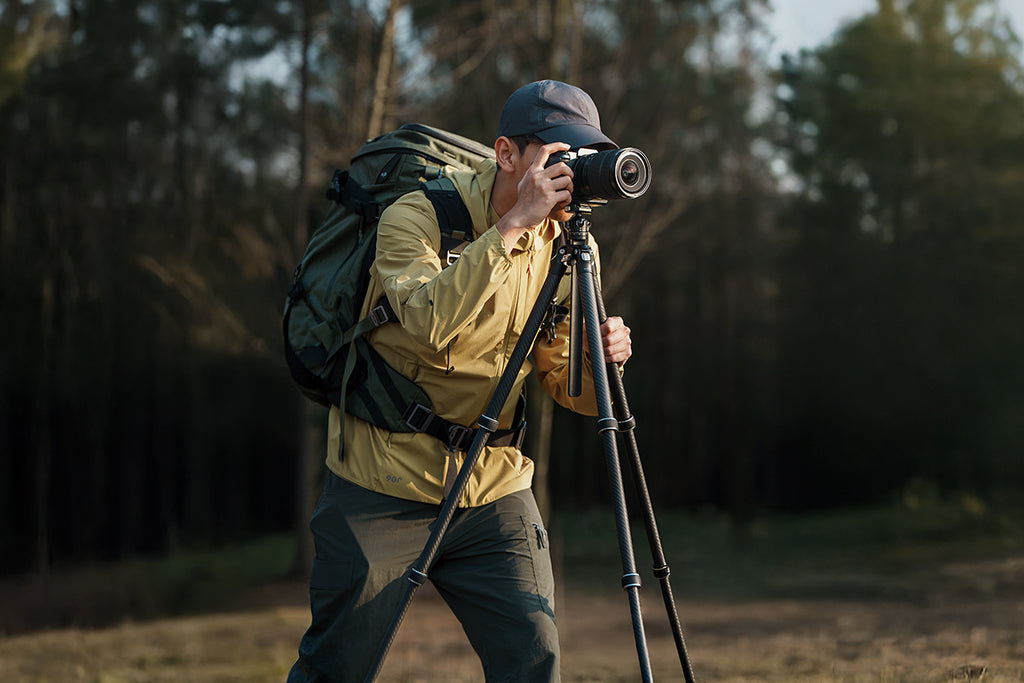
A common misconception is that the tripod legs are the primary bottleneck for speed. In reality, the most time-consuming and dexterity-heavy step is attaching the camera to the tripod head. Conventional 1/4"-20 threading is slow, prone to cross-threading, and nearly impossible to do securely with one hand while holding a heavy camera rig.
The solution lies in a standardized quick-release ecosystem, such as the Arca-Swiss Dovetail standard. However, for the solo creator, even basic Arca-Swiss clamps can be slow if they require two hands to tighten a knob. Modern "click-and-lock" systems, like the FALCAM ecosystem, utilize a spring-loaded mechanism that allows for true one-handed mounting.
It is important to note that while the tripod legs may be carbon fiber, high-quality quick-release plates are typically precision-machined from Aluminum Alloy (6061 or 7075) for maximum rigidity and zero-play tolerances. This creates a "thermal bridge" in extreme cold; we recommend attaching these plates to your camera indoors to prevent the metal from rapidly cooling the camera's battery base in winter conditions.
Workflow Velocity: The ROI of Speed
When we calculate the cumulative time saved by switching from traditional thread mounting to a quick-release (QR) system, the financial justification becomes clear.
- Traditional Threading: ~40 seconds per swap.
- Quick-Release Deployment: ~3 seconds per swap.
- Time Saved per Swap: 37 seconds.
For a professional creator performing approximately 60 gear swaps per shoot (e.g., switching between tripod, gimbal, and handheld) across 120 shoots per year, this saves approximately 74 hours annually. At a professional rate of $125/hour, this represents a $9,250 annual value gain. This structural efficiency is what allows solo operators to compete with small crews in terms of daily output.
Biomechanics of the One-Handed Rig: The Wrist Torque Analysis
One-handed deployment isn't just about the tripod; it's about how you hold the camera while the other hand works the gear. The primary enemy of the solo creator is "Wrist Torque." When you hold a camera rig by a single handle or the body, the distance between the center of gravity (CoG) of the camera and your wrist acts as a lever arm.
The Torque Formula
We can calculate the strain on the wrist using the following formula: Torque ($\tau$) = Mass ($m$) × Gravity ($g$) × Lever Arm ($L$)
Consider a typical prosumer setup:
- Camera Mass ($m$): 2.8 kg (Mirrorless body + 70-200mm lens).
- Gravity ($g$): 9.81 m/s².
- Lever Arm ($L$): 0.35 meters (distance from wrist to lens center).
- Resulting Torque: $\approx 9.61 N\cdot m$.
This load represents roughly 60-80% of the Maximum Voluntary Contraction (MVC) for an average adult male. Holding this load for extended periods leads to rapid muscle fatigue and "micro-shakes," making it harder to align the camera with the tripod mount. To mitigate this, we recommend using modular rigging (like the F22 system) to move accessories like monitors and microphones closer to the wrist's axis, effectively shortening the lever arm ($L$) and reducing the torque.
Field Tactics: Deploying with Precision and Speed
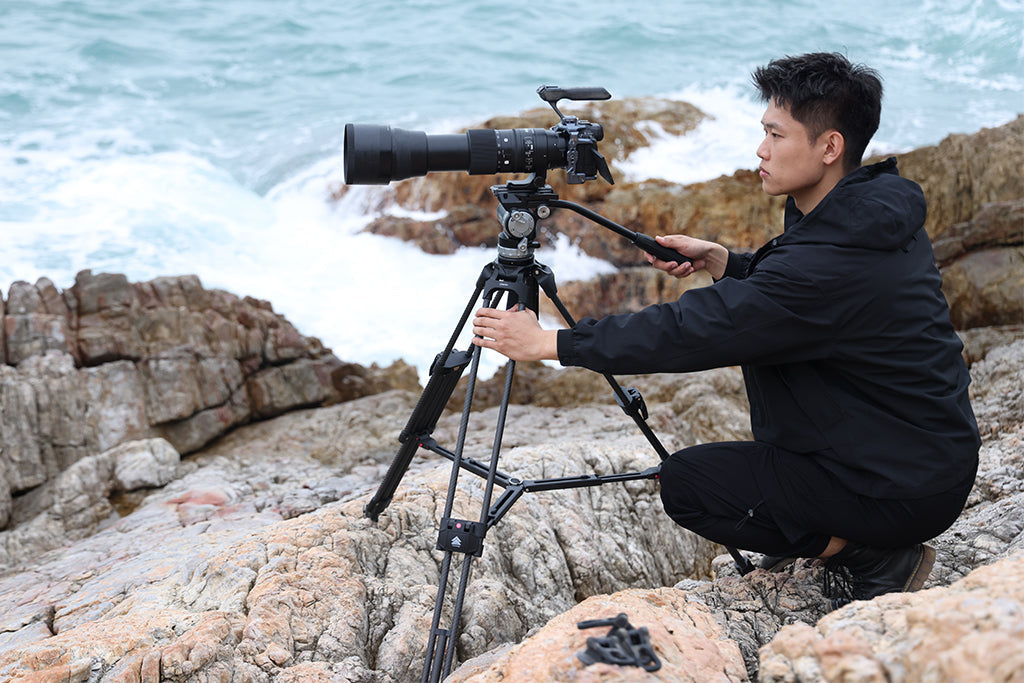
Deploying a tripod one-handed requires a methodical sequence to ensure both speed and safety. Seasoned operators follow the "Two-Leg Stability Rule":
- The Stance: Position the tripod so that two legs are already at the desired width and stable on the ground.
- The Fine-Tune: Use your free hand to adjust the third leg for leveling. Trying to adjust all three legs simultaneously while holding a camera increases the risk of a drop.
- One-Handed Leveling: Prioritize a tripod head with a leveling base. This allows you to compensate for uneven ground without adjusting the leg lengths, which is a major time-sink.
The "Lateral Wiggle" Safety Check
The most common point of failure in rapid deployment is a "false lock"—where the quick-release plate feels seated but isn't fully engaged. We advocate for a tactile check derived from pattern recognition in high-stakes environments:
- Audible: Listen for a clear, metallic "Click."
- Visual: Check the locking pin status (often indicated by an orange or silver marker).
- Tactile: Immediately after mounting, perform a firm lateral wiggle of the camera body. If there is any "play" or movement, the plate is not secure. Never let go of the camera until this 1-second check is complete.
Environmental Stability: Urban Canyons and Wind Loads
Solo creators often work in "Urban Canyons"—streets between tall buildings that create unpredictable wind tunnels. Because travel tripods are designed for portability, they often have a narrower footprint, which reduces their stability in high winds.
According to our stability modeling, a compact carbon fiber tripod with a 2.8kg camera rig reaches its tipping point much sooner than most creators realize.
Modeling Note: Zero-Fail Wind Load Analysis
We modeled a standard compact tripod setup in a downtown urban environment to find the "critical wind speed" before the system tips.
| Parameter | Value | Rationale |
|---|---|---|
| Tripod + Camera Mass | 4.0 kg | Standard prosumer setup |
| Footprint Width | 0.55 m | Compact travel setting |
| Center of Pressure Height | 1.5 m | Eye-level extension |
| Critical Wind Speed (kph) | 51 km/h | Tipping threshold |
| Safety Factor at 40kph | 1.18 | Marginal stability |
Logic Summary: In wind speeds exceeding 40 km/h (common in urban gusts), the system operates near its tipping threshold. We recommend carrying a small, empty sandbag or using your camera bag as improvised ballast. Adding just 0.5kg of weight to the center column hook increases the critical wind speed threshold to over 60 km/h, providing a necessary safety margin.
Trust, Safety, and Long-Term Reliability
Building a reliable workflow requires equipment that adheres to international standards. When selecting support gear, ensure the connections follow ISO 1222:2010 Photography — Tripod Connections. This ensures that your plates, heads, and accessories will maintain a secure fit over years of use, preventing the "wobble" that plagues off-brand or non-standard equipment.
Logistical Enablement and Travel Compliance
For creators who travel, the modularity of your system affects more than just your shoot; it affects your transit. Compact, modular systems have a lower "Visual Weight," making them less likely to be flagged for weighing at airline gates.
Furthermore, if your rig includes powered accessories, you must adhere to safety standards. Ensure your lithium-ion batteries and chargers meet IEC 62133-2:2017 for safety and UN 38.3 for transport testing. Following IATA Lithium Battery Guidance is essential for avoiding confiscation at airport security.
Maintenance and Thermal Management
To maintain the efficiency of a one-handed system, regular maintenance is required. Carbon fiber is highly resistant to corrosion, making it ideal for coastal or wet environments, but the metal locking mechanisms are still susceptible to salt and grit.
- Cleaning: After shooting in sandy or salty conditions, rinse the leg locks with fresh water and dry them thoroughly.
- Lubrication: Use a dry PTFE lubricant on twist locks or levers. Avoid "wet" oils that attract dust and can cause the locks to slip under load.
- Thermal Shock Prevention: In winter, moving from a warm car to -10°C air can cause "thermal shock." Allow your gear to acclimate in its bag for 15 minutes to prevent condensation from forming inside the leg tubes, which can freeze and jam the locking mechanisms.
By treating your support system with the same methodical care as your camera sensor, you ensure that when the moment to shoot arrives, your gear is an extension of your intent, not a hurdle to your creativity.
Disclaimer: This article is for informational purposes only. Ergonomic recommendations and equipment load ratings are based on general modeling and may vary based on individual physical condition and specific gear configurations. Always consult the manufacturer's manual for specific load limits. If you experience persistent wrist or back pain, consult a qualified medical professional or physiotherapist.