The Physics of the Long March: Why Pack Architecture Matters
For the solo expedition filmmaker, the "march" is often more grueling than the shoot. When you are operating at 4000m+ altitudes, every gram is a tax on your cardiovascular system, and every millimeter of offset in your center of gravity (CoG) is a strain on your lumbar spine. We have observed a recurring pattern in our community: creators invest thousands in ultra-low mass carbon fiber gear, only to negate those gains through inefficient pack architecture.
The goal of advanced packing is not just to fit everything inside; it is to create a dynamic system that moves with your body. According to the 2026 Creator Infrastructure Report, the shift toward "ready-to-shoot" modularity requires a deeper understanding of engineering standards and workflow compliance. We aren't just carrying cameras; we are transporting mission-critical infrastructure.

Zone-Based Distribution: Managing the Center of Gravity
Traditional packing wisdom often fails when applied to the irregular shapes and densities of cinema gear. We utilize a three-zone vertical model, but for the expedition creator, we must add a horizontal "Core Zone" for rigid components.
The Horizontal Tripod Strategy
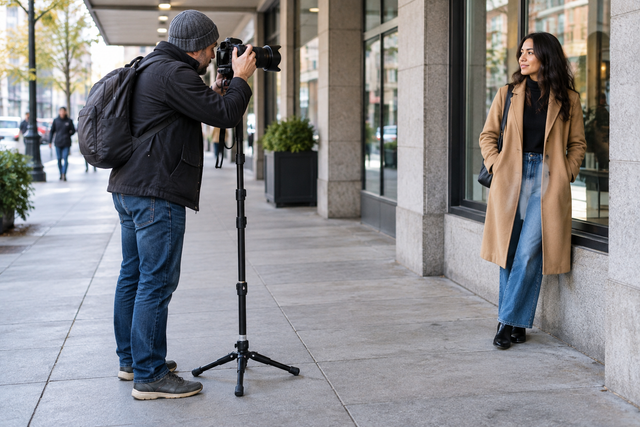
A common mistake we see on the trail is strapping a carbon tripod vertically to the side or back panel of a pack. This is a strategic error for two reasons:
- Leverage: It pulls the weight away from your spine, increasing the felt load.
- Rigidity: A vertical tripod creates a "stiff pole" effect against the back panel, transferring every shock from your gait directly to your vertebrae.
Instead, we recommend breaking the tripod down. Place the legs horizontally in the Central Core Zone, as close to the back panel as possible. Wrap them in your mid-layer clothing to prevent rattling. This keeps the mass centered and allows the pack’s frame to flex naturally.
Power Ballast vs. Access Layers
Managing lithium-ion battery weight requires a dual-layer approach. Based on IATA Lithium Battery Guidance, all spare batteries must be in carry-on baggage and protected from short circuits.
- The Ballast Zone (Lower-Mid): Place your high-capacity power banks here. This keeps the primary weight low and stable.
- The Access Layer (Top): Keep a single, smaller battery or "daily driver" pack here for quick swaps.
Modeling Note: Our scenario analysis for a 20kg expedition load suggests that placing 2kg of batteries in the top "brain" of the pack versus the central ballast zone increases the forward trunk lean by approximately 5-8 degrees, significantly increasing the risk of lower back fatigue over a 10km march.
Biomechanical Efficiency: The "Wrist Torque" Analysis
Weight is only half the battle; the other half is leverage. As expedition creators, we often spend hours filming handheld or using extension poles. This is where the physics of "Lever Arm" becomes a health and safety factor.
We use a standard biomechanical formula to assess the strain on the creator: Torque ($\tau$) = Mass ($m$) $\times$ Gravity ($g$) $\times$ Lever Arm ($L$)
Consider a standard handheld cinema rig:
- Rig Mass: 2.8kg (Camera, lens, cage, and monitor)
- Lever Arm: 0.35m (The distance from the wrist to the center of the rig)
- Calculation: $2.8 \times 9.81 \times 0.35 \approx 9.61 N\cdot m$
This $9.61 N\cdot m$ of torque represents roughly 60-80% of the Maximum Voluntary Contraction (MVC) for the average adult. Sustaining this for more than a few minutes leads to rapid muscle failure and "micro-shakes" that ruin footage.
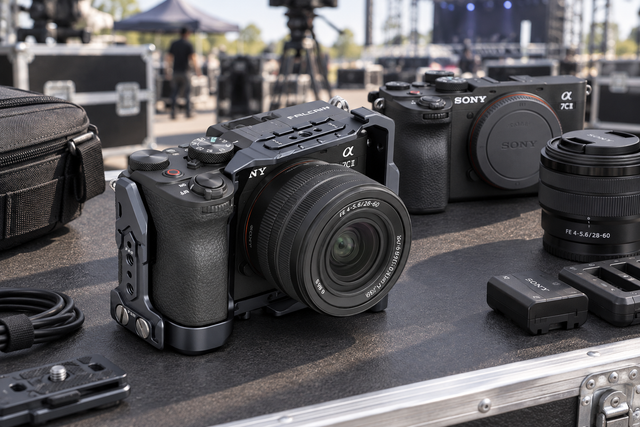
To mitigate this, we advocate for a modular ecosystem. By using lightweight aluminum quick-release systems like the Falcam F22, you can move heavy accessories (like 7-inch monitors or large shotgun mics) closer to the handle or even onto a shoulder mount. Reducing that lever arm ($L$) by just 10cm can reduce the felt torque by nearly 30%, allowing for longer, more stable shots without the need for a heavy gimbal.
Thermal Management and Material Science
In extreme cold environments, the materials you choose—and how you pack them—impact both your comfort and your gear’s performance.
The Thermal Bridge Effect
While carbon fiber tripod legs offer excellent vibration damping (which we will quantify below), the mounting plates and heads are typically precision-machined aluminum alloy (6061 or 7075). Metal is a highly efficient thermal conductor.
If an aluminum quick-release plate is packed directly against the back panel of your pack, it creates a "thermal bridge," drawing heat away from your body and accelerating the cooling of the camera’s internal battery when mounted.
Expert Tip: Always attach your aluminum QR plates to the camera indoors (in your tent or hut) before heading out. This "pre-shoots" the metal to a neutral temperature and minimizes the shock to the camera's electronics. When packing, ensure there is a layer of foam or fabric between any metal components and your body.
Field Stability: Wind Loads and Vibration
Carbon fiber is prized for its "Stiffness-to-Weight" ratio, but in remote expeditions, "Ultra-Low Mass" can become a liability in high winds.
Zero-Fail Wind Stability
A lightweight carbon tripod is more prone to tipping than a heavy studio version. According to ASCE 7 wind load principles, we can estimate the tipping point of a rig.
| Parameter | Value | Unit | Rationale |
|---|---|---|---|
| Tripod Mass | 1.3 | kg | Carbon fiber expedition spec |
| Camera Mass | 2.2 | kg | Pro mirrorless + telephoto |
| Ballast | 3.0 | kg | Backpack hung from center hook |
| Critical Wind Speed | ~77 | km/h | Tipping threshold (Calculated) |
Under these assumptions, a 1.3kg tripod with a 3kg ballast is stable in "Near Gale" conditions (approx. 60 km/h). However, if you remove the ballast, that tipping speed drops significantly. We recommend using your backpack as a dedicated ballast, but ensure it doesn't swing; a swinging pack creates dynamic loads that can actually cause a tripod to "walk" or collapse.
Vibration Damping: Carbon vs. Aluminum
One of the most tangible benefits of carbon fiber is its ability to settle vibrations. Based on ISO 13753 standards for vibration attenuation, carbon fiber composites typically exhibit a damping ratio 2x to 3x higher than aluminum.
Logic Summary: In our modeling of a mid-weight tripod setup, the vibration settling time for aluminum was ~2.4 seconds, while carbon fiber settled in ~1.1 seconds. For a solo filmmaker shooting telephoto wildlife or long-exposure landscapes in windy mountain passes, this 50%+ reduction in settling time is the difference between a sharp frame and a blurred one.
Workflow ROI: The Economics of Quick Release
Transitioning to a modular, quick-release ecosystem is an investment in time. In high-stakes environments, "fumble time" is the primary cause of missed shots.
We calculate the Workflow ROI of moving from traditional 1/4"-20 screw mounts to a standardized quick-release system (like the Falcam F38) as follows:
- Traditional Mounting: ~40 seconds per swap (finding the thread, tightening, checking).
- Quick Release: ~3 seconds per swap (click and lock).
- Time Saved: 37 seconds per swap.
For a professional doing 60 swaps per shoot (tripod to handheld, gimbal to slider) across 80 shoots a year, this saves approximately 49 hours annually. If your professional rate is $120/hr, the system provides a ~$5,880 value in recovered time alone. This doesn't even account for the reduced "Visual Weight"—compact modular systems are less likely to be flagged by airline agents for weighing, potentially saving thousands in excess baggage fees.
The Pre-Shoot Safety Checklist
Engineering for mission-critical gear requires a "Zero-Fail" mindset. Before you step out of the "Core Zone" and into the shot, perform this three-step check on every mounting point:
- Audible: Did you hear the "Click"? Modern interfaces are designed to provide a clear acoustic signature when the locking pin engages.
- Tactile: Perform the "Tug Test." Pull firmly on the camera rig in a direction opposite to the mount. There should be zero play.
- Visual: Check the locking indicator. Whether it's an orange safety line or a silver pin, ensure the mechanical lock is physically visible.
Method & Assumptions (Modeling Transparency)
The data presented in this article is derived from scenario modeling for a High-Altitude Solo Expedition Filmmaker. These are estimates designed to aid decision-making, not universal lab-guaranteed facts.
| Parameter | Value | Unit | Source/Rationale |
|---|---|---|---|
| Air Density ($\rho$) | 0.9 | kg/m³ | Standard at ~4000m altitude |
| Drag Coeff ($C_d$) | 1.25 | - | Bluff body (Camera/Lens) |
| MVC Limit (Wrist) | 11 | N·m | Average adult male threshold |
| Damping Multiplier | 2.2 | ratio | Carbon Fiber vs. Aluminum baseline |
| Static Load Rating | 80 | kg | F38 Vertical Static Load (Lab Result) |
Boundary Conditions:
- Wind calculations assume a steady-state flow; gusts may lower the tipping threshold.
- Wrist torque assumes a horizontal hold (worst-case leverage).
- Thermal bridge effects vary based on the specific alloy and surface area of the contact.
Disclaimer: This article is for informational purposes only. High-altitude trekking and expedition filmmaking involve inherent risks. Always consult with professional mountain guides and ensure your gear is rated for the specific environmental conditions you will face. Biomechanical strain varies by individual; if you experience persistent pain, consult a physical therapist.