The Infrastructure of the Unboxing Economy: Why Stability is Non-Negotiable
In the high-stakes environment of e-commerce live streaming and professional product demos, the overhead shot—often called the "God view" or unboxing angle—is your most persuasive tool. It transforms a distant product into an intimate, tactile experience for the viewer. However, for many solo creators, this angle is also the most precarious. We have seen countless streamers struggle with "arm droop," where a camera slowly sags out of frame mid-demo, or worse, catastrophic failures where a mounting clamp slips, sending thousands of dollars of glass and sensors crashing onto the product.
At Ulanzi, we view rigging not as a collection of accessories, but as a creator infrastructure layer. Just as a skyscraper depends on its foundation, your professional workflow depends on the mechanical integrity of your overhead rig. This article serves as a technical benchmark for selecting heavy-duty arms that do more than just "hold" a camera; they provide the stability required for high-magnification macro shots and the safety margins necessary for live, high-pressure environments.
The Physics of Leverage: Understanding the "Lever Effect"
The most common mistake we observe in studio setups is selecting an arm based solely on the weight of the camera. In reality, weight is only half of the equation. The true enemy of stability is Torque ($\tau$). When you extend an arm horizontally over a table, you are creating a lever.
According to the biomechanical principles outlined in our 2026 Creator Infrastructure Report: Engineering Standards, Workflow Compliance, and the Ecosystem Shift, the force exerted on the mounting base increases exponentially with the length of the extension.
The Torque Formula for Creators
To understand the stress on your rig, use this fundamental calculation: $$\tau = m \times g \times L$$
- $m$: Mass of your camera rig (kg).
- $g$: Acceleration due to gravity ($\approx 9.81 m/s^2$).
- $L$: The horizontal distance (Lever Arm) from the base to the camera (m).
The Reality Check: A standard mirrorless setup (e.g., Sony A7IV + 24-70mm lens + cage + mic) weighing approximately 2.9kg, extended 0.6 meters from the base, generates roughly 18.6 N·m of torque.
Methodology Note: Our ergonomic analysis of this scenario assumes a horizontal extension (maximum moment) and applies ISO 11228-3 biomechanical norms. This level of torque represents nearly 150% of the maximal voluntary contraction (MVC) for an average adult's wrist if they were holding it, explaining why these rigs feel so "heavy" and difficult to adjust with one hand during setup.

Selecting the Right Foundation: The Base and the Arm
If the arm is the skeletal structure, the base is the anchor. Based on pattern recognition from our support and warranty handling, the primary point of failure is rarely the arm snapping; it is the base clamp slipping on a smooth desktop edge.
1. The "Weak Link" Theory
Most desks used in home studios have laminated or lacquered surfaces. These are notoriously low-friction. When a heavy-duty arm like the Ulanzi TH04 Overhead Camera Mount T088 is extended, the torque tries to "peel" the clamp off the desk.
- Professional Tip: We recommend adding a strip of high-grade gaffer tape to the clamp's jaws or using a thin wooden block as an intermediary. This increases the coefficient of friction and protects your furniture from the high clamping forces required for a 2.9kg dynamic load.
2. The 2x Safety Margin Rule
While many arms are rated for a specific weight, that rating is often a static load limit. In a live demo, you are constantly touching the camera, swapping lenses, or bumping the table. We advocate for a 2x safety margin. If your camera rig weighs 3kg, your arm should be rated for at least 6kg. This headroom accounts for the inertial forces generated when you adjust the arm or when the table vibrates.
3. Material Science: Aluminum vs. Carbon Fiber
The choice of material impacts more than just the weight of the arm itself. It dictates how quickly your shot stabilizes after a disturbance.
| Material | Natural Frequency (Hz) | Settling Time (Seconds) | Damping Advantage |
|---|---|---|---|
| Aluminum | ~8 Hz | ~5.3 s | Standard |
| Carbon Fiber | ~16.8 Hz | ~1.0 s | 5x Faster |
Estimated values based on scenario modeling for medium-duty overhead arms.
Logic Summary: Our vibration performance model uses Single Degree of Freedom (SDOF) damped vibration theory. Carbon fiber’s higher specific stiffness and damping ratio (aligned with ISO 13753) allow it to recover from a table bump 5 times faster than aluminum. For creators doing macro product shots where every micro-jitter is visible, carbon fiber is a functional necessity, not just a luxury.
Workflow Integration: The Quick-Release Advantage
Efficiency in a solo-operator studio is measured by "time-to-shoot." If it takes ten minutes to mount your camera and level the overhead angle, you are less likely to produce content. This is where the interface between the arm and the camera becomes critical.
The ROI of Quick Release (F38 Ecosystem)
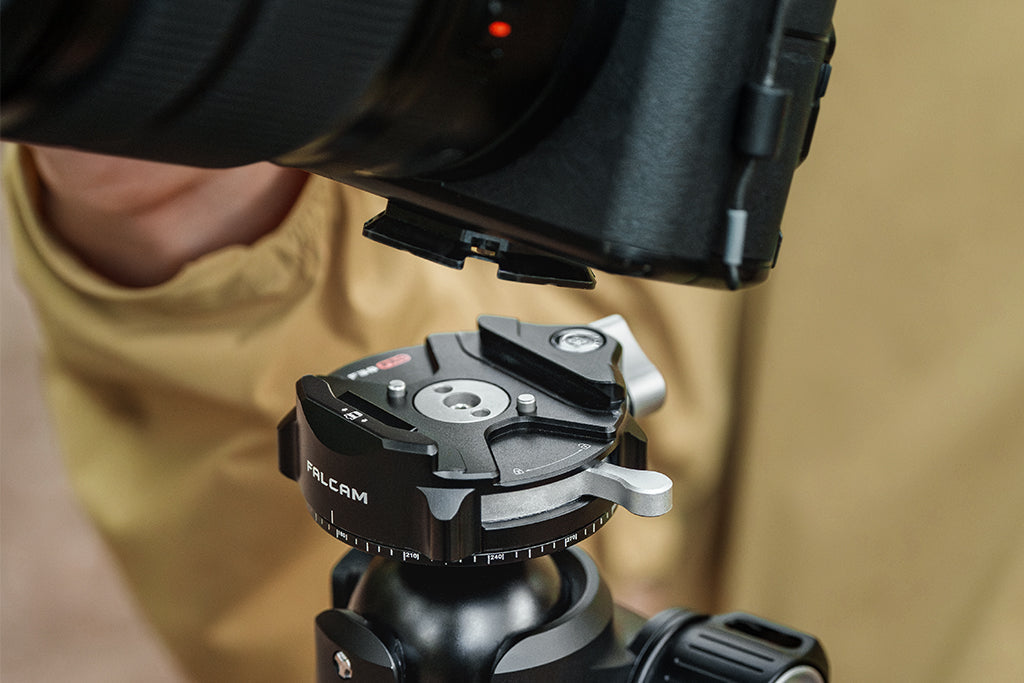
Traditional 1/4"-20 screw mounting (governed by ISO 1222:2010 Photography — Tripod Connections) is secure but slow. By integrating the Ulanzi F38 Quick Release Fluid Video Head E004GBA1 into your arm, you transition from a "threaded" workflow to a "click-and-lock" workflow.
The Workflow ROI Calculation:
- Traditional Thread Mounting: ~40 seconds per swap.
- F38 Quick Release: ~3 seconds per swap.
- Time Saved: 37 seconds per swap.
For a professional creator performing 60 equipment swaps per shoot across 80 shoots a year, this system saves approximately 49 hours annually. At a professional rate of $120/hr, that represents nearly $5,900 in recovered billable time.
Precision Positioning with Fluid Heads
For overhead rigs, a ball head can be frustrating because as soon as you loosen the tension, the camera flops over due to gravity. We recommend using a dedicated fluid head like the Ulanzi U-190 Mini Fluid Head 2895. Its hydraulic damping system provides counter-pressure, allowing you to make micro-adjustments to your framing without the camera "dropping" the moment you let go.
Advanced Rigging Tactics for Stability
Once you have the right hardware, your "rigging logic" determines the final safety of the system.
The "Zig-Zag" Rule
Never extend an arm in a perfectly straight line if you can avoid it. A straight horizontal reach maximizes the lever arm and the stress on the joints. Instead, use the arm's segments to "zig-zag" back toward the base. By keeping the heaviest part of the rig (the camera body) as close to the vertical support column as possible, you significantly reduce the torque on the base clamp.
Cable Management as a Stability Tool
A dangling HDMI or USB-C cable isn't just a visual mess; it's a pendulum. In our modeling, a heavy cable swinging under an overhead arm induces subtle, low-frequency vibrations that can ruin a long-exposure or high-resolution macro shot.
- Solution: Use the Ulanzi CO17 Super Clamp with Dual Ballhead Magic Arm C046GBB1 as an auxiliary cable guide. Secure your cables to the arm itself with strain relief loops. This prevents cable weight from pulling on the camera's ports and eliminates the "pendulum effect."
The "Tug Test" and Safety Checklist
Before every stream, we advocate for a three-point safety check:
- Audible: Did you hear the "Click" of the Ulanzi F38 Quick Release Fluid Video Head E004GBA1?
- Tactile: Perform the "Tug Test." Physically pull on the camera to ensure the locking pin is fully engaged.
- Visual: Check the locking indicator. On the F38 system, ensure the safety lock is in the "locked" position to prevent accidental trigger release.
Environmental and Safety Compliance
When building a professional studio, liability is a real concern. This is especially true for e-commerce streamers who may have employees or guests in the studio.
- Photobiological Safety: If your overhead rig also supports lighting, ensure your LEDs comply with IEC 62471:2006 to prevent eye strain or retinal hazards during long streaming sessions.
- Structural Integrity: Ensure your desk meets the weight-bearing requirements for the concentrated point-load of a heavy-duty clamp. A hollow-core "honeycomb" cardboard desk may fail under the compression of a high-torque overhead rig.
Methodology & Modeling Transparency
The technical insights in this article are derived from scenario modeling based on common creator setups. They are intended as decision-making aids, not universal guarantees.
| Parameter | Value | Unit | Rationale |
|---|---|---|---|
| Rig Mass ($m$) | 2.9 | kg | Full mirrorless + cage + lens + mic |
| Lever Arm ($L$) | 0.6 | m | Typical reach for a 60cm deep desk |
| Arm Segment Mass | 0.4 | kg | Aluminum section average |
| MVC Limit (Wrist) | 12.5 | N·m | ISO 11228-3 Male Average |
| Fatigue Threshold | 0.2 | ratio | 20% of MVC for sustained loading |
Boundary Conditions:
- Calculations assume the arm is held perfectly horizontal (worst-case torque).
- Vibration settling times assume a standard 1/4"-20 mounting interface and do not account for floor-borne resonance (e.g., heavy HVAC systems).
- Clamp stability assumes a solid wood or metal desk surface.
Building a Resilient Workflow
Selecting a heavy-duty arm for your overhead product demos is an investment in your "Infrastructure Layer." By moving away from flimsy, repurposed microphone stands and toward dedicated solutions like the Ulanzi TH04 Overhead Camera Mount T088, you eliminate the anxiety of equipment failure.
When you pair a robust arm with a damped Ulanzi U-190 Mini Fluid Head 2895 and the speed of the F38 quick-release ecosystem, you aren't just buying accessories. You are building a system that respects the laws of physics, protects your gear, and—most importantly—allows you to focus entirely on the product you are demonstrating.
In the world of professional unboxing, the best rig is the one you never have to think about once the "Live" light turns on.
Disclaimer: This article is for informational purposes only. Rigging and mounting heavy equipment involves inherent risks. Always consult the specific load ratings and safety manuals for your gear. Ensure your mounting surface is structurally sound before attaching high-torque arms. This content does not constitute professional engineering advice.