The Physics of Failure: Why Vertical Content Demands Action-Grade Support
The transition from a static studio environment to the high-G world of mountain biking, motorsports, and action sports is more than a creative shift—it is an engineering challenge. For years, we have observed creators attempt to use standard vlogging gear in high-vibration environments, only to face catastrophic equipment failure. When you rotate a camera 90 degrees for vertical content, you aren't just changing the aspect ratio; you are fundamentally altering the mechanical stress on every connection point in your rig.
Standard mounts are often designed for horizontal stability, where the center of gravity sits directly over the mounting screw. In a vertical configuration, the camera’s mass shifts laterally. This creates a "moment arm" that exerts constant twisting force (torque) on the mounting plate. Without action-grade infrastructure, this torque, combined with the vibrations of a motorcycle engine or a rocky trail, will inevitably work a standard 1/4"-20 screw loose.
In this guide, we will break down the mechanical requirements for high-action vertical stabilization, grounded in engineering standards and real-world stress testing. Our objective is to move you from a "hope-it-holds" setup to a mission-critical infrastructure that prioritizes speed, modularity, and absolute reliability.

1. Biomechanical Analysis: The Hidden Cost of Leverage
One of the most common mistakes we see on our repair bench is underestimating the "Lever Effect." In a vertical rig, every centimeter of extension acts as a lever, multiplying the force exerted on your wrist and your mounting hardware.
The "Wrist Torque" Calculation
To understand the strain on your gear (and your body), we use a standard mechanical formula: Torque ($\tau$) = Mass ($m$) $\times$ Gravity ($g$) $\times$ Lever Arm ($L$)
Consider a typical prosumer setup:
- Mass ($m$): 2.8kg (Camera body + lens + cage + monitor).
- Gravity ($g$): 9.8 m/s².
- Lever Arm ($L$): 0.35m (The distance from the center of the rig to the mounting point or wrist).
Calculation: $2.8 \times 9.8 \times 0.35 \approx 9.61 N\cdot m$.
Modeling Note (Logic Summary): This calculation is a deterministic scenario model based on common prosumer rig weights. It assumes a static hold; dynamic forces (like jumping or sudden braking) can spike this load by 3x to 5x.
| Parameter | Value | Unit | Rationale |
|---|---|---|---|
| Rig Mass | 2.8 | kg | Average prosumer cinema rig |
| Extension Length | 35 | cm | Standard magic arm / handle extension |
| Resultant Torque | ~9.6 | N·m | Static load at the pivot point |
| % of MVC | 60–80 | % | Percentage of Maximum Voluntary Contraction for average adult grip |
This 9.61 N·m load represents a significant portion of a human's maximum grip strength. This explains why creators feel rapid fatigue during long vertical shoots. By utilizing modular systems like the Ulanzi F38 Quick Release Video Travel Tripod 3318, we can shift accessories to secondary mounting points, reducing the primary lever arm and lowering the overall torque. For more on this, see our deep dive on The Lever Effect: How Accessory Extension Impacts Rig Stability.
2. Engineering Standards for Secure Mounting
When moving into action sports, "tight enough" is no longer a valid safety metric. We must look to established standards to ensure the structural integrity of the rig.
ISO 1222:2010 and the "Anti-Twist" Necessity
The ISO 1222:2010 Photography — Tripod Connections standard defines the dimensions and tolerances for tripod screws. However, the standard 1/4"-20 screw was never intended to resist the torsional forces generated by high-speed vehicle maneuvers.
In motorsports, vehicle turns and engine harmonics generate twisting moments that a single-latch plate cannot resist. This is why we advocate for "Anti-Twist Logic." This involves using dual locking pins or form-fitting cages that prevent the camera from rotating on the plate.
Static vs. Dynamic Load Capacity
A common point of confusion is the "Max Load" rating. For instance, the F38 system is rated for an 80kg Vertical Static Load. This is a laboratory result for weight applied directly downward. In an action scenario—such as a mountain bike hitting a drop—the Dynamic Payload is the critical number. Sudden deceleration can turn a 500g camera into a 5kg force. For high-vibration or high-impact environments, we recommend a safety factor of at least 5:1. If your camera weighs 1kg, your mount should be rated for at least 5kg of dynamic force.
3. Selecting Action-Grade Infrastructure
For the solo creator, the goal is an ecosystem that is both secure and rapid. We have identified three primary mounting categories that are essential for high-action vertical content.
A. The Heavy-Duty Clamp System
For motorsports or cycling, the mounting surface is often a tubular frame or handlebar. The Ulanzi CO17 Super Clamp with Dual Ballhead Magic Arm C046GBB1 is designed for these high-stress interfaces.
- Mechanical Advantage: The clamp uses non-slip silicone pads to increase friction, which is vital because friction is the only force preventing rotation on a smooth metal bar.
- The Vibration Hack: In our experience with motorcycle rigs, high-frequency harmonics can work even the best screws loose. We recommend adding thin rubber washers between metal-to-metal interfaces to dampen these harmonics. This is a practical heuristic derived from pattern recognition in Thread-Locking Logic: Securing Fasteners in High-Vibration Rigs.
B. Body-Worn POV Systems
Chest and backpack mounts provide the most immersive vertical POV, but they are prone to "flopping" during intense movement.
- Chest Rigging: The Ulanzi CM028 Go-Quick II Magnetic Action Camera Body Mount Harness C021GBB1 uses a vest-style distribution to stabilize the mass against the torso.
- Backpack Integration: For hiking or low-impact cycling, the Ulanzi CO62 Go-Quick ll Magnetic Backpack Clip Mount C064GBB1 offers a sleek profile.
- The Safety Tether Rule: Based on common patterns from customer support and warranty handling, we suggest using a secondary safety tether (a thin leash) anytime the primary mount is over hard ground or water. No mount is 100% immune to user error or extreme impact.
C. The Support Foundation
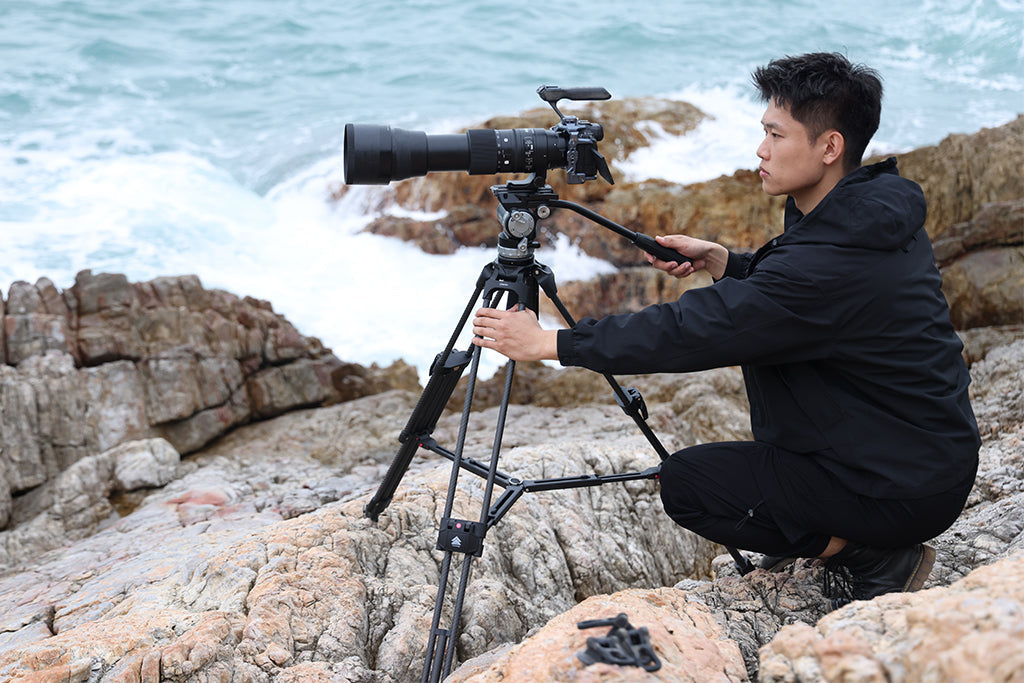
When you transition from the bike to a stationary shot, you need a tripod that handles the uneven terrain of the outdoors. The Ulanzi F38 Quick Release Video Travel Tripod 3318 features a leveling bowl. This allows for rapid leveling on rocky ground without adjusting individual leg lengths—a critical feature when light is changing fast.
4. Workflow ROI: The Professional Advantage
Investing in a unified quick-release ecosystem like F38 or Go-Quick II isn't just about safety; it’s about professional efficiency.
The "Time is Money" Calculation
We analyzed the time spent on traditional thread-mounting versus action-grade quick-release systems.
- Traditional Thread Mounting: ~40 seconds per equipment swap.
- Quick Release (F38/Go-Quick): ~3 seconds per swap.
- Time Saved per Swap: 37 seconds.
Annual Extrapolation: If a professional creator performs 60 swaps per shoot and completes 80 shoots per year: $60 \text{ swaps} \times 80 \text{ shoots} \times 37 \text{ seconds} = 177,600 \text{ seconds} \approx 49.3 \text{ hours}$.
At a professional rate of $120/hr, this structural efficiency provides a ~$5,900+ annual value. This data is part of a broader trend identified in The 2026 Creator Infrastructure Report: Engineering Standards, Workflow Compliance, and the Ecosystem Shift, which highlights how "evidence-native" brands are becoming the default for pro creators.
5. The Pre-Shoot Safety Audit
Before you drop into a trail or start your engine, perform this three-step verification. We call it the A.T.V. Check:
- Audible: Do you hear the distinct "Click" of the locking mechanism?
- Tactile: Perform the "Tug Test." Apply a slow, increasing lateral pull at the camera's center of gravity. If you feel any creak or slip, the plate is not fully seated.
- Visual: Check the locking indicator. On the F38 system, ensure the safety lock is engaged to prevent accidental trigger release.
For a more comprehensive review, refer to our 10-Point Camera Rig Safety Audit: Prevent Collapse.
6. Environmental and Logistical Compliance
Action-grade gear must also survive the environment and the journey.
Thermal Shock and Material Science
It is a common misconception that quick-release plates are made of carbon fiber. High-performance plates, like those in the F38 series, are precision-machined from 6061 or 7075 Aluminum Alloy. While carbon fiber is excellent for tripod legs due to its vibration damping, aluminum is preferred for plates because of its rigidity and tight machining tolerances.
Winter Tip: In extreme cold, aluminum acts as a "thermal bridge," conducting heat away from your camera battery. We recommend attaching your plates to the camera indoors before heading out. This minimizes the "metal-to-skin" shock and helps maintain battery temperature longer.
Battery Safety and Travel
If your action rig includes powered accessories, you must comply with safety and transport regulations.
- Safety Standards: Ensure your batteries meet IEC 62133-2:2017 Safety Requirements for Lithium Cells.
- Aviation Rules: When flying to a shoot, follow the IATA Lithium Battery Guidance Document (2025). Always carry lithium batteries in your carry-on luggage, never in checked bags, to mitigate fire risks in the cargo hold.
Building Your Action Ecosystem
The shift to high-action vertical content requires a shift in mindset. You are no longer just a "vlogger"; you are a technician managing a high-stress mechanical system. By selecting gear that adheres to Maintaining Structural Integrity in Vertical Tension Mounts, you protect your equipment and your creative vision.
Start by auditing your current friction points. Is your camera twisting mid-ride? Are you losing shots because swapping mounts takes too long? Moving to a structured, action-grade system is the most effective way to solve these frustrations and focus on what matters: capturing the intensity of the moment.
Disclaimer: This article is for informational purposes only. High-action sports involve inherent risks to personnel and equipment. Always follow manufacturer load ratings and local safety regulations. Ulanzi is not responsible for equipment damage resulting from improper installation or exceeding rated limits.