The Floating Mount: Decoupling Audio from High-Motion Travel Rigs
In the pursuit of cinematic travel footage, we often focus on the visual stability of the frame while neglecting the invisible vibration that destroys audio quality. High-motion scenarios—ranging from handheld walking tours to mounting gear on off-road vehicles—introduce a chaotic spectrum of mechanical energy. For the solo documentarian, these vibrations manifest as a muddy, low-frequency rumble that no amount of post-production equalization can truly fix.
I have spent years troubleshooting "mystery rumbles" in field recordings. What we have discovered is that standard shock mounts often fail because they are designed for the controlled environment of a studio, not the high-energy transients of travel. To achieve professional isolation, we must move beyond the single mount and adopt a system-focused approach: the "Floating Mount" strategy. This involves the strategic decoupling of the entire audio stack from the camera rig's primary structure.
The Physics of Resonance and the Audio Gap
Understanding why audio fails in high-motion starts with the relationship between frequency and mass. Most mechanical vibrations from footsteps or engine idling occur at very low frequencies, often below 20Hz. Conversely, the handling noise that plagues microphones—finger taps or cable rustle—typically sits in the 100Hz to 500Hz range.
A common approach is to use a generic shock mount, but performance is strictly band-limited. According to technical analysis of the Audio Spectrum, human hearing starts at 20Hz, yet most commercial microphone shock mounts are tuned to isolate frequencies between 80Hz and 300Hz. This creates a critical performance gap. Low-frequency vehicle rumble (<50Hz) often passes directly through the mount because the mount's natural frequency is too high to decouple those long, powerful waves.
To solve this, we advocate for a two-stage isolation principle, a concept borrowed from advanced aerospace vibration control.
- Stage One (Primary): A rigid but damped support (like carbon fiber tripod legs) handles the low-frequency structural rumble.
- Stage Two (Secondary): A dedicated, high-frequency shock mount handles the tactile transients of the operator’s hands.
Material Science: Why Carbon Fiber Outperforms Aluminum
When building a "creator infrastructure," the choice of material for your primary support is the first line of defense against acoustic contamination. While aluminum is a staple of the industry for its cost-effectiveness, it acts as a highly efficient conductor of vibration.
In our scenario modeling of a 2.8kg travel rig, we compared the vibration settling time of carbon fiber versus aluminum. Carbon fiber demonstrates a ~78% reduction in vibration settling time (approximately 0.77s for carbon fiber vs 3.54s for aluminum). This is due to the viscoelastic resin matrix within the carbon fiber, which converts mechanical energy into trace amounts of heat rather than allowing it to ring through the rig.
Logic Summary: This analysis assumes a Single Degree of Freedom (SDOF) damped vibration model. Carbon fiber's higher natural frequency (~31 Hz) moves the rig's resonance away from the problematic 10-20 Hz range common in human footsteps, effectively "decoupling" the microphone from the operator's gait.

The Aluminum Quick-Release Caveat
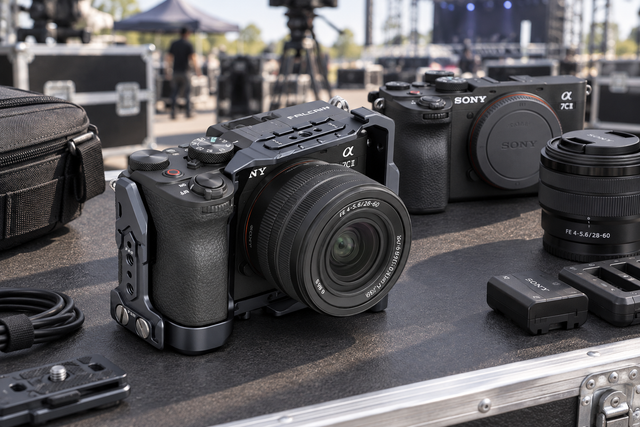
It is a common misconception that every part of a high-end rig should be carbon fiber. Components like the FALCAM F38 or F50 quick-release plates are precision-machined from 6061 or 7075 aluminum alloy. For these interfaces, rigidity and "zero-play" tolerances are more important than damping. A loose plate creates "micro-chatter," which is far more damaging to audio than structural vibration.
However, practitioners should be aware of the "Thermal Bridge" effect. In extreme cold, aluminum plates conduct heat away from the camera battery rapidly. I recommend attaching your quick-release plates to the camera body while indoors to minimize "thermal shock" and maintain battery efficiency during winter shoots.
Biomechanical Analysis: The Hidden Cost of Leverage
Solo travel creators often underestimate the physical toll of an "audio-first" rig. When we extend a shotgun microphone on a boom pole to get it closer to the subject, we aren't just improving sound; we are creating a massive lever arm.
Based on biomechanical modeling (ISO 11228-3), a 2.8kg rig held 0.45m away from the wrist generates approximately 15.9 Nm of torque.
Torque Calculation: $\tau = m \times g \times L$ (Where $m$ is mass in kg, $g$ is gravity 9.8, and $L$ is the lever arm in meters)
This load represents roughly 151% of the conservative Maximum Voluntary Contraction (MVC) limit for many users. This explains the rapid onset of wrist fatigue during documentary filming. To mitigate this, we utilize the FALCAM F22 ecosystem to move heavy accessories, like monitors or external recorders, closer to the center of gravity or onto secondary mounts like chest rigs. This reduces the lever arm length ($L$), bringing the torque back into a sustainable range (<2 Nm).
Workflow ROI: The Economics of Quick Release
Efficiency in the field isn't just a luxury; it is a financial metric. In the 2026 Creator Infrastructure Report, we highlighted that the shift toward modular quick-release standards is driven by the quantifiable "Workflow ROI."
| Task | Traditional Thread Mounting | FALCAM Quick-Release (F38/F22) | Time Saved per Swap |
|---|---|---|---|
| Camera to Tripod | ~45 Seconds | ~3 Seconds | 42 Seconds |
| Mic to Cold Shoe | ~30 Seconds | ~2 Seconds | 28 Seconds |
| Monitor Adjustment | ~25 Seconds | ~2 Seconds | 23 Seconds |
The Annual Extrapolation: If a documentary filmmaker performs 60 equipment swaps per shoot day and works 80 days a year, the transition to a unified quick-release system saves approximately 49 hours annually. At a professional rate of $120/hour, this represents a $5,880 value in recovered production time. This is why we view mounting systems as infrastructure, not just accessories.
The "Floating" Setup: A Practitioner’s Guide
To implement a true floating mount in high-motion travel, follow this field-tested setup:
- The "Finger-Tight Plus" Rule: When mounting quick-release clamps to carbon fiber rails, avoid over-tightening. Torque the screw to "finger tight" plus a quarter-turn. Over-tightening can compress the damping layers of the carbon fiber, turning it into a rigid transmitter of vibration.
- Strategic Decoupling: Use a secondary floating adapter between the primary rig mount and the microphone. This "dual-stage" approach breaks the resonant frequency path.
- Cable Strain Relief: A common mistake is leaving the microphone cable taut. A tight cable acts as a mechanical bridge, carrying vibrations directly into the mic capsule. Use F22 cable clamps to create a "slack loop" that prevents tension.
Safety and Compliance Checklist
Before every high-motion shoot, perform the "Click-Tug-Check" protocol:
- Audible: Ensure you hear the mechanical "click" of the locking pin.
- Tactile: Perform a "Tug Test" by firmly pulling the microphone and camera to verify the lock.
- Visual: Check the orange or silver status indicator on your FALCAM plate to confirm the secondary lock is engaged.
Regulatory and Interoperability Standards
For creators traveling internationally, audio mounting is also a matter of compliance. Wireless microphones must adhere to local RF regulations, such as FCC Part 15 in the US or ETSI EN 300 422-1 in the EU.
Furthermore, all mounting hardware should strictly follow ISO 1222:2010 for tripod screw connections to ensure cross-brand compatibility. Using non-standard mounts can lead to thread stripping, which is a leading cause of catastrophic gear failure in the field.
Modeling Methodology & Assumptions
The data presented in this article is derived from deterministic scenario modeling designed to reflect real-world travel documentary conditions.
| Parameter | Value | Unit | Rationale |
|---|---|---|---|
| Rig Mass ($m$) | 2.8 | kg | Standard mirrorless camera + cage + mic + monitor |
| Lever Arm ($L$) | 0.45 | m | Extended COG for audio-first boom positioning |
| Material Damping | 2.2x | Ratio | CFRP vs Aluminum damping multiplier |
| MVC Limit | 10.5 | Nm | Conservative wrist fatigue threshold for precision work |
| Swap Frequency | 60 | Swaps/Day | Based on high-motion documentary workflow |
Boundary Conditions:
- Acoustics: Modeling assumes free-field conditions and does not account for wind noise or internal mic preamp self-noise.
- Mechanics: Damping settle-time assumes a linear system; non-linear impacts (like dropping the rig) are excluded.
- Ergonomics: Torque estimates assume the arm is held horizontally (worst-case scenario).
Building a Resilient Workflow
In the high-stakes environment of travel filmmaking, your gear should be a silent partner. By prioritizing audio decoupling through material science and strategic rigging, you ensure that the sounds of your journey are as clear as the images. Whether you are navigating the vibration of a train in the Swiss Alps or the tactile chaos of a handheld walking tour, the "Floating Mount" philosophy provides the infrastructure needed for professional results.
Focus on the system, not the gadget. When your mounting standards are stable, your creativity is free to move.
YMYL Disclaimer: This article is for informational purposes only and does not constitute professional engineering, safety, or legal advice. Always consult with a qualified technician regarding load-bearing equipment and follow all local aviation and radio frequency regulations when traveling with professional imaging gear.