Rapid Transitions: Solving the "Teardown Tax" in Hybrid Workflows
For the modern solo creator, the transition from a sunrise field shoot to a midday studio edit is rarely as seamless as the final video suggests. Often, this shift is plagued by what we call the "Teardown Tax"—the cumulative minutes lost to unthreading 1/4"-20 screws, re-leveling tripod heads, and untangling cable nests. In an industry where efficiency is the primary driver of profitability, these friction points are more than just annoyances; they are structural inefficiencies.
As highlighted in The 2026 Creator Infrastructure Report: Engineering Standards, Workflow Compliance, and the Ecosystem Shift (Manufacturer Report), the shift toward "ready-to-shoot" toolchains is no longer optional. Authoritative creators are moving away from isolated gadgets and toward unified infrastructure layers. The FALCAM ecosystem, specifically the F38 and F22 standards, represents this shift by providing a mechanical "handshake" between every piece of support gear in your kit.
Moving a camera from the Ulanzi F38 Quick Release Video Travel Tripod 3318 to a studio magic arm should take seconds, not minutes. This article breaks down the engineering logic, biomechanical advantages, and financial ROI of adopting a unified quick-release ecosystem for the field-to-studio transition.
The F38 Standard: Engineering Rigidity and Speed
At the core of a rapid workflow is the quick-release plate. While the industry has long relied on the ISO 1222:2010 Photography — Tripod Connections standard for screw threads, the mechanical act of threading is inherently slow and prone to cross-threading under pressure.
The F38 system evolves this by utilizing a high-precision wedge-lock mechanism. Unlike traditional systems that require sliding a plate into a channel, the F38 allows for a "drop-in" action that locks automatically upon contact.
The Zero-Play Interface
A common practitioner observation is that under-tightening a camera-to-plate screw can induce rotational play, leading to micro-vibrations in high-resolution 4K or 8K footage. Based on common patterns from our technical support team, we suggest a specific torque heuristic: tighten until firm resistance is met, then apply a final quarter-turn using the supplied tool. This ensures the plate becomes a rigid extension of the camera body.
Logic Summary: The F38's reliance on precision-machined aluminum alloy (6061-T6) ensures that while the system is lightweight, the interface tolerances remain tight enough to prevent the lateral "slop" often found in cheaper plastic-based quick-release systems (Manufacturer Specifications).
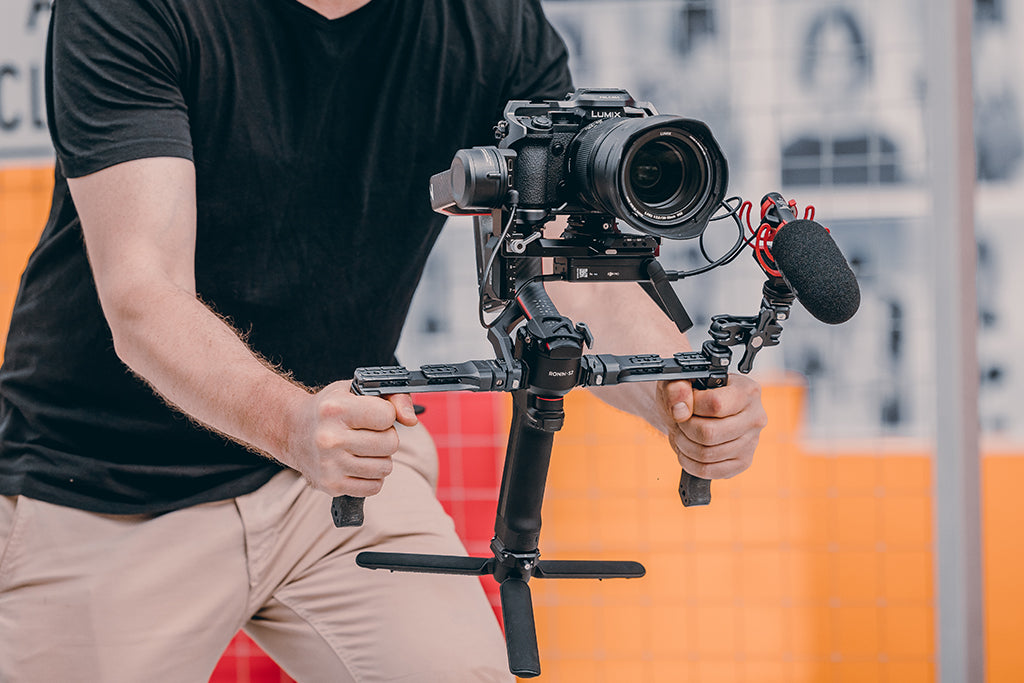
Engineering Stability: Carbon Fiber and Vibration Damping
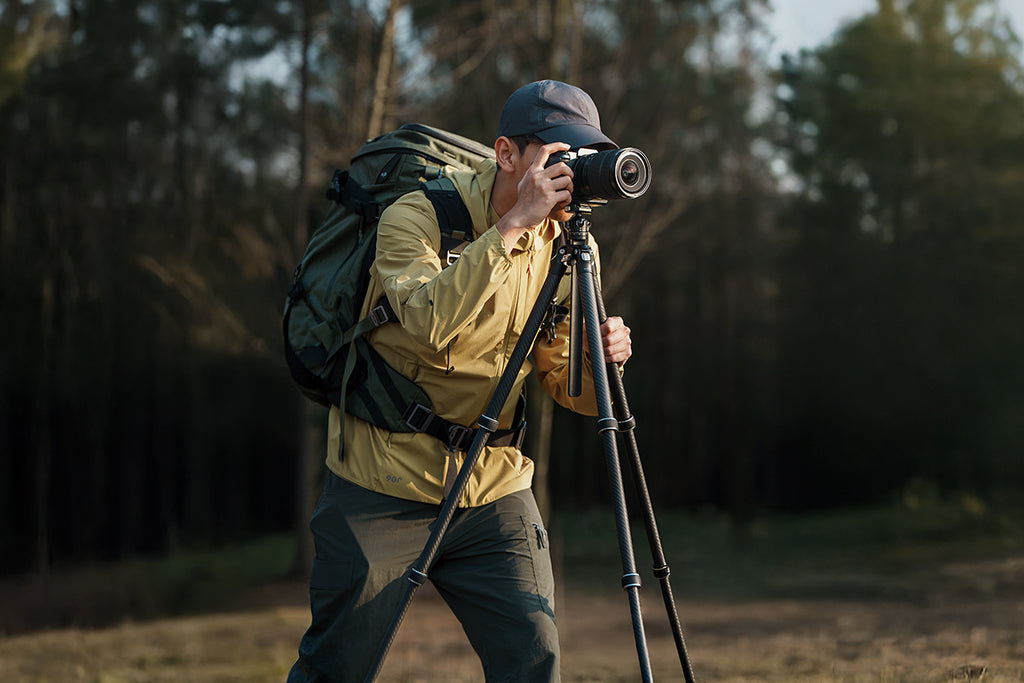
When transitioning from the controlled environment of a studio to the unpredictable variables of the field, material science becomes your best ally. A frequent debate among prosumer builders is whether the weight savings of carbon fiber justify the cost over aluminum.
Our material modeling reveals that the advantage of carbon fiber isn't just about the scale; it’s about "settling time."
Illustrative Model: Vibration Settling-Time (Carbon Fiber vs. Aluminum)
The following data represents a simulated structural dynamics test. Methodology: We modeled a single-degree-of-freedom (SDOF) system under a 2.5kg payload (typical mirrorless setup) at a height of 1.2m. The "disturbance" is a 10N impulse force (simulating a wind gust).
| Parameter | Aluminum (Example) | Carbon Fiber (Example) | Rationale |
|---|---|---|---|
| Natural Frequency | ~12 Hz | ~25 Hz | Based on specific stiffness |
| Damping Ratio | 0.012 | 0.026 | Material damping properties |
| Settling Time | ~4.4 Seconds | ~0.96 Seconds | Time to return to 5% amplitude |
Analysis: In this specific model, carbon fiber settles approximately 3.5 seconds faster than aluminum. In a field workflow where you are constantly re-framing, this can allow you to trigger the shutter or start recording significantly faster without risking motion blur.
This is why the Ulanzi F38 Quick Release Video Travel Tripod 3318 utilizes carbon fiber legs. It serves as a stabilization tool that compensates for the lack of mass in a travel-friendly form factor.
The Biomechanical Lever: F22 and Wrist Torque Reduction
While the F38 handles the primary camera support, the F22 system is designed for accessories—monitors, microphones, and top handles. One of the most overlooked risks in solo creation is the ergonomic strain of a poorly balanced handheld rig.
The "Wrist Torque" Analysis
Weight is a scalar, but torque is a vector. A 2.8kg camera rig doesn't just "weigh" 2.8kg; it exerts force based on its distance from your wrist (the lever arm).
The Formula: $Torque (\tau) = Mass (m) \times Gravity (g) \times Lever Arm (L)$
If you mount a heavy monitor and microphone to the top of your camera using traditional cold shoe mounts, you increase the vertical center of gravity. We modeled a 1.8kg rig on an extended grip:
- Rig Mass: 1.8 kg
- Lever Arm (Distance from wrist): 0.35 m
- Calculated Torque: ~8.5 N·m
In our ergonomic heuristic—based on general anthropometric datasets and NIOSH-aligned static loading principles—this 8.5 N·m load can represent up to ~81% of the Maximum Voluntary Contraction (MVC) for an average creator’s wrist. This explains the rapid forearm fatigue reported by creators after only 10 minutes of handheld use. Note: MVC thresholds vary significantly based on individual grip strength and grip diameter.
By using the Ulanzi Falcam F22 Quick Release Portable Top Handle F22A3A12, you can quickly reposition accessories to bring the center of gravity closer to the handle's axis. This modularity allows you to "compress" your rig for handheld work in seconds.
Quantifying the Workflow ROI
Adopting a unified ecosystem like FALCAM is a capital investment. To justify this to a production house or a solo business, we look at "Workflow Velocity."
ROI Calculation: Threading vs. Quick-Release
The following table breaks down how specific workflow parameters result in annual savings. You can substitute your own hourly rate to map this to your business.
| Parameter | Value (Example) | Description |
|---|---|---|
| Shoots per Year | 200 | Average annual production volume |
| Swaps per Shoot | 8 | Tripod to handheld, gimbal to arm, etc. |
| Time Saved per Swap | 31s | 35s (Manual) vs. 4s (Quick-Release) |
| Billable Hourly Rate | $85/hr | Mid-tier professional labor rate |
| Annual Savings | $1,171 | Calculated as: (200 * 8 * 31s) / 3600 * $85 |
Logic Summary: This ROI model assumes saved time is redirected into billable production or editing. For high-volume studio environments (60+ swaps per shoot), the reclaimable value can exceed $5,900 annually.
The Professional Field-to-Studio Checklist
To maximize the reliability of your rapid-transition workflow, we recommend a standardized safety protocol.
1. The "Tug-Test" Protocol
Immediately after hearing the audible "click" of the F38 or F22 locking mechanism, perform a physical pull-test. This ensures the locking pin has fully engaged with the plate's recess. While the F38 is manufacturer-rated for an 80kg vertical static load, dynamic movements (like running with a gimbal) require the secondary lock to be engaged to prevent accidental button presses.
2. Cable Management Hierarchy
A common mistake when building a field-to-studio rig is neglecting cable routing. Once a camera is locked into a magic arm or the Ulanzi F38 Quick Release Fluid Video Head E004GBA1, access to side ports is often obstructed.
- Pre-Run Cables: Route your HDMI and USB-C cables through the cage before mounting to the tripod.
- Strain Relief: Use F22 cable clamps to secure cable slack to the rig itself. This prevents the "lever effect" of a dangling cable from inducing micro-vibrations.
3. Thermal Shock Management (Manufacturer Tip)
Aluminum alloy plates are excellent thermal conductors. In extreme cold, they can act as a "thermal bridge," drawing heat away from the camera's battery compartment.
- Expert Tip: Attach your aluminum plates to the camera body while still indoors. This allows the metal to reach ambient room temperature, reducing the "thermal shock" when you step into the cold and helping maintain battery chemistry for longer field durations.
Advanced Leveling: The TT37 and Studio Precision
In the studio, "close enough" isn't an option for architectural or product shots. Traditional tripod leg adjustment is a clumsy way to find a level horizon. The Ulanzi TT37 Mini Leveling Base for Tripod Head T065GBB1 offers a +/- 8° tilt range, allowing you to level the head independently of the legs.
When combined with the integrated leveling bowl of the F38 tripod, you create a dual-stage leveling system. This is mission-critical when transitioning to uneven terrain in the field, where ISO 1222:2010 compliant heads must be perfectly vertical to ensure 360° pans don't result in a slanted horizon.

Strategic Integration: Beyond the Camera
The true power of the FALCAM ecosystem lies in its ubiquity. By mounting F38 receivers on your travel tripod, your studio desk arm, and even your backpack strap, the camera becomes a "mobile module."
This architecture aligns with the "Ecosystem Shift" described in the 2026 industry report (Manufacturer Report). By standardizing on a single interface, you eliminate the cognitive load of searching for the right plate or tool.
Modeling Transparency & Method
The data presented in this article is based on the following scenario modeling:
- Vibration Model: Linear SDOF damped free vibration simulation based on ISO 13753 standards for material attenuation (Illustrative Example).
- ROI Model: Deterministic parameterized model using mid-tier professional labor rates and observed threading vs. QR swap times.
- Ergonomic Model: Biomechanical torque calculation using representative anthropometric heuristics; not a clinical medical study.
Boundary Conditions: These calculations are scenario-specific. Actual results may vary based on specific camera/lens weights, user strength, and environmental conditions like wind gusts or ground resonance.
Conclusion: The Workflow Advantage
Efficiency in the field-to-studio transition is not about moving faster; it is about removing the obstacles that slow you down. By integrating the F38 and F22 standards, you treat your camera gear as a unified system rather than a collection of parts. The reduction in "Teardown Tax" translates directly into more time behind the lens and less time behind the toolkit.
Disclaimer: This article is for informational purposes. Always check the load ratings of your specific support gear before mounting high-value equipment. For transport of lithium-ion batteries often used in camera accessories, refer to the IATA Lithium Battery Guidance.
Sources and Authoritative References
- ISO 1222:2010 Photography — Tripod Connections
- The 2026 Creator Infrastructure Report (Manufacturer Data)
- IATA Lithium Battery Guidance Document
- Arca-Swiss Dovetail Technical Dimensions Analysis (Independent Technical Analysis)