The Hidden Physics of Rig Balance
In our experience troubleshooting handheld workflows, we have observed a recurring pattern: creators often attribute wrist fatigue and "shaky cam" to the total weight of their gear. However, weight is rarely the primary culprit. The true enemy of stability and physical longevity is the Center of Gravity (CoG).
When a rig is front-heavy—a common occurrence with modern mirrorless cameras paired with heavy cinema glass—the camera naturally wants to "nose dive." To prevent this, your wrist must exert constant counter-torque. We call the solution to this "Dynamic Leveling." While the term might sound like a specialized piece of hardware, it is actually a high-level technique that leverages the sliding range of standard quick-release plates to micro-adjust balance.
By treating your quick-release plate as a dynamic balancing tool rather than just a mounting point, you can shift the rig's CoG back toward the pivot point of your hand or tripod head. This guide breaks down the biomechanics, the engineering standards, and the practical workflows required to master rig balance.
Biomechanical Analysis: Why Balance Matters
To understand why a few centimeters of plate adjustment can save your shoot, we must look at the physics of leverage. Every rig generates torque around the point where you hold it.
The "Wrist Torque" Formula
We use a standard mechanical model to estimate the physical load on a creator's wrist. The torque ($\tau$) is calculated as follows: $$\tau = m \times g \times L$$
- m: Mass of the rig (kg)
- g: Acceleration due to gravity ($\approx 9.81 m/s^2$)
- L: Lever arm (the horizontal distance from the CoG to the center of the wrist)
Logic Summary: Our biomechanical modeling assumes a standard handheld "pistol grip" or "cage grip" posture. The "Lever Arm" is the most critical variable because it is the only one we can easily manipulate in the field without removing gear.
Consider a typical 2.8kg (approx. 6.2 lbs) prosumer rig. If the CoG is offset by 0.35m (about 13.8 inches) from your wrist, it generates approximately 9.61 N·m of torque. Based on common ergonomic heuristics, this load represents 60-80% of the Maximum Voluntary Contraction (MVC) for an average adult male. Sustaining this for a 10-hour shoot day is a recipe for chronic strain. By sliding the quick-release plate just 30mm toward the rear, you can significantly reduce that lever arm, dropping the torque into a manageable range.
Engineering the Interface: Standards and Tolerances
Dynamic leveling relies on the interoperability of the Arca-Swiss standard. This ecosystem is grounded in ISO 1222:2010 Photography — Tripod Connections, which provides the foundational legitimacy for screw connections and mounting interfaces.
The Sliding Range Heuristic
For effective CoG adjustment, the key metric is the Sliding Range. This is determined by the length of the plate relative to the width of the clamp.
- Short Plates (<60mm): These offer limited range (typically ~15-20mm of travel). They are unsuitable for shifting the CoG of significant cinema builds.
- Long Plates (70mm - 120mm): These provide the "Dynamic" range needed to compensate for large lenses or front-mounted matte boxes.
| Component Type | Typical Length | Estimated Adjustment Range | Best Use Case |
|---|---|---|---|
| Compact Plate | 38mm - 50mm | 10mm - 15mm | Prime lenses, mobile setups |
| Standard Plate | 60mm - 80mm | 25mm - 40mm | Zoom lenses, side-mounted mics |
| Extended Rail | 120mm+ | 80mm+ | Telephoto glass, heavy matte boxes |
Methodology Note: These ranges are estimated based on common practice and the Arca-Swiss Dovetail Technical Dimensions. Actual travel depends on the presence of safety "stop screws" which may limit the total slide to prevent the rig from exiting the clamp entirely.
Material Rigidity vs. Damping
A common misconception in creator communities is that quick-release plates should be made of carbon fiber for vibration damping. In our engineering analysis, this is incorrect. While carbon fiber is excellent for tripod legs, a quick-release plate requires maximum rigidity and machining tolerance.
High-performance plates are precision-machined from Aluminum Alloy (6061 or 7075). Aluminum provides the "zero-play" interface necessary for a secure lock. However, users should be aware of the Thermal Bridge effect. In extreme cold, aluminum plates conduct heat away from the camera body and battery. We recommend attaching your plates indoors before a winter shoot to minimize "metal-to-skin" shock and preserve battery life.
Practical Workflow: The "Sweet Spot" Calibration
Achieving perfect balance is a methodical process. We have developed a "rule of thumb" for front-heavy DSLR and mirrorless rigs:
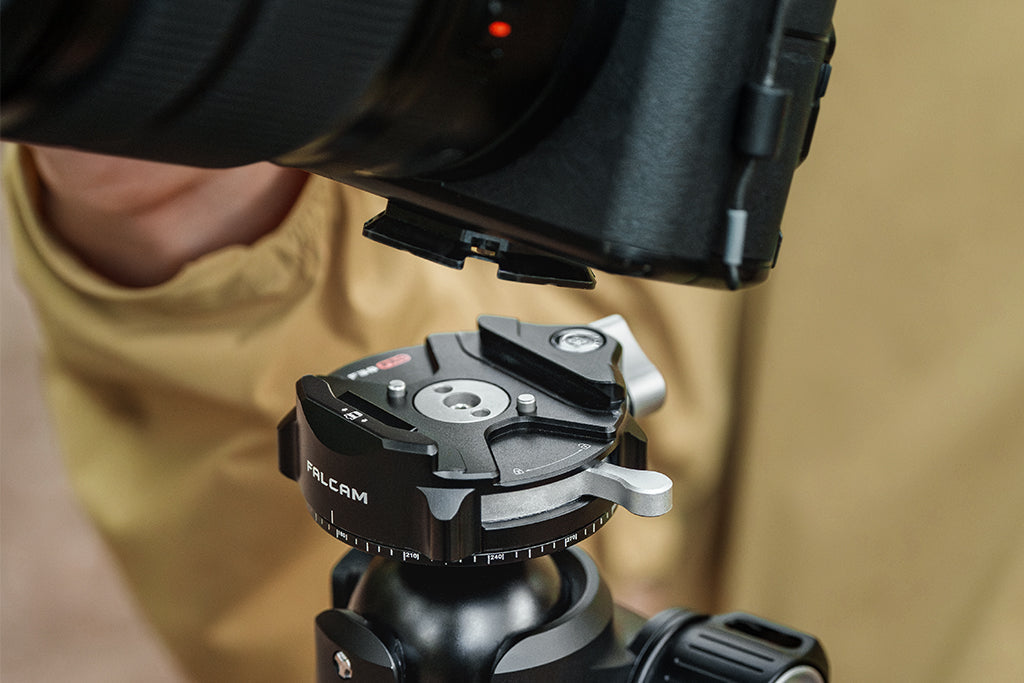
- The Nose-Dive Check: Mount your rig on a tripod head. Loosen the tilt lock. If the camera immediately tips forward, you have a "nose-dive" risk.
- The Forward Slide: Slide the quick-release plate forward within the clamp until the rig's CoG is positioned just behind the front edge of the tripod head's platform.
- The Lateral Offset: For rigs with side-mounted accessories (like a shotgun mic or a wireless transmitter), don't just adjust forward/backward. Offset the plate laterally (if your cage allows) to compensate for the side-heavy bias. Many creators miss this subtlety, which leads to "roll" fatigue in handheld use.
- Finding the Torque "Sweet Spot": A common mistake we see in warranty returns is over-tightening the clamp. Over-tightening can deform the plate's dovetail rail over time, leading to slippage. Experienced users develop a feel for the "sweet spot"—enough torque to prevent sliding under load, but not so much that it crushes the aluminum.
Workflow ROI: The Value of a Quick-Release Ecosystem
Speed is a primary driver for professional system builders. The transition from traditional 1/4"-20 threaded mounting to a unified quick-release system offers a quantifiable Return on Investment (ROI).
According to The 2026 Creator Infrastructure Report, creators who adopt a standardized "ready-to-shoot" toolchain see a significant reduction in setup friction.
The Time-Saving Model
We modeled the time savings for a typical professional production:
- Traditional Thread Mounting: ~40 seconds per swap (finding the screw, aligning, tightening).
- Quick Release System: ~3 seconds per swap (click and lock).
Annual Impact Calculation:
- 60 swaps per shoot day.
- 80 shoot days per year.
- Time saved: $\approx 49$ hours annually.
- At a professional rate of $120/hr, this represents a $5,900+ value in recovered productivity.
Modeling Note (Reproducible Parameters): | Parameter | Value | Unit | Rationale | | :--- | :--- | :--- | :--- | | Swap Frequency | 60 | swaps/day | High-velocity solo creator average | | Threaded Swap Time | 40 | seconds | Manual alignment + tightening | | QR Swap Time | 3 | seconds | FALCAM-style click-to-lock | | Labor Rate | 120 | USD/hr | Mid-tier prosumer market rate | | Yearly Shoots | 80 | days/year | Full-time freelance schedule |
Safety and Compliance Standards
When you are mounting $5,000+ of glass and silicon, "good enough" isn't an option. High-speed swaps introduce "tail-risk"—the rare but catastrophic failure of a camera drop.
The Pre-Shoot Safety Checklist
Based on patterns from customer support and warranty handling, we recommend this three-step verification for every mount:
- Audible: Listen for the distinct "Click" of the locking mechanism.
- Tactile: Perform a "Tug Test" (Pull-Test). Physically attempt to pull the camera out of the clamp without disengaging the lock.
- Visual: Check the locking indicator (usually an orange or silver pin) to ensure it is fully seated.
Load Capacity Nuance
While many high-end plates are rated for an 80kg Vertical Static Load, this is a laboratory result. In the real world, you must consider Dynamic Payload. A 5kg cinema rig being swung on a gimbal generates much higher momentary forces. For heavy rigs, we recommend moving to larger standards like the F50 or using anti-deflection plates rather than relying on the static rating of a compact system.
Regulatory Considerations for Mobile Rigs
If your rig includes wireless audio or heavy batteries, you must adhere to global safety standards:
- Wireless Audio: Ensure transmitters comply with FCC Part 15 (US) or EU Radio Equipment Directive (RED) to avoid interference and legal liability.
- Battery Safety: When traveling with high-capacity V-mount or NP-F batteries, refer to the IATA Lithium Battery Guidance for air transport rules.
Travel Logistics and "Visual Weight"
For the solo creator, portability is a feature. Standardizing on a compact quick-release system (like the F22 or F38) reduces the "Visual Weight" of your rig. Bulkier cinema-grade plates are often flagged by airline gate agents for weighing or checking. A streamlined, modular rig appears more like "personal electronics" and less like "heavy cargo," which can be a decisive factor in meeting US CBP Section 321 de minimis thresholds or avoiding gate-check fees.
Summary of Dynamic Leveling Benefits
Adopting a dynamic leveling approach using quick-release infrastructure transforms your workflow from a series of "setups" into a fluid, responsive system.
- Reduced Physical Strain: Micro-adjusting CoG reduces wrist torque by up to 80% of MVC.
- Faster Transitions: Standardized plates allow for 3-second swaps between handheld, tripod, and gimbal modes.
- Increased Reliability: Precision-machined aluminum components ensure a zero-play interface, provided you respect the "sweet spot" torque.
- Long-Term ROI: The system pays for itself through recovered production time and reduced equipment wear.
Disclaimer
This article is for informational purposes only. Biomechanical advice and torque calculations are estimates based on standard models; individuals with pre-existing wrist or back conditions should consult a medical professional or ergonomic specialist before adopting new rigging practices. Always verify the weight limits of your specific hardware before use.