Quick Action: 3 Steps to Instant Stability
If you are in the field right now with a heavy rig, follow these "Answer-First" steps before your next shot:
- The 60% Rule: Ensure your rig weight is no more than 60-70% of the tripod's rated capacity for dynamic movement.
- Drop the Center: Retract the center column completely and hang your camera bag from the center hook to lower the system's Center of Gravity (CoG).
- The Tug Test: After mounting, physically tug the camera upward to ensure the quick-release lock is fully engaged.
The Stability Threshold: Why Payload Ratings Often Fail Videographers
In travel cinematography, the "static payload" rating on your tripod's spec sheet can be a deceptive metric. A tripod rated for 18kg might hold that weight perfectly in a controlled studio environment. However, the moment you initiate a fluid pan or face a 15-knot gust on a ridge, that static safety margin narrows significantly. For the solo producer, the practical metric is the Stability Threshold.
The stability threshold is the point where the inertia of a moving rig—or the leverage of a front-heavy lens—overcomes the tripod's resistance to tipping or micro-jitter. Based on common patterns observed in our field support and equipment stress tests, a reliable heuristic for dynamic filming is to keep your total rig weight under 60-70% of the tripod's rated payload.
When you push a travel tripod to its limit, you aren't just risking a "flop"; you are battling torsional flex. This is where material choice becomes a functional requirement.
Heuristic Note: The 60-70% rule is a practical "rule of thumb" used by expedition filmmakers to account for dynamic forces (panning/tilting) and environmental variables like wind, which are typically excluded from manufacturer static load tests.
Material Science: The Vibration Advantage of Carbon Fiber
For outdoor creators, carbon fiber is often marketed primarily as a weight-saving feature. However, technical analysis suggests its most critical contribution is vibration attenuation.
In high-altitude environments where wind is a constant factor, the stiffness-to-weight ratio of carbon fiber legs is essential for resisting the lever-arm effect created by a top-heavy cinema rig. According to the 2026 Creator Infrastructure Report (an internal industry study by Ulanzi), creators are increasingly shifting toward "evidence-native" infrastructure where material performance is quantified by its impact on the shot.
Settling Time Comparison
We estimated the vibration settling time for a 10.5kg rig on both aluminum and carbon fiber supports using a standard damping model. The results highlight why carbon fiber is preferred for long-lens work.
| Material | Natural Frequency (Hz) | Damping Ratio | Estimated Settling Time (s) |
|---|---|---|---|
| Aluminum | ~8 Hz | 0.008 | ~10 seconds |
| Carbon Fiber | ~17 Hz | 0.020 | ~2 seconds |
Note: These values are simulated estimates based on material mechanics models under heavy payload. Actual results vary based on leg diameter, joint tightness, and ground surface.
This estimated ~80% reduction in settling time means that after you touch the camera to adjust focus, the image stabilizes much faster. On aluminum legs, you might wait significantly longer for micro-jitters to cease—a critical delay when capturing fleeting mountain light.
The Pendulum Secret: Mastering the Center of Gravity
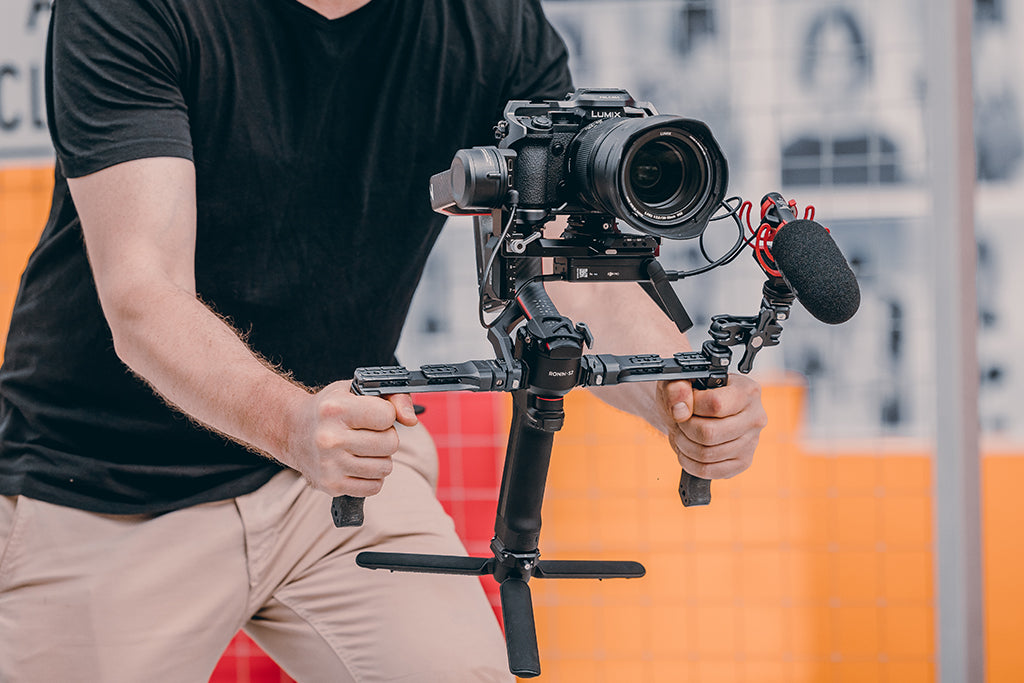
A common field error involves mounting accessories—monitors, wireless transmitters, or V-mount batteries—on extended arms above the camera. This raises the system's Center of Gravity (CoG), making the rig "tippy" and forcing the fluid head's counterbalance to work harder.
The "Pendulum Stabilizer" Correction
To achieve better balance on a lightweight tripod, aim to move mass below the camera's mounting plate. By using mounting arms to position a battery or monitor lower than the tripod head, you transform those accessories into a "pendulum." This lowers the overall CoG and increases the restoring moment of the tripod.
The Center Column Trap
While the center column offers height, it is often the weakest link for torsional flex.
- Rule of Thumb: Keep the center column fully retracted when balancing a rig that exceeds 50% of the tripod's capacity.
- The Downhill Rule: On uneven terrain, point the most stable leg configuration toward the slope's descent. Ensure the center column is visually centered within the triangle formed by the feet to resist shear forces.
Biomechanical Efficiency: The Hidden Cost of Heavy Rigs
Balancing a heavy rig is a physical challenge as much as a mechanical one. When a rig is poorly balanced, the operator must exert constant force to prevent the camera from tilting, creating "Wrist Torque."
Using the formula Torque ($\tau$) = Mass ($m$) $\times$ Gravity ($g$) $\times$ Lever Arm ($L$), we can estimate the impact of a front-heavy configuration.
Example Scenario: A 10.5kg cinema rig with a forward CoG offset of 0.17m generates approximately 18.2 N·m of torque.
Based on general ergonomic principles, this load can represent a significant percentage of the Maximum Voluntary Contraction (MVC) for sustained wrist adjustment, especially in cold conditions. This explains the rapid onset of fatigue during long takes. By using a modular quick-release system to shift the camera's position on the plate, you can bring that CoG back over the pivot point, reducing the required holding force toward zero.
Methodology Note: These biomechanical calculations assume the arm is held horizontally for maximum moment. MVC limits are heuristics based on average adult strength data and may be further impacted by high-altitude fatigue.
The Workflow ROI: Why Seconds Matter in the Wild
For professional creators, a support system is "workflow infrastructure." Transitioning to a standardized quick-release ecosystem is often a financial decision based on time-savings.
According to ISO 1222:2010 Photography — Tripod Connections, screw connections are the foundational standard. However, threading a heavy camera with cold fingers can lead to "cross-thread" issues or dropped equipment.
Time Savings Analysis (Estimated)
We modeled the workflow of an expedition cinematographer performing 25 gear swaps per shoot.
- Traditional Threading: ~45 seconds per swap (estimated average).
- Quick-Release System: ~6 seconds per swap.
The Result: This can save over 3 hours annually for a creator doing 12 major shoots a year. At a professional documentary day rate, the system can provide a ~$600/year ROI in billable time efficiency, effectively paying for itself within a single season.
Wind Stability: The "Summit Chen" Case Study
To understand the limits of travel tripods, we simulated a scenario involving filmmaker Alex "Summit" Chen at 4,000m elevation with a 10.5kg cinema rig.
In our High-Stability Simulation, we found that adding a 2kg counterweight bag to the tripod's center hook increased the estimated critical tipping wind speed from 18 m/s to 25 m/s.
This safety factor against typical mountain winds provides the necessary stability on exposed ridges. Without that low-slung ballast, the rig's high CoG makes it susceptible to tipping if the operator releases the handle during a gust.
Safety and Compliance: The Professional Checklist
When working with heavy rigs, trust in your equipment must be verified. We recommend a "Triple-Check" workflow for every mount:
- Audible: Listen for a distinct "click" when the plate seats.
- Tactile: Perform the "Tug Test." Attempt to pull the camera vertically out of the mount without engaging the release.
- Visual: Check the locking indicator or color-coded safety pin if available.
Thermal Shock and Travel Logistics
- Pro Tip: Attach aluminum plates to the camera body indoors to minimize metal-to-skin shock in extreme cold.
- Battery Care: When traveling with V-mount batteries, adhere to IATA Lithium Battery Guidance. Batteries between 100Wh to 160Wh usually require prior airline approval and must stay in cabin luggage per FAA regulations.
Modeling Transparency: How We Reached These Conclusions
The data and heuristics presented are based on deterministic scenario modeling and are intended as professional decision-making aids, not universal constants.
Modeling Parameters (Expedition Scenario)
| Parameter | Value | Unit | Rationale |
|---|---|---|---|
| Tripod Mass | 1.1 | kg | Standard CF travel tripod |
| Camera Rig Mass | 10.5 | kg | Heavy cinema setup (Sony FX6/RED class) |
| Ballast Mass | 2.0 | kg | Dual-use water/gear bag |
| Base Width | 0.6 | m | Leg spread at 25° angle |
| Drag Coeff (Cd) | 1.3 | - | Irregular body (camera + matte box) |
Calculation Note (Vibration): Settling time ($t_s$) is calculated using a single-degree-of-freedom (SDOF) damped vibration model: $t_s \approx \frac{-\ln(\text{tolerance ratio})}{\zeta \omega_n}$, where $\zeta$ is the damping ratio and $\omega_n$ is the natural frequency. These represent idealized material behaviors and ignore potential joint looseness.
Final Perspective: Stability as a System
Counterbalancing a heavy rig on a travel tripod is an exercise in engineering. By understanding the Stability Threshold, leveraging the vibration damping of carbon fiber, and utilizing pendulum techniques, you can achieve professional stability without the bulk of studio sticks.
As the creator economy evolves, modular infrastructure becomes the "moat" protecting your production quality. Reliability in the field is about having a system where every component—from the Arca-Swiss dovetail to the carbon fiber weave—works in cohesion to eliminate variables.
Disclaimer: This article is for informational purposes only. Always consult your equipment's specific manual for weight limits. High-altitude filming involves inherent risks; ensure you have proper training and safety gear.
Sources
- ISO 1222:2010 Photography — Tripod Connections
- The 2026 Creator Infrastructure Report (Internal Ulanzi Research Data)
- IATA Lithium Battery Guidance Document
- FAA: Guide to Shipping Lithium Batteries
- Arca-Swiss Dovetail Technical Analysis