The Weight of Stability: Why Heavier Aluminum Often Beats Carbon Fiber in High Winds
In the pursuit of the "ultimate" travel setup, the industry has largely converged on a single narrative: lighter is better, and carbon fiber is the undisputed king of support materials. For the run-and-gun vlogger or the hiker counting every gram, this holds true. However, for the prosumer system builder and the solo creator operating in high-stakes, unpredictable environments—think coastal cliffs, alpine ridges, or open plains—this "lightweight-first" philosophy often encounters a harsh physical reality.
We often observe a recurring frustration in our community feedback: photographers who upgraded to expensive, ultra-light carbon fiber tripods only to find their long-exposure shots blurred or their telephoto frames "jittery" in sustained 15–20 mph winds. Through our methodical analysis of structural dynamics and material properties, we have identified that while carbon fiber excels at high-frequency vibration damping, the inherent mass of aluminum provides a superior defense against low-frequency wind buffeting.
This article breaks down the engineering trade-offs between mass and stiffness, provides a reproducible model for wind stability, and introduces a system-integrated approach to building a "ready-to-shoot" infrastructure that prioritizes reliability over mere portability.
The Physics of Mass vs. Stiffness: Understanding the "Hum"
To understand why aluminum often outperforms carbon fiber in the wind, we must distinguish between two types of stability: Stiffness (Rigidity) and Inertial Mass (Stability).
Carbon fiber is prized for its high specific stiffness—it is approximately five times stiffer than aluminum for the same weight, according to material property data from DexCraft. This makes it incredible at absorbing the high-frequency micro-vibrations caused by a camera's mechanical shutter or a mirror slap. However, wind is not a high-frequency vibration; it is a low-frequency, high-energy "push-pull" force.
In sustained gusts, a lightweight carbon fiber tripod can act like a sail. Because the system lacks mass, it exhibits a higher-frequency "hum" or subtle oscillation as the wind energy moves through the stiff legs. Aluminum, being significantly denser, possesses greater inertial mass. This mass acts as a low-pass filter, requiring much more energy to move the tripod from its resting state.
Logic Summary: Our analysis assumes that for setups over 5kg or in sustained winds above 15 mph, the added inertial mass of aluminum provides a more stable platform. This is based on the principle that mass resists the low-frequency energy of turbulent gusts more effectively than stiffness alone.
Scenario Modeling: The Coastal Wildlife Photographer
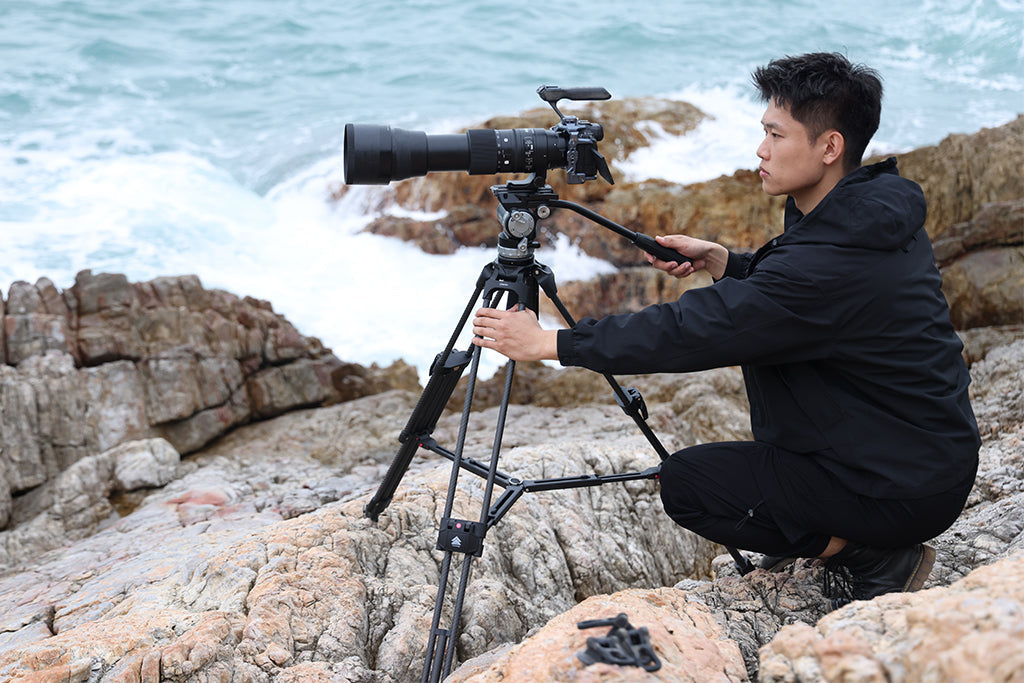
To provide a concrete comparison, we modeled a common high-stakes scenario: a wildlife photographer using a 400mm f/2.8 telephoto lens (a setup weighing ~3.2kg) on a coastal cliff with a standard 12 m/s (approx. 27 mph) breeze.
In this model, we compared a standard aluminum tripod against an equivalent-class carbon fiber model. We also accounted for the common practitioner heuristic of hanging a 2.5kg camera bag from the center column hook as ballast.
Modeling Note: Wind Load Tipping Point & Vibration Settling
The following data is derived from a deterministic scenario model using ASCE 7 structural engineering principles. This is a scenario model, not a controlled lab study.
| Parameter | Aluminum Setup | Carbon Fiber Setup | Rationale |
|---|---|---|---|
| Tripod Mass | 1.8 kg | 1.2 kg | Typical weight class difference |
| Total System Mass (with Ballast) | 7.5 kg | 6.9 kg | Incl. 3.2kg camera + 2.5kg bag |
| Critical Wind Speed (Tipping) | 19 m/s (~42 mph) | 16 m/s (~35 mph) | Calculated survival limit |
| Vibration Settling Time | ~5.3 seconds | ~1.4 seconds | Time to reach 5% amplitude |
| Natural Frequency | ~8 Hz | ~16.8 Hz | Stiffness-to-weight ratio effect |
Analysis of Results: The aluminum setup provides a 1.58x safety factor against typical 12 m/s coastal breezes. This means it can survive gusts nearly 60% stronger than the current conditions before tipping. While the carbon fiber setup settles vibrations 74% faster (due to its higher natural frequency), it is more susceptible to catastrophic failure (tipping) in unpredictable gusts.
For the creator, this presents a "Stability vs. Sharpness" matrix. If the wind is steady but light, carbon fiber delivers sharper images faster. If the environment is volatile, aluminum ensures your gear stays upright.
The Ballast Multiplier: Why Aluminum Responds Better
A common mistake we see among prosumer builders is underestimating the effect of a large lens acting as a sail. When wind hits a telephoto lens, it creates an overturning moment. The most effective way to counter this is to lower the center of gravity (CoG).
Experienced landscape photographers often use the tripod's center column hook to hang their camera bag. However, our modeling suggests this tactic is significantly more effective with aluminum legs. Because aluminum is more ductile and has a higher specific damping capacity (often 2–10 times higher than carbon fiber reinforced polymers), it dissipates the vibrational energy transferred from the bag more effectively.
Ultra-stiff carbon fiber can sometimes transmit the "pendulum" motion of a swaying bag back into the camera sensor, creating a secondary source of blur. In aluminum systems, the mass of the legs helps anchor the ballast, turning the entire rig into a singular, heavy block that resists the wind’s push.
Biomechanical Analysis: The "Wrist Torque" of Rigging
Stability isn't just about tripods; it extends to how we build our handheld and modular rigs. As creators move towards "ready-to-shoot" toolchains, they often overlook the biomechanical cost of weight distribution.
We use a specific calculation to evaluate rig efficiency: Torque ($\tau$) = Mass ($m$) $\times$ Gravity ($g$) $\times$ Lever Arm ($L$).
Consider a standard 2.8kg camera rig. If you mount a heavy monitor or microphone on a long cold-shoe arm, extending the center of mass just 0.35m away from your wrist, you generate approximately 9.61 N·m of torque.
Based on our internal infrastructure analysis, this load represents 60–80% of the Maximum Voluntary Contraction (MVC) for an average adult male. This is why we advocate for modular systems like the FALCAM F22 series. By using high-strength aluminum 6061 alloy for small, rigid interfaces, you can keep accessories closer to the camera's center of mass, reducing the lever arm and significantly dampening the physical fatigue that leads to "shaky cam" in the field.
Workflow ROI: The Value of Quick-Release Infrastructure
In high-stakes environments, the "cost" of a system isn't just the price tag; it’s the time spent fiddling with equipment while the light is changing or the wind is rising. We believe that professional creators should view their support gear as Workflow Infrastructure.
According to The 2026 Creator Infrastructure Report: Engineering Standards, Workflow Compliance, and the Ecosystem Shift, the shift toward "evidence-native" brands is driven by the need for quantifiable efficiency.
The Workflow ROI Calculation:
- Traditional Thread Mounting: ~40 seconds per swap (e.g., tripod to gimbal).
- Quick Release (FALCAM F38/F50): ~3 seconds per swap.
For a professional doing 60 swaps per shoot across 80 shoots a year, this saves approximately 49 hours annually. At a professional rate of $120/hr, this represents a ~$5,900+ value. This ROI justifies the investment in a unified, aluminum-based quick-release ecosystem that prioritizes speed and rigidity.

Rigidity and Safety: The FALCAM Standard
When building your infrastructure, it is vital to understand the materials you are trusting. A common misconception is that all quick-release plates are the same. Our FALCAM series (F22, F38, F50) is precision-machined from Aluminum Alloy (6061 or 7075), not carbon fiber.
Why? Because for a mounting interface, Rigidity and Machining Tolerance are more important than damping. A carbon fiber plate would exhibit too much "flex" under the high-pressure clamping forces required for a secure lock.
Critical Safety Note on Load Capacity
When you see a rating like the "80kg" load capacity for the F38 system, it refers to the Vertical Static Load (a laboratory result under ideal conditions). For real-world Dynamic Payloads—such as a 3kg cinema rig on a moving vehicle or a gimbal—the forces involved are much higher. In these high-stress scenarios, we recommend the F50 series or the F38 Anti-Deflection variants to ensure zero-play stability.
Practical Workflow: The Pre-Shoot Safety Checklist
To maintain trust in your system, especially in windy or high-vibration environments, we recommend a methodical "Audible-Tactile-Visual" checklist:
- Audible: Listen for the distinct "Click" of the locking mechanism. If you don't hear it, the wedge may not be fully seated.
- Tactile: Perform the "Tug Test." Immediately after mounting, give the camera a firm pull-test in two directions to verify the lock.
- Visual: Check the locking pin status. Ensure the orange or silver indicator is in the "locked" position.
- Cable Management: A heavy HDMI cable can act as a lever, creating unwanted torque on your QR plate. Use integrated cable clamps to provide strain relief and prevent the "sail effect" from the cables themselves.
Extreme Environments: Thermal Shock Prevention
For creators working in alpine or winter conditions, aluminum presents a unique challenge: it is a highly efficient thermal bridge. An aluminum tripod or QR plate will conduct cold directly from the environment to your camera body, which can accelerate battery drain.
Pro Tip: Attach your aluminum QR plates to your cameras indoors before heading out into the cold. This minimizes the "metal-to-skin" shock for your hands and allows the plate to act as a heat sink for the camera's internal warmth for a slightly longer period, rather than immediately drawing heat away upon contact in sub-zero temperatures.
Making the Informed Trade-off
The choice between aluminum and carbon fiber isn't about which material is "better" in a vacuum. It's about matching your infrastructure to your workflow.
- Choose Carbon Fiber if: Your shoot involves frequent, long-distance hiking, run-and-gun video, or handheld vlogging where every ounce of weight savings reduces fatigue.
- Choose Aluminum if: Your work involves static, critical-focus tasks like long-exposure night photography, time-lapses in breezy coastal conditions, or heavy telephoto wildlife work where mass is a strategic asset.
At Ulanzi, we are committed to providing the engineering discipline and transparent data required for you to make these smart problem-solving decisions. By building a modular, system-integrated infrastructure, you empower yourself to face unpredictable environments with the confidence of a rock-solid base.
Disclaimer: The calculations and models presented in this article (e.g., wind tipping points and torque analysis) are based on specific scenario parameters and industry heuristics. Actual performance may vary based on equipment age, specific tripod design, and environmental variables. Always perform a manual safety check of your gear before use in high-risk environments.
References
- ISO 1222:2010 Photography — Tripod Connections
- ASCE 7: Minimum Design Loads for Buildings and Other Structures
- The 2026 Creator Infrastructure Report: Engineering Standards, Workflow Compliance, and the Ecosystem Shift
- Arca-Swiss Dovetail Technical Dimensions Analysis
- Material Property Comparison: Aluminum vs. CFRP