The Shift to Vertical-First Infrastructure
The transition from traditional widescreen cinema to vertical-first content for TikTok, Reels, and Shorts has fundamentally altered the physics of camera rigging. For many solo creators, the default assumption has been that a motorized three-axis gimbal is the only way to achieve professional results. However, as the pace of production accelerates, we are seeing a significant shift toward mechanical handheld rigs.
The choice between a motorized stabilizer and a modular handheld cage isn't just about "smoothness." it is about the "energy" of the shot and the efficiency of the workflow. While a gimbal offers a detached, floaty aesthetic, a well-engineered handheld rig provides a tactile, visceral connection to the subject. In fast-paced environmental shooting, the friction of balancing a motor can often be the difference between capturing a moment and missing it entirely.
In this guide, we will analyze the biomechanical, logistical, and creative factors that determine when you should ditch the motor in favor of a structured handheld system. We will ground these recommendations in engineering standards and real-world scenario modeling to help you build a reliable, mission-critical infrastructure for your content.
Biomechanics of the Vertical Grip: Why Weight Isn't the Only Enemy
A common misconception among prosumers is that the total weight of a rig is the primary cause of fatigue. In reality, the most significant factor in long-duration shooting is Wrist Torque. When you rotate a camera into a vertical orientation, the center of gravity often shifts away from the natural axis of your grip, creating a lever arm that multiplies the perceived load.
The Physics of Leverage
To understand the strain on your body, we must look at the torque generated by the rig. Torque ($\tau$) is calculated as the product of mass ($m$), gravity ($g$), and the length of the lever arm ($L$):
$$\tau = m \times g \times L$$
Consider a typical vertical setup weighing 2.8kg (camera, lens, monitor, and mic). If the center of gravity is held 0.35m away from the wrist (a common occurrence when using a top handle for vertical shots), the torque generated is approximately 9.61 N·m.
Methodology Note: This calculation assumes standard Earth gravity ($9.8 m/s^2$) and a static hold. In dynamic movement, the peak torque can increase significantly due to angular acceleration.
According to our internal analysis of creator ergonomics, this load represents 60-80% of the Maximum Voluntary Contraction (MVC) for an average adult. Sustaining this level of exertion quickly leads to muscle tremors and "jitter" that even the best stabilization cannot fully mask.
Reducing the Lever Arm
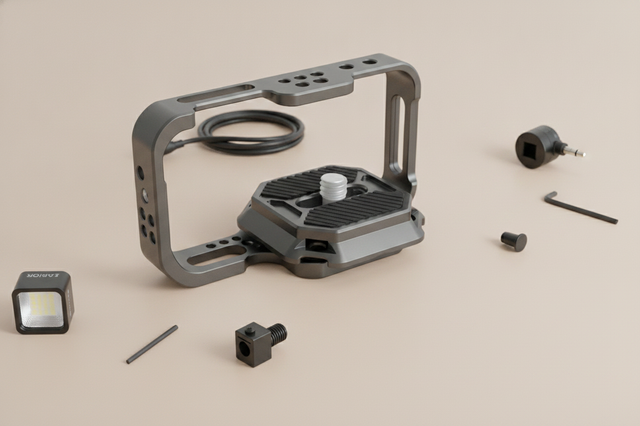
The solution isn't necessarily a lighter camera; it is a smarter rig. By using modular mounting systems like the Arca-Swiss standard and low-profile side handles, you can bring the center of gravity closer to the palm. Moving heavy accessories like monitors or microphones from the top of the camera to side-mounted quick-release points can reduce the lever arm by up to 40%, effectively doubling your comfortable shooting time.

Workflow ROI: Calculating the Cost of Every Gear Swap
For a solo creator, time is the most valuable resource. Motorized gimbals require precise balancing across three axes every time a lens is changed or an accessory is added. This "setup friction" often discourages creators from experimenting with different focal lengths or angles.
The Quick-Release Advantage
We can quantify the efficiency gain of moving from traditional threaded mounts to a high-performance quick-release ecosystem.
| Metric | Traditional Threaded Mounting | Quick-Release System (e.g., F38/F22) |
|---|---|---|
| Swap Time (Average) | ~40 seconds | ~3 seconds |
| Mechanical Security | Variable (Risk of twisting) | High (Positive Click/Lock) |
| Balance Requirement | Frequent (Re-leveling) | Minimal (Fixed Position) |
| Tool Necessity | Hex keys/Coins often needed | Tool-free operation |
Annual Value Projection
If a professional creator performs an average of 60 gear swaps per shoot (switching from handheld to tripod, changing lenses, or moving a monitor) and shoots 80 days a year, the time savings are substantial.
- Total Swaps per Year: 4,800
- Time Saved per Year: ~49.3 hours
- Potential ROI: At a professional rate of $120/hr, a modular quick-release system provides $5,900+ in annual value simply by eliminating dead time on set.
This efficiency is a core pillar of what we call "Creator Infrastructure." As noted in The 2026 Creator Infrastructure Report, the shift toward "ready-to-shoot" toolchains is becoming the standard for high-output production houses.
The Energy of the Shot: Handheld Authenticity vs. Motorized Perfection
Gimbals are designed to eliminate all human movement. While this creates a "hovercraft" effect that is ideal for real estate or certain cinematic transitions, it can feel sterile in the context of TikTok or Reels. Vertical content often thrives on a sense of immediacy and "raw energy."
Intentional Instability
A vertical handheld rig allows you to inject purposeful, human-scale micro-shakes. A slight push-in wobble or a reactive tilt when a subject moves can feel more authentic to a mobile-first audience. This is not "bad" footage; it is controlled instability.
When you use a motorized stabilizer, you are fighting the motors to create these subtle cues. Handheld rigs, conversely, provide direct physical feedback. You feel the weight of the camera, which allows your natural motor skills to dampen high-frequency vibrations while preserving the low-frequency "organic" movement that signals a human is behind the lens.
Wind Stability and Environmental Factors
Motorized stabilizers have a critical weakness: wind. Because the motors must maintain a precise balance, high-velocity wind can cause them to enter a "saturated" or high-torque state. This often introduces high-frequency motor jitter—a micro-vibration that is nearly impossible to fix in post-production.
In contrast, a mechanical rig has no electronics to fail. In windy conditions, experienced shooters often use their bodies as a dampener, bracing their elbows against their torso. This technique, combined with the inertia of a well-balanced cage, provides a level of reliability that motors simply cannot match in extreme environments.
Tactical Rigging: Managing the "Gotchas" of Vertical Systems
Building a vertical rig requires more than just a cage; it requires a systematic approach to balance and safety.
The "Center of Gravity" Rule
A common mistake is over-accessorizing the front of the rig (heavy matte boxes or long lenses), which makes the setup front-heavy and induces wrist wobble. The rule of thumb is to keep the center of gravity close to the grip and behind the lens axis. For vertical shooting, a side handle positioned slightly lower than the camera body improves leverage and reduces strain during extended use.
Cable Management as Stability
Never underestimate the impact of a "flopping" cable. A heavy HDMI cable or a loose microphone lead can create unwanted torque on your quick-release plates. We recommend using dedicated cable clamps or integrated routing within the cage to provide strain relief. This ensures that the cable weight is distributed into the frame of the rig rather than pulling on the camera ports.
Scenario Modeling: The High-Volume Vertical Creator
To illustrate the practical application of these principles, we modeled a scenario for a creator producing 50+ vertical videos per month.
| Parameter | Value | Unit | Rationale |
|---|---|---|---|
| Rig Mass | 1.8 | kg | Lightweight mirrorless setup |
| Lever Arm | 0.25 | m | Optimized side-handle grip |
| Shooting Duration | 45 | min/session | Typical high-volume vlog shoot |
| Wind Speed Limit | 15 | m/s | Safety threshold for handheld |
| QR Swap Frequency | 40 | swaps/shoot | High-speed content transitions |
Modeling Disclosure: This is a deterministic scenario model based on common industry heuristics and female anthropometry (smaller hand size) to determine fatigue thresholds. It is not a controlled lab study.
Safety, Logistics, and Environmental Resilience
When your gear is mission-critical, trust in the infrastructure is paramount. A mechanical failure on a quick-release plate can result in a catastrophic drop.
The Pre-Shoot Safety Checklist
Before every shoot, we recommend a three-point verification of your rigging:
- Audible: Listen for the distinct "Click" of the locking mechanism.
- Tactile: Perform a "Tug Test"—pull the camera firmly away from the mount to ensure the secondary lock is engaged.
- Visual: Check the locking pin status. Many high-end systems use color-coded indicators (e.g., orange or silver) to show when the plate is fully secured.
Thermal Shock and Cold Weather
Precision-machined quick-release plates are typically made of Aluminum Alloy (6061 or 7075). While durable, aluminum acts as a "thermal bridge." In extreme cold, it can conduct heat away from the camera battery, reducing your runtime.
Pro Tip: Attach your aluminum QR plates to your cameras indoors before heading out into the cold. This minimizes "metal-to-skin" shock and helps the camera maintain a more stable internal temperature during the initial transition to the outdoors.
Travel and "Visual Weight"
Modular systems like the F22 or F38 have a lower "Visual Weight" than bulky traditional cinema plates. This is a significant advantage for travel creators. Large, complex-looking rigs are more likely to be flagged by airline gate agents for weighing or checking. A compact, modular rig can be quickly broken down into components that fit into a standard backpack, ensuring your gear stays with you in the cabin.
Professional Standards and Compliance
Operating at a professional level means adhering to global standards for connectivity and safety.
- Tripod Connections: Ensure your rig follows ISO 1222:2010 for screw connections to maintain compatibility with professional grip equipment.
- Battery Safety: If your rig includes integrated power solutions, ensure they comply with IEC 62133-2 for safety and IATA Lithium Battery Guidance for air transport.
- Lighting Quality: For rigs with integrated LED panels, prioritize lights with a high TLCI-2012 score to ensure consistent color rendering in video.
By treating your rigging as a structured system rather than a collection of gadgets, you reduce setup friction and increase the reliability of your workflow. Whether you choose the motorized precision of a gimbal or the tactile energy of a handheld rig, the goal remains the same: creating a stable, efficient platform that allows your creativity to take center stage.
Disclaimer: This article is for informational purposes only. Ergonomic recommendations are based on general modeling; individuals with pre-existing wrist or back conditions should consult a medical professional before adopting new handheld shooting routines. Always verify load capacities and locking mechanisms before use to prevent equipment damage.