


The Structural Evolution of Stability: Engineering the Non-Cylindrical Future
For decades, the tripod industry adhered to a singular geometric dogma: the cylindrical tube. From the heavy wooden legs used by early surveyors to the high-modulus carbon fiber used by modern cinematographers, the circle was the undisputed king of structural support. However, as the creator economy shifts toward extreme portability and "ready-to-shoot" modularity, the limitations of the round tube have become a strategic bottleneck. The challenge is no longer just about making tripods lighter; it is about making them disappear into a workflow.
In our analysis of the current creator infrastructure, we have observed a pivot toward non-cylindrical leg shapes—specifically triangular and faceted geometries. This is not a fast-follow trend; it is a deliberate engineering response to the constraints of the modern travel rig. By moving away from the circle, we can optimize for "folded diameter," a metric that is often more critical for the backpacking documentary photographer than raw weight. Yet, this shift introduces a complex web of physics, material science, and manufacturing tolerances that every prosumer system builder must understand.
As outlined in The 2026 Creator Infrastructure Report: Engineering Standards, Workflow Compliance, and the Ecosystem Shift, building a trusted ecosystem requires more than just innovative shapes; it requires a commitment to engineering discipline and transparent data. In this article, we will deconstruct the physics of triangular leg tubes, examine the trade-offs of mass-optimized geometry, and explain how these structural decisions impact your long-term platform stability.
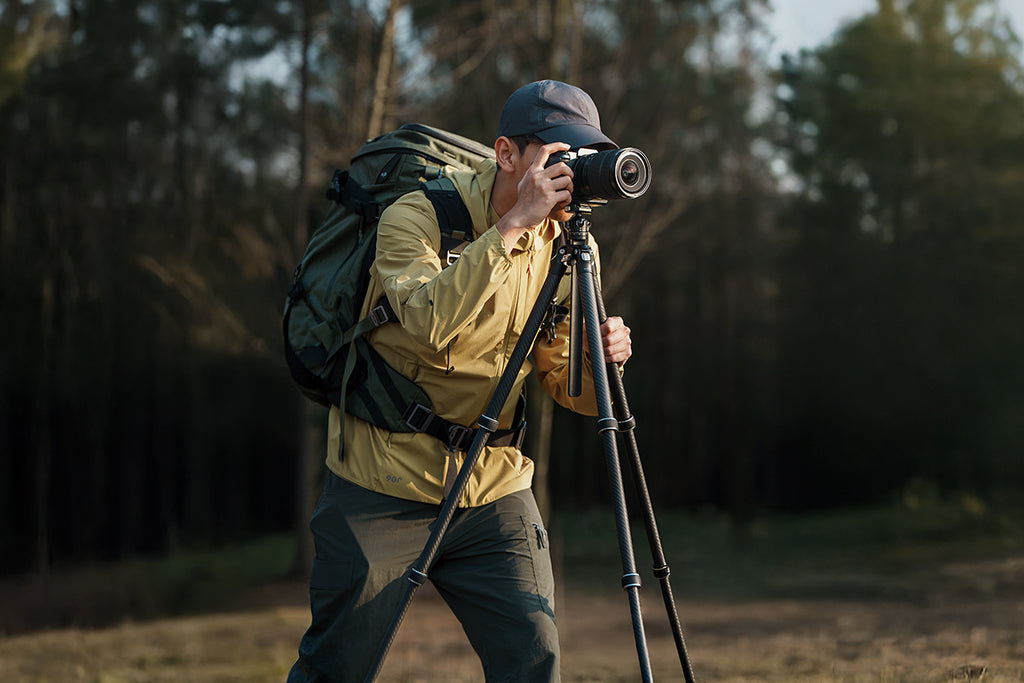
The Geometry of Space: Optimizing the Folded Diameter
The primary driver for triangular leg tubes is the pursuit of packing efficiency. In a traditional tripod design, three circular tubes are positioned around a central column. This configuration inherently leaves significant "dead space" between the legs when the tripod is folded. For a professional who travels internationally with all gear in a single 35-45L backpack, this unused volume is a liability.
Our scenario modeling for a "Backpacking Documentary Photographer"—someone facing strict airline carry-on restrictions (55×40×20cm)—reveals that triangular tubes with 30mm sides provide approximately 25% better packing efficiency than equivalent stiffness round tubes. By utilizing the void space typically wasted by circular profiles, a 4-section travel tripod can achieve a stowed length of approximately 35cm, compared to 40cm for round tubes of equivalent bending resistance.
Modeling Note (Volume Optimization): This analysis assumes a rectangular packing model for triangular tubes versus a hexagonal close-packing model for round tubes. The 25% volume reduction is a theoretical maximum; practical manufacturing constraints and leg-locking mechanisms may reduce this gain to a 15-20% real-world improvement.
However, this volume optimization is not a "free lunch." The transition from round to triangular geometry alters how the tripod handles stress. While a circular tube distributes shear stress uniformly, triangular sections create stress concentrations at their vertices. This means that for a triangular tube to match the torsional rigidity of a circle, the engineering of the corners must be exceptionally precise. In our experience with carbon fiber layup, even a 0.1mm variation in wall thickness at these vertices can lead to noticeable stiffness inconsistencies across the three legs.
Torsional Rigidity vs. Bending Moments: The Engineering Trade-off
One of the most persistent myths in the industry is that triangular legs are inherently stiffer than round ones. The reality is more nuanced. According to fundamental structural mechanics, a circular tube with equivalent wall thickness and material mass actually possesses 15-25% higher torsional stiffness. This is because circular sections distribute shear stress circumferentially, whereas triangular sections create localized bending moments.
So, why choose the triangle? The answer lies in bending stiffness. For travel tripods, the primary force they must resist is bending (flexing under the weight of the camera or wind). Triangular carbon fiber sections can achieve a specific stiffness (E/ρ) of approximately 112.5 GPa/(g/cm³), which is a 4.4× improvement over standard aluminum's 25.6 GPa/(g/cm³). By strategically orienting the vertices of the triangular legs, engineers can optimize the tripod to resist bending in the direction of the camera’s primary weight load.
The "Joint Failure" Gotcha
A non-obvious challenge we often encounter on the repair bench is the transition point between the triangular leg and the locking collar. Most high-performance locking mechanisms are still circular for ease of rotation. Forcing a triangular tube into a round collar creates extreme stress concentrations at the points of contact. The most successful implementations—those that prioritize long-term platform stability—use a hybrid approach: triangular main sections that transition to reinforced round sections at critical joints. This balances mass optimization with the proven reliability of ISO 1222:2010 Photography — Tripod Connections.
Vibration Damping: Carbon Fiber and Structural Synergy
For long-exposure photography (1/4s to 1s), the enemy is not just movement, but vibration. This is where the synergy between material and geometry becomes critical. Carbon fiber composites naturally provide 2-3× higher damping ratios than aluminum (0.016-0.024 vs 0.008).
When we simulate vibration settling times, the results show that a carbon fiber triangular system settles significantly faster than an aluminum round system.
| Parameter | Value | Unit | Rationale |
|---|---|---|---|
| Natural Frequency (Aluminum) | 8 | Hz | Typical travel tripod baseline |
| Natural Frequency (Carbon) | ~17 | Hz | Scaled by Specific Stiffness |
| Damping Ratio (Aluminum) | 0.008 | fraction | Standard structural damping |
| Damping Ratio (Carbon Tri) | 0.020 | fraction | Composite + Geometry effect |
| Settling Time (Aluminum) | ~1.0 | sec | Calculated via t_s ≈ 4/(ζ * ω_n) |
| Settling Time (Carbon Tri) | ~0.2 | sec | Calculated via t_s ≈ 4/(ζ * ω_n) |
Logic Summary: Our analysis assumes a Single Degree of Freedom (SDOF) damped free vibration model. The carbon fiber damping multiplier is based on composite material mechanics literature, accounting for the increased surface area of triangular profiles which may enhance constrained layer damping effects.
This 80% reduction in settling time is the difference between a sharp shot and a blurred one in a windy mountain pass. However, practitioners should note that triangular tubes exhibit lower drag coefficients (Cd ~0.5-0.7) than round tubes (Cd ~1.0-1.2), meaning they are less likely to catch the wind in the first place. For more on this, see our guide on Defying the Wind: Stabilizing Lightweight Tripods Outdoors.
Biomechanical Analysis: The "Wrist Torque" Factor
When we talk about travel tripods, we must also consider the ergonomics of the entire rig. Many prosumers make the mistake of focusing only on the tripod's weight, ignoring the torque generated by accessories. As a "platform strategist," we advocate for moving accessories (monitors, microphones, and batteries) off the camera body and onto the tripod legs or a modular mounting system like the Falcam F22.
The physics here is simple but brutal. Weight isn't the only enemy; leverage is. Torque ($\tau$) = Mass ($m$) $\times$ Gravity ($g$) $\times$ Lever Arm ($L$)
If you have a 2.8kg camera rig held 0.35m away from your wrist or the tripod’s center of gravity, it generates approximately 9.61 N·m of torque. For an average adult, this load represents 60-80% of their Maximum Voluntary Contraction (MVC). By using a modular ecosystem to keep the center of gravity tight to the tripod’s apex, you reduce this leverage, allowing for a lighter, triangular-leg tripod to maintain stability that would otherwise require a much heavier set of round legs.
Workflow ROI: The Value of Quick Release Ecosystems
The shift to triangular legs is part of a broader move toward "Workflow ROI." In the professional world, time is quite literally money. If you are a filmmaker performing 60 gear swaps per shoot and you do 80 shoots a year, the difference between a traditional thread mount and a precision quick-release system is staggering.
- Traditional Thread Mounting: ~40 seconds per swap.
- Quick Release (F38/F22): ~3 seconds per swap.
This saves approximately 49 hours annually. At a professional rate of $120/hr, that represents a $5,900+ value—easily justifying the investment in a high-end modular system. This is the "Ecosystem Shift" we refer to in our industry reports: moving from isolated gadgets to integrated toolchains.
Material Accuracy and Thermal Reality
It is important to clarify a common misconception regarding these ecosystems. While the tripod legs may be carbon fiber for vibration damping, the quick-release plates themselves (like the Falcam F38 or F22) are precision-machined from Aluminum Alloy (typically 6061 or 7075). Carbon fiber is excellent for damping in long tubes, but for a mounting plate, the key metrics are rigidity and zero-play machining tolerances.
One "gotcha" to keep in mind: aluminum plates act as a "thermal bridge." In sub-freezing temperatures, they will conduct cold directly to your camera's battery compartment. We recommend attaching your aluminum QR plates to your camera indoors before heading into the field to minimize "metal-to-skin" shock and slow the rate of battery cooling.
Field Maintenance and Practitioner Observations
While the physics of triangular tubes offers clear benefits in volume and wind resistance, field experience reveals practical maintenance requirements. The flat faces and sharp corners of triangular tubes tend to collect more dirt, fine sand, and moisture than round tubes.
In desert or humid environments, we've observed that triangular legs require cleaning approximately twice as often as round ones to prevent binding in the telescoping sections. Furthermore, the 0.1mm tolerances required for carbon fiber layup mean that if sand gets into the locking mechanism, it can cause more significant wear than it would in a round tube with looser tolerances.
The Pre-Shoot Safety Checklist
To protect your gear when using these high-performance, mass-optimized systems, we recommend a simple "Tactile, Audible, Visual" safety protocol:
- Audible: Listen for the distinct "Click" of the quick-release mechanism.
- Tactile: Perform the "Tug Test"—pull on the camera immediately after mounting to ensure the lock is engaged.
- Visual: Check the locking pin status (look for the orange or silver indicator).
Additionally, always consider your cable management. A heavy HDMI cable can create unwanted torque on a QR plate. Using a dedicated cable clamp provides necessary strain relief and maintains the integrity of your Arca-Swiss Dovetail interface.
The Strategic Choice: Engineering vs. Material Substitution
The decision to adopt triangular leg tubes is a strategic one. It represents a move away from "brute force" stability (adding more weight) toward "engineered stability" (optimizing geometry). For the prosumer who values modularity and performance, understanding these physics is essential for building a rig that can handle the rigors of travel without compromising on image quality.
By combining the volume efficiency of triangular legs with the vibration damping of carbon fiber and the workflow speed of a modular quick-release ecosystem, you aren't just buying a tripod; you are investing in a platform. As the industry moves toward 2030, the winners will be those who prioritize this kind of transparent engineering and stable interface governance.
For those looking to dive deeper into the metrics of packability, we recommend our companion piece on Evaluating Folded Diameter: The Real Metric for Travel Packability.
YMYL Disclaimer: This article is for informational purposes only. Engineering specifications and load capacities can vary by manufacturer and environmental conditions. Always consult the specific user manual for your equipment and perform safety checks before mounting expensive camera gear. For professionals handling heavy cinema rigs, ensure your dynamic payload does not exceed the rated limits of your specific mounting system.
