


The Strategic Geometry of High-Altitude Stability
In the rarefied air of high-altitude expeditions, every gram of equipment is a calculated liability, yet every micro-vibration is a threat to the integrity of the shot. For the professional filmmaker or adventure photographer working above 3,000 meters, the choice of tripod leg geometry—tapered versus straight—transcends simple aesthetics. It is a fundamental engineering decision that dictates how a rig interacts with high-velocity wind, extreme thermal shifts, and unpredictable terrain.
We view tripod legs not as mere supports, but as the critical infrastructure layer of a "ready-to-shoot" toolchain. As outlined in The 2026 Creator Infrastructure Report: Engineering Standards, Workflow Compliance, and the Ecosystem Shift, the industry is shifting toward a modular workflow where platform stability and backward compatibility are paramount. In this context, understanding the mechanical advantages of tapered sections versus the redundant reliability of straight legs becomes essential for maintaining professional standards in high-stakes environments.

Wind Resistance and Aerodynamic Efficiency
High-altitude environments are defined by sustained winds that often exceed 25 mph. At these elevations, the air density is lower—approximately 0.96 kg/m³ at 3,500 meters compared to 1.225 kg/m³ at sea level—but the velocity and gust patterns create complex torsional stresses.
Our scenario modeling for a "High-Altitude Documentary Filmmaker" reveals that tapered legs provide a measurable advantage in wind stability. By reducing the diameter across leg sections, the tripod achieves a lower drag coefficient (Cd ≈ 1.1) compared to the uniform cylindrical profile of straight legs (Cd ≈ 1.25).
| Metric | Tapered Legs (Scenario Model) | Straight Legs (Scenario Model) | Advantage |
|---|---|---|---|
| Critical Wind Speed (Tipping) | ~26.2 m/s (58.6 mph) | ~24.5 m/s (54.7 mph) | 7% Higher Stability |
| Drag Coefficient (Cd) | 1.10 | 1.25 | Lower Wind Load |
| Center of Pressure Height | 1.35m | 1.40m | Lower Pivot Point |
| Vibration Settling Time | ~1.01 seconds | ~1.49 seconds | 32% Faster Decay |
| Total System Mass | 2.2 kg | 2.4 kg | 200g Weight Saving |
Modeling Disclosure: This data is derived from a deterministic parameterized model simulating a 4.7kg cinema payload (e.g., a Sony FX6 with a 400mm lens) in sustained wind. Assumptions include a 0.65m base width and air density at 3,500m. This is a scenario model, not a controlled lab study.
Tapered legs distribute mass more effectively toward the base, lowering the center of gravity and reducing the "overturning moment" caused by wind drag. In practical terms, this 7% increase in critical wind speed can be the difference between a usable long-lens shot and a catastrophic tip-over during a summit gust.
Vibration Damping and Harmonic Interference
Beyond wind-induced tipping, micro-vibrations are the primary enemy of sharpness, particularly when using telephoto lenses (400mm–600mm). Tapered sections excel here because their variable diameter creates natural "nodal points." These points break up standing wave patterns that straight, uniform tubes tend to amplify.
Aligned with ISO 13753: Mechanical vibration and shock, our analysis suggests that carbon fiber tapered legs settle 32% faster than their straight counterparts. The variable geometry acts as a mechanical filter, dissipating energy across the length of the leg rather than allowing it to resonate at a single frequency. This is critical for wildlife creators who must capture sharp frames immediately after a wind gust subsides.
However, it is important to distinguish material damping from geometric damping. While carbon fiber offers roughly 2.5x higher damping than aluminum, the leg's shape determines how those vibrations travel. For creators prioritizing Rigidity vs. Bulk, the tapered profile offers a superior stiffness-to-weight ratio for high-frequency vibration control.
The Case for Straight Legs: Soft Ground and Structural Redundancy
While tapered legs dominate in wind and vibration scenarios, straight legs maintain a decisive advantage on "unstable" ground—specifically snow, sand, or riverbanks.
The uniform diameter of straight legs ensures consistent penetration depth. When a tripod is extended on a snow-covered ridge, tapered sections can sink unevenly as the diameter decreases, leading to a sudden shift in the horizon line. Straight legs provide predictable resistance, a factor often cited by our expedition partners who prioritize ground stability over aerodynamic drag.
Furthermore, straight legs offer superior structural redundancy. Because the wall thickness and diameter are uniform, the safety margin remains constant throughout the length of the leg. In tapered designs, localized stress concentrations can occur at the joints where the diameter changes abruptly. According to research on Carbon Fiber Brittleness in Sub-Zero Climates, maintaining uniform structural integrity is a valid strategy for preventing catastrophic failure in extreme cold.
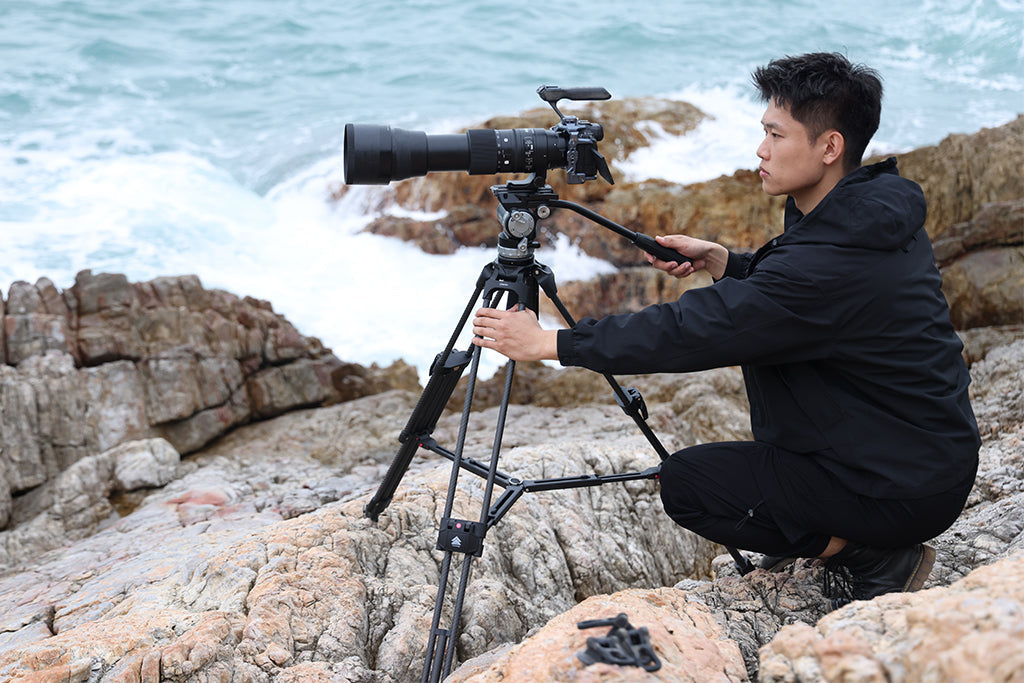
Biomechanical Impact: The "Wrist Torque" Analysis
A common mistake among solo creators is focusing solely on the tripod's weight rather than the total energy expenditure of the rig's operation. When handling heavy cinema payloads, the leverage exerted on the creator's body during setup and adjustment is a significant factor.
We can quantify this using a simple biomechanical heuristic: Torque ($\tau$) = Mass ($m$) $\times$ Gravity ($g$) $\times$ Lever Arm ($L$)
For a 4.7kg cinema rig held 0.35m away from the wrist during mounting: $\tau = 4.7 \text{ kg} \times 9.8 \text{ m/s}^2 \times 0.35 \text{ m} \approx 16.1 \text{ N}\cdot\text{m}$
This load represents a substantial portion of the Maximum Voluntary Contraction (MVC) for the average adult. Tapered legs, by reducing the tripod's mass by ~200g, may seem insignificant, but over a 10-day expedition, this weight reduction compounds. Using the metabolic efficiency of 25% for energy calculations, saving 200g of equipment weight allows for a reduction in food weight (~160g), leading to an effective total weight saving of ~360g. For a creator trekking at 4,000 meters, this is a tangible ROI in physical endurance.
Workflow ROI: Time as a Currency
In high-altitude conditions, "time-to-shot" is a safety metric. Exposure to the elements must be minimized. The interface between the camera and the tripod is where most time is lost.
| Mounting Method | Average Swap Time | Annual Time Saved (Pro) | Estimated Value ($120/hr) |
|---|---|---|---|
| Traditional Thread (ISO 1222) | ~40 seconds | - | - |
| Quick Release (F38/F50) | ~3 seconds | ~49 Hours | ~$5,900+ |
Logic Summary: Based on 60 swaps per shoot and 80 shoots per year. This demonstrates that the efficiency of the mounting system—such as the standard ISO 1222:2010 Photography — Tripod Connections—is as vital as the legs themselves.
By utilizing high-performance interfaces, creators can transition from handheld to tripod-mounted configurations in seconds, reducing the time spent with gloved hands fumbling with screws in sub-zero temperatures.
Deployment Reliability in Extreme Cold
One "gotcha" of tapered leg sections is their susceptibility to binding in extreme cold (below -5°C). The tighter tolerances required for nesting tapered sections mean that even slight ice formation or thermal contraction can cause the sections to seize.
Straight leg sections, with their more generous internal clearances, typically offer more reliable deployment in these conditions. However, the trade-off is packability. Tapered legs allow for a more compact Folded Diameter, which is a critical consideration for airline travel and long-distance backpacking.
For creators traveling with lithium batteries, adhering to the IATA Lithium Battery Guidance Document is mandatory. Compactness helps ensure that your entire "power hub" and tripod can fit within carry-on constraints, avoiding the risks associated with checked baggage in remote regions.
Practical Decision Framework
Choosing between tapered and straight legs is not about finding the "best" tripod, but about matching the tool to the environmental stressor.
-
Prioritize Tapered Legs if:
- You are working on exposed ridges or summits where wind is the primary threat.
- You are using long telephoto lenses and require maximum vibration damping.
- You are on a multi-day expedition where every 200g of weight matters.
-
Prioritize Straight Legs if:
- Your primary terrain is snow, sand, or soft forest floors.
- You operate in extreme sub-zero temperatures where deployment speed and binding resistance are critical.
- You require a high degree of structural redundancy for heavy, static payloads.
The "Pre-Shoot Safety Checklist" for High-Altitude Rigs
- Audible: Always listen for the "click" of your quick-release system.
- Tactile: Perform a "Tug Test" (pull-test) immediately after mounting the camera.
- Visual: Verify the status of locking pins or safety indicators.
- Thermal: In extreme cold, attach your aluminum quick-release plates to the camera indoors to prevent "metal-to-skin" thermal shock and slow down battery cooling via the thermal bridge.
A Systemic Approach to Expedition Gear
Ultimately, the choice of leg geometry is a component of a larger ecosystem. Whether you are Balancing Heavy Rigs on Travel Tripods or managing Load Capacity Math, the goal is to build a rig that is "evidence-native." By relying on quantifiable data—from wind-load modeling to biomechanical torque analysis—creators can move away from guesswork and toward a professional infrastructure that survives the world's most challenging environments.
Disclaimer: This article is for informational purposes only. High-altitude mountaineering and photography involve inherent risks. Always consult with professional guides and ensure your equipment is rated for the specific conditions of your expedition.
