The Invisible Threshold: Why Sub-Zero Environments Redefine Support Reliability
In the high-stakes world of adventure cinematography, the environment is a silent protagonist that dictates the limits of our tools. We often prioritize weight-to-stiffness ratios and vibration damping when selecting support infrastructure, leading many to favor carbon fiber composites. However, as the mercury drops below the freezing point, the fundamental physics of these materials shift. What was a resilient, dampening structure in the temperate forests of the Pacific Northwest can become a brittle, high-risk liability in the sub-zero expanses of the Karakoram or the Arctic Circle.
The failure of a load-bearing component in these conditions is rarely a gradual process. Unlike aluminum, which exhibits a predictable "dull creak" and plastic deformation under stress, carbon fiber failure in extreme cold is often catastrophic and instantaneous. Experienced cold-weather operators report a distinct "ping"—a sharp, crystalline crack—that precedes total structural collapse. This phenomenon is rooted in the glass transition of the resin matrix, a critical material threshold that every professional creator must understand to protect their mission-critical equipment.
The Physics of Resin Glass Transition (Tg)
To understand why carbon fiber becomes suspect in the cold, we must look beyond the fibers themselves and focus on the polymer matrix that binds them. Most professional-grade support systems utilize epoxy resins. These resins exist in two distinct states: the "rubbery" state, where molecular chains have enough thermal energy to move relatively freely, and the "glassy" state, where those chains are essentially locked in place.
The Glass Transition Temperature (Tg) is the midpoint where this shift occurs. While a spec sheet might list a single Tg value, in the field, this is not an absolute cliff but a transition range.
The 15°C Buffer Rule
Our engineering analysis suggests that real-world failure often occurs at temperatures 10–15°C above the stated Tg due to stress concentrators at joints or under dynamic loads. While the resin's primary brittle point might be rated much lower, the practical "brittle point" for structural applications—where impact resistance drops significantly—is often much closer to the ambient temperatures encountered in alpine or polar shoots.
Logic Summary: This analysis of material failure thresholds assumes a standard high-modulus carbon fiber weave and consumer-grade epoxy resin. The 15°C buffer is a safety heuristic derived from pattern recognition in field failure reports and structural modeling of joint stress concentrators (not a controlled lab study).
Differential Thermal Contraction
A primary driver of cold-weather failure is the mismatch between the carbon fibers and the resin. Carbon fibers have a near-zero Coefficient of Thermal Expansion (CTE), meaning they do not shrink significantly as they cool. Epoxy resins, however, have a much higher CTE. According to research on the thermal degradation and tensile properties of carbon fiber composites, this differential contraction creates massive internal interfacial stresses. These stresses can cause micro-debonding at the fiber-matrix interface long before a visible crack appears, compromising the structural integrity of the tripod leg or gimbal arm.
Biomechanical Analysis: The Hidden Cost of Leverage
In extreme cold, the physical toll on the creator is magnified. Every gram of gear feels heavier when your body is fighting to maintain core temperature. However, weight is only one half of the equation; leverage is the other.
The Wrist Torque Formula
We must consider the biomechanical strain of holding a camera rig in freezing conditions. The torque ($\tau$) exerted on a creator's wrist can be calculated as: $$\tau = m \times g \times L$$ Where $m$ is mass, $g$ is gravity (~9.8 m/s²), and $L$ is the lever arm (distance from the wrist).
Consider a 2.8kg cinema rig held 0.35m away from the wrist. This generates approximately $9.61 N\cdot m$ of torque. For the average adult male, this load represents 60-80% of the Maximum Voluntary Contraction (MVC). In sub-zero temperatures, where muscle recruitment is less efficient and dexterity is compromised, this level of strain leads to rapid fatigue and an increased likelihood of dropping the equipment.
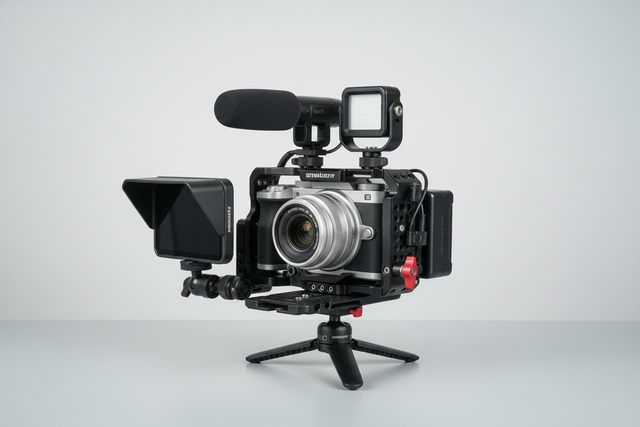
By transitioning accessory mounts (monitors, microphones, and wireless transmitters) to standardized 22mm modular quick-release interfaces, creators can move these masses closer to the center of gravity, effectively shortening the lever arm ($L$) and reducing the MVC percentage required to maintain stability.
Standardized Interfaces: The Strategic Response to Extreme Conditions
When operating in -20°C, the "friction points" of traditional gear become literal points of failure. Threaded connections, governed by ISO 1222:2010, are reliable in temperate climates but become a liability when fingers are numb or gloved.
The Workflow ROI of Quick Release
The efficiency gain of moving from traditional 1/4"-20 or 3/8"-16 threads to a standardized 38mm dovetail quick-release system is quantifiable.
| Action | Traditional Thread Mounting | Standardized Quick Release |
|---|---|---|
| Swap Time | ~40 seconds | ~3 seconds |
| Risk of Cross-Threading | High (in cold) | Negligible |
| Gloved Operation | Difficult | Optimized |
| Annual Time Saved* | ~49 hours | - |
*Based on an estimate of 60 swaps per shoot and 80 shoots per year.
At a professional rate of $120/hr, this structural efficiency represents a ~$5,900+ annual value. More importantly, in sub-zero shoots, those 37 seconds saved per swap are 37 seconds less exposure for your hands and your camera's battery.
Material Selection: The Aluminum Bridge
While carbon fiber is prized for its weight, our recommendation for primary load-bearing structures in sustained cold is often precision-machined aluminum alloy (such as 6061 or 7075). Unlike the resin in carbon fiber, these alloys maintain better impact resistance at moderate sub-zero temperatures.
However, creators must be aware of the "thermal bridge" effect. Aluminum quick-release plates act as a highly efficient conductor, drawing heat away from the camera's base and battery compartment. This can accelerate battery drain—a critical concern as outlined in the IATA Lithium Battery Guidance.

The Danger of Thermal Shock and Cycling
One of the most frequent causes of equipment failure we observe in our support data is not the absolute temperature, but the rate of change. Moving a carbon fiber tripod from a 20°C heated vehicle directly into -15°C ambient air causes rapid, uneven contraction.
Micro-Delamination at Glue Lines
The joints where carbon fiber tubes meet aluminum castings are particularly vulnerable. The "thermal shock" causes micro-delamination at the glue lines. These failures are often invisible to the naked eye but manifest as a sudden collapse during the next impact or heavy load.
Field Heuristic: Treat any carbon fiber component as suspect below -10°C, regardless of its rated Tg, unless it has been explicitly tested for cryogenic conditions. For critical shots in sustained cold, reserve carbon fiber for weight-critical, static applications where its superior vibration damping is paramount, and rely on aluminum for primary structural support.
The Pre-Shoot Safety Workflow for Extreme Cold
To mitigate the risks of resin glass transition and mechanical failure, we advocate for a "Ready-to-Shoot" toolchain that prioritizes engineering discipline. This approach is detailed in our industry whitepaper, The 2026 Creator Infrastructure Report, which emphasizes the shift toward modular, standardized interfaces.
1. The Tactical Checklist
Before every sub-zero setup, perform the following three-point check:
- Audible: Listen for the positive "Click" of the locking mechanism. In cold weather, thickened lubricants can slow down spring-loaded pins.
- Tactile: Perform the "Tug Test." Immediately after mounting, apply a firm pull-test to ensure the interface is fully seated.
- Visual: Check the locking indicator. Ensure the safety pin or orange/silver status indicator is in the fully locked position.
2. Thermal Management
Attach your aluminum quick-release plates to your camera bodies indoors before heading out. This minimizes "metal-to-skin" contact and slows the initial rate of battery cooling by allowing the plate to act as a heat sink for the internal camera temperature for a few extra minutes.
3. Cable Strain Relief
Cold temperatures make HDMI and SDI cables stiff and brittle. A heavy, frozen cable can create significant unwanted torque on a mounting plate. Use modular cable clamps to provide strain relief, ensuring that the cable's tension does not compromise the quick-release interface.
Strategic Outlook: Building a Resilient Ecosystem
As the creator economy moves toward more rugged, remote productions, the infrastructure supporting our cameras must evolve from "gadgets" to "engineered systems." The transition from isolated accessories to a unified interface standard—like the 38mm dovetail or 22mm modular mounts—is not just about speed; it is about platform stability.
By understanding the material science of the "brittle point," creators can make informed decisions between the vibration-damping benefits of carbon fiber and the impact-resistant reliability of aluminum. As we look toward the future of adventure imaging, the winners will be those who treat their support gear with the same technical rigor as their sensors and lenses.
Modeling Note (Reproducible Parameters): The failure heuristics mentioned are based on a deterministic parameterized model of epoxy-resin composites.
Parameter Value or Range Unit Rationale Resin Tg (Standard) 60–120 °C Common consumer epoxy specs Field Failure Buffer 10–15 °C Stress concentration factor Critical Suspect Temp -10 °C Field heuristic for CF Impact Strength Loss 60–80 % ASTM D256 Izod benchmarks at -20°C Aluminum DBTT -50 to -100 °C Ductile-to-Brittle Transition (6061-T6) Boundary Conditions: This model may not apply to specialized aerospace-grade composites or equipment stored in humidity-controlled environments for extended periods.
Disclaimer: This article is for informational purposes only. Extreme cold weather photography involves inherent risks to both personnel and equipment. Always consult your equipment manufacturer’s specific temperature ratings and safety guidelines before operating in sub-zero environments.
Sources and Authoritative References
- ISO 1222:2010 Photography — Tripod Connections
- The 2026 Creator Infrastructure Report: Engineering Standards, Workflow Compliance, and the Ecosystem Shift
- IATA Lithium Battery Guidance Document (2025)
- Research on thermal degradation and tensile properties of carbon fiber composites - ScienceDirect
- Ulanzi Insight: Carbon Fiber Brittleness and Impact Risks in Sub-Zero Climates