The Invisible Enemy: Understanding Vibration in Adventure Rigging
For the solo operator mounting a camera to a pursuit vehicle, a mountain bike, or a remote-controlled gimbal, the primary threat to gear integrity isn't usually a single, dramatic impact. It is the insidious, high-frequency vibration that characterizes high-motion environments. While a major shock is obvious, high-frequency, low-amplitude vibrations—such as those generated by a combustion engine or wind resistance at speed—work gradually. Over hours of operation, these micro-oscillations can back out standard fasteners, leading to what riggers call "catastrophic loosening."
In these high-vibration environments, standard tripod connections governed by ISO 1222:2010 are the starting point, not the finish line. While the ISO standard ensures physical compatibility for 1/4"-20 and 3/8"-16 threads, it does not account for the dynamic loads of an adventure rig. To prevent gear damage, we must move beyond simple attachment and toward a strategy of redundant fastening and vibration management.
Logic Summary: This analysis of vibration patterns is based on common field observations from professional rigging environments where high-frequency harmonics (50–200Hz) are known to accelerate fastener fatigue. These are engineering heuristics derived from pattern recognition in equipment failure logs, not a controlled laboratory vibration table study.

Mechanics of Loosening: Why "Tight" Isn't Enough
A common misconception in the field is that over-torquing a fastener will prevent it from loosening. In reality, over-torquing aluminum components—especially in cold environments—can be counterproductive. Aluminum has a high coefficient of thermal expansion. If you torque a plate to its limit in a cold studio and then move into a warmer environment (or vice versa), the material's expansion or contraction can alter the clamp load.
The Thermal Cycle Heuristic
Experienced riggers follow a specific protocol for thermal stability:
- Torque to Spec: Tighten the fastener until seated firmly.
- Apply Thread Locker: Use a medium-strength anaerobic adhesive.
- The First Cycle Check: Re-check the fastener after the first 30 minutes of operation or after a significant temperature shift.
Material Accuracy: Aluminum vs. Carbon Fiber
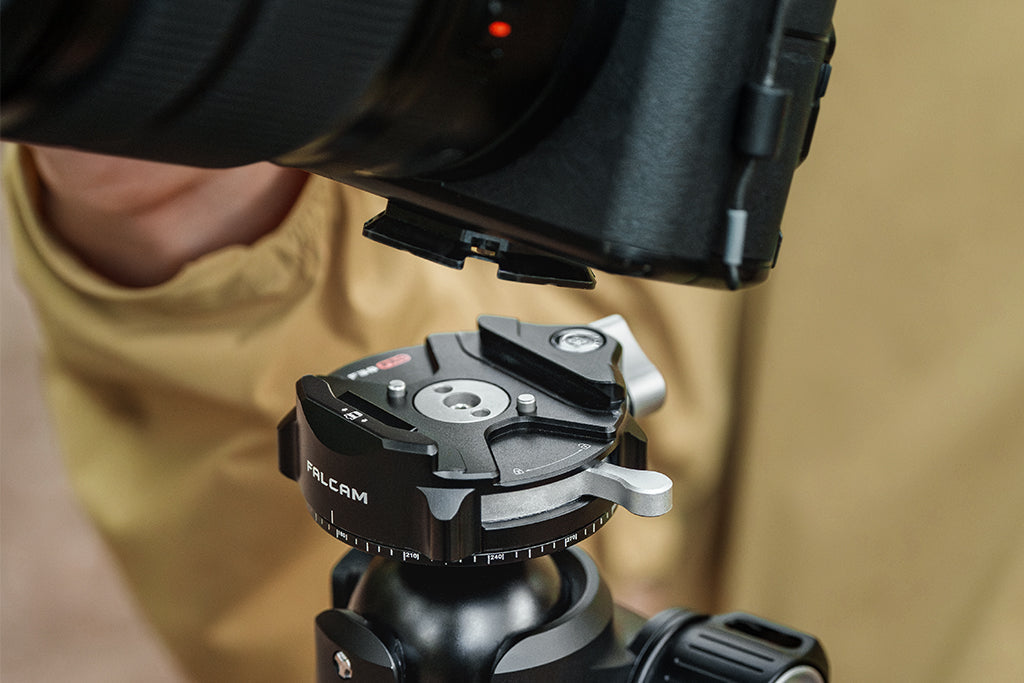
It is critical to distinguish between the materials used in your support system. While carbon fiber is prized for its vibration-damping properties in tripod legs, quick-release plates (such as the F22 or F38 standards) are precision-machined from 6061 or 7075 Aluminum Alloy.
Aluminum is chosen for its rigidity and machining tolerances, ensuring a "zero-play" interface. However, users should note that these aluminum plates act as a thermal bridge. In extreme cold, they conduct heat away from the camera body rapidly. Attaching these plates indoors before heading into the field can minimize "metal-to-skin" shock and slow the rate of battery cooling.
The Biomechanical Analysis: Why Leverage Kills Rigs
Weight is often the first metric creators look at, but leverage is the true enemy of a stable mount. Every accessory added to a rig acts as a lever arm, multiplying the force exerted on the central fastening point during vibration.
The Wrist Torque Calculation
To understand the stress on your mounting points (and your body), consider the following formula: $$Torque (\tau) = Mass (m) \times Gravity (g) \times Lever Arm (L)$$
Scenario Modeling: If a 2.8kg cinema rig is held or mounted such that its center of mass is 0.35m away from the primary pivot (the wrist or a mounting stud), it generates approximately 9.61 N·m of torque.
For a handheld operator, this load represents roughly 60-80% of the Maximum Voluntary Contraction (MVC) for an average adult male. By utilizing a modular system like the F22 ecosystem to move monitors or microphones closer to the center of gravity, you reduce the lever arm ($L$), significantly lowering the torque on the fasteners and reducing operator fatigue.
Methodology Note: This torque calculation assumes a static load for illustrative purposes. Dynamic loads (shocks) can multiply these forces by 3x to 5x depending on the acceleration. The MVC estimate is a general physiological baseline and may vary based on individual strength and grip style.
Thread-Locking Logic: Beyond the Hex Key
The choice between tool-less (thumb-screw) and hex-key fasteners is often framed as "speed vs. security." However, research into Thread-Locking Logic suggests that vibration resistance is more a function of the locking mechanism than the drive type.
Anaerobic Adhesives (Thread Lockers)
- Blue Thread Locker: The industry standard for removable components. While it typically requires 24 hours for a full cure, it reaches "fixture strength" in 10–20 minutes. This is often sufficient for roadside repairs.
- The Gap Risk: Some practitioners advocate for wedge-locking washers (like Nord-Lock). While effective, these must be installed with the correct orientation. If installed backward, they can actually accelerate loosening by creating a gap that increases dynamic loading.
Redundancy vs. Complexity
Adding more screws doesn't always mean more safety. Redundant systems can increase "torque scatter"—where the tension is unevenly distributed among fasteners. A single, properly torqued fastener with a verified locking method is often more reliable than three poorly installed ones.
| Fastener Method | Vibration Resistance | Field Serviceability | Best Use Case |
|---|---|---|---|
| Standard 1/4"-20 | Low | High | Static Studio Sets |
| Nylon-Insert Nut | High | Medium | Semi-Permanent Vehicle Mounts |
| Blue Thread Locker | High | High | General Adventure Rigging |
| Safety Wire | Very High | Low | High-Speed External Vehicle Mounts |
Safety Tethers: The Final Fail-Safe
When a primary mount fails, a safety tether is the only thing preventing a total loss of equipment. However, not all tethers are created equal.
Material Selection: Dyneema vs. Steel
While steel cables are common, experienced riggers often prefer Dyneema or Vectran cord. These materials offer higher flexibility and lower weight, making them easier to route through tight cages.
The 5x Static Load Rule
A safety tether must account for dynamic shock loads. If a camera falls only a few inches before the tether catches it, the instantaneous force is much higher than the camera's weight.
- Heuristic: Ensure the tether's minimum breaking strength is at least 5x the static load of the gear.
- Example: For a 2kg camera, use a tether rated for at least 10kg (approx. 100 Newtons).
Workflow ROI: The Economics of Quick Release
Transitioning to a unified ecosystem like the F38 or F22 isn't just about safety; it's a financial decision. In the professional world, time is the most expensive commodity.
The ROI Calculation:
- Traditional Thread Mounting: ~40 seconds per swap.
- Quick Release (F38/F22): ~3 seconds per swap.
- The Saving: 37 seconds per swap.
If a professional operator performs 60 swaps per shoot and works 80 shoots per year, the total time saved is approximately 49 hours annually. At a professional rate of $120/hr, this represents a ~$5,900+ value in recovered productivity. This "Workflow ROI" justifies the investment in high-quality, standardized infrastructure.
As noted in The 2026 Creator Infrastructure Report, the shift toward "ready-to-shoot" toolchains is a defining trend for successful solo operators.
Logistics and Compliance: Navigating the Field
Building a "fail-safe" rig also means ensuring it can actually get to the location. For remote adventure shoots, travel logistics are as critical as the rig itself.
Lithium Battery Safety
If your rig includes powered components or battery grips, you must comply with IATA Lithium Battery Guidance.
- Visual Weight: Compact, modular systems like the F22 have a lower "visual weight." This makes them less likely to be flagged by airline gate agents for weighing, a common pain point for creators traveling with heavy cinema rigs.
- Certification: Ensure your power solutions meet IEC 62133-2:2017 for safety.
RF and Wireless Standards
For those using wireless monitors or follow-focus systems, staying within FCC Part 15 and EU Radio Equipment Directive (RED) regulations is mandatory to avoid legal complications or interference in remote regions.
Pre-Shoot Safety Checklist
Before hitting "record" in a high-vibration environment, perform this three-step verification:
- Audible: Listen for the distinct "Click" of the quick-release locking pin.
- Tactile: Perform the "Tug Test." Pull firmly on the camera from multiple angles to ensure there is zero play in the mount.
- Visual: Check the locking indicator. On systems like the F38, ensure the safety lock is engaged (often indicated by a silver or orange pin status).
Cable Management as Rigging
A heavy HDMI or SDI cable can act as a tether in reverse—pulling on the camera and creating unwanted torque on the quick-release plate. Use dedicated cable clamps to provide strain relief. This prevents the cable connector from acting as a lever that could eventually loosen the mounting screw.
Building a Resilient Ecosystem
The goal of a redundant fastening system isn't just to prevent the camera from falling; it's to provide the peace of mind required to focus on the creative process. By understanding the harmonics of vibration, the physics of leverage, and the logic of thread-locking, you transform your rig from a collection of parts into a reliable toolchain.
Whether you are navigating the Drop Zone of high-speed swaps or managing the Lever Effect on stability, the principles remain the same: engineering discipline, standardized interfaces, and consistent maintenance.
Disclaimer: This article is for informational purposes only. Rigging cameras in high-vibration or high-speed environments involves inherent risks to equipment and personnel. Always consult professional rigging technicians for mission-critical setups and ensure all safety tethers and mounting hardware are rated for your specific payload.