High-Heat Performance: Managing LED Thermals in Desert Climates
In the high-stakes environment of desert cinematography, heat is not just an atmospheric detail; it is a primary failure mode. When ambient temperatures exceed 40°C (104°F) and radiant heat from direct sunlight strikes a camera rig, the margin for technical error vanishes. For creators and gear operators, the challenge is twofold: preventing total system shutdown and maintaining the color accuracy required for professional workflows.
Quick Summary: Immediate Actions for High-Heat Reliability
To ensure your production survives extreme temperatures, prioritize these three steps:
- Perform a "Stress-to-Fail" Baseline: Test gear in a controlled high-heat environment (e.g., a parked vehicle) to find your specific thermal ceiling before arriving on set.
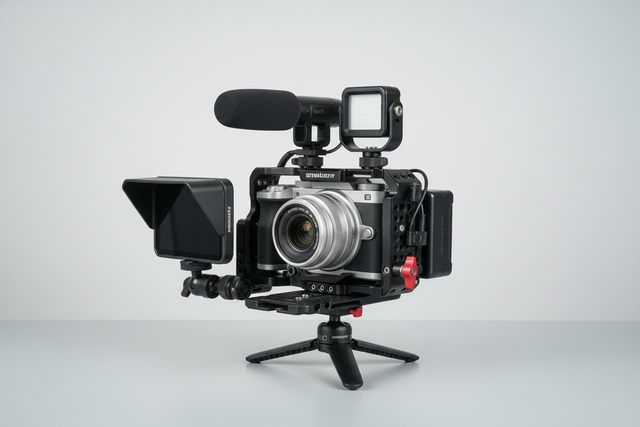
- Use Aluminum as a Heat Sink: Mount lights to aluminum alloy cages/arms to increase surface area for passive dissipation.
- Monitor Battery Thresholds: Immediately isolate and power down any battery whose casing exceeds 60°C (140°F) to prevent permanent cell damage or venting.
The IP Rating Myth: Why Sealing Can Be a Thermal Liability
A common mistake observed in field support cases is assuming that a high Ingress Protection (IP) rating—designed to keep out dust—guarantees thermal performance. In reality, the opposite is often true.
Based on patterns from professional equipment repairs, the very seals that protect a light from fine sand also trap heat within the internal chassis. This creates a "soak" condition where the LED diodes and driver circuitry operate at or above their maximum rated temperatures. Unlike industrial LEDs, portable cinematography lights are high-density arrays where "mutual heating" between diodes can trigger thermal runaway even if individual components are rated for high temperatures.
Technical Context: Our analysis of desert thermal load assumes a "still air" scenario where convective cooling is minimized. We base these heuristics on the 2026 Creator Infrastructure Report, which emphasizes engineering for real-world failure modes rather than lab-idealized conditions.
Pre-Shoot Diagnostics: The Stress-to-Fail Protocol
To build a predictive model for your rig's runtime, we recommend a standardized "Stress-to-Fail" test. This protocol should be performed at least three times to establish an average baseline.
Test Environment & Equipment:
- Environment: A shaded, static-air environment (e.g., inside a vehicle with the engine off) to simulate the worst-case lack of wind.
- Measurement Points: Use an IR thermometer (e.g., Fluke 62 Max or similar ±1.5% accuracy) to measure the hottest point on the light's rear chassis and the battery contact point.
- Sampling: Record temperatures every 5 minutes until thermal throttling or shutdown occurs.
The Test Steps:
- The Baseline Soak: Run your light at 100% power. Record the time to "First Throttle" (dimming) and "Hard Shutdown."
- The Radiant Load Factor: In the field, subtract a heuristic 30–40% from your recorded runtime if the light is in direct sunlight.
| Parameter | Value / Range | Unit | Source / Type |
|---|---|---|---|
| Ambient Baseline | 45 | °C | Standard extreme heat threshold |
| Solar Radiant Load | +30 to +40 | % | Field heuristic (estimated load from direct sun) |
| Critical Surface Temp | 65 (±5) | °C | Common threshold for thermal throttling |
| Color Drift Delta | 100–200 | K | Heuristic shift per 10°C rise above 45°C ambient |
| Passive Sink Gain | ~25 | % | Estimated gain from 6061 aluminum rigging |
Standardized Measurement Log (CSV Fields):
Date, Ambient_Temp, Equipment_ID, Time_to_Throttle, Max_Surface_Temp, Battery_Temp, Result_Pass/Fail

Maintaining Color Integrity: The 10°C Rule
Heat degrades the spectrum. As an LED's junction temperature rises, phosphor efficiency changes, leading to a perceptible shift in chromaticity.
A practical rule of thumb for field operators is the 10°C Rule: For every 10°C rise above a 45°C ambient temperature, expect a shift of approximately 100–200K toward cooler color temperatures. This occurs because heat often affects red-emitting phosphors more aggressively than the blue pump.
To maintain professional standards, verify sources against the EBU R 137 / TLCI-2012 and the AMPAS Spectral Similarity Index (SSI). Without active thermal compensation, manual correction in-camera or via gels is often necessary as the day heats up.
The Mechanical Advantage: Rigging as a Passive Heat Sink
One method for extending stable output is to treat your rigging as part of the thermal management system. Mounting lights using aluminum alloy cage arms (such as 6061 or 7075 alloy) rather than plastic mounts can act as a passive heat sink. Internal modeling suggests this can dissipate enough heat to potentially extend 100% output time by up to 25% compared to isolated plastic mounts.
Biomechanical Analysis: "Wrist Torque"
Creators must also account for the physical toll of heat. We use a biomechanical model to understand how accessory placement affects fatigue. The Formula: Torque ($\tau$) = Mass ($m$) $\times$ Gravity ($g$) $\times$ Lever Arm ($L$).
If a 2.8kg rig is held on a side arm 0.35m away from the wrist, it generates ~$9.61 N\cdot m$ of torque. This can represent 60–80% of the Maximum Voluntary Contraction (MVC) for an average adult. In high heat, where dehydration reduces muscle endurance, this leads to rapid failure. Using modular quick-release systems to move heavy accessories closer to the center of gravity (reducing $L$) improves both thermal dissipation and operator safety.
Battery Safety: Emergency Thresholds & Procedures
Lithium batteries are chemically sensitive. Operating them at the edge of their thermal envelope increases the risk of "venting" or internal shorts.
- Compliance: Ensure batteries meet IEC 62133-2:2017 safety requirements.
- Transport: Adhere to the IATA Lithium Battery Guidance (2025).
Emergency Shutdown Protocol: If a battery casing feels painful to touch or exceeds 60°C (140°F):
- Immediate Isolation: Power down the device and remove the battery using heat-resistant gloves or a thick cloth.
- Containment: Place the battery in a fire-retardant bag or on a non-flammable surface (e.g., sand or concrete), away from personnel.
- Observation: Do not attempt to recharge or reuse the battery until it has returned to room temperature and been inspected for swelling. If venting (smoke/hissing) occurs, evacuate the area and contact emergency services.
Workflow ROI: The Value of Infrastructure Stability
Investing in heat-resistant infrastructure is a financial choice. We calculate the Return on Investment (ROI) based on time saved during "golden hour" windows.
The Calculation:
- Traditional Thread Mounting: ~40s per swap.
- Quick-Release System: ~3s per swap.
- Annual Savings: For a professional performing 60 swaps per shoot across 80 shoots a year, this saves ~49 hours annually. At a rate of ~$120/hr, this represents over $5,800 annually in reclaimed productivity.
Pre-Shoot Safety Checklist
- Audible Verification: Listen for a "Click" when engaging quick-release plates. Dust can prevent full engagement.
- The "Tug Test": Physically pull on every mounted accessory to ensure the locking pin is seated.
- Cable Strain Relief: Use aluminum cable clamps. Heat makes rubberized cables more pliable and prone to stretching.
- Surface Check: Use an IR thermometer to identify hotspots before they lead to shutdown.
Disclaimer: This article is for informational purposes only. High-temperature environments pose significant risks to personnel and equipment. Always consult manufacturer specifications and follow local safety regulations regarding heat exposure and battery transport.