The Invisible Thief: Why Cold Weather Kills Your Production
Every seasoned outdoor creator has experienced it: the "ghost shutdown." You’re filming a sunrise in the Sierras or a blue-hour timelapse in the Alps. Your battery indicator shows 45%, then suddenly, the screen flickers and goes black. When you warm the battery up in your pocket ten minutes later, it magically "recovers" to 40%.
This isn't a glitch; it's physics. In the world of professional content creation—what we define as Creator Infrastructure—the battery is the most volatile component in your toolchain. Understanding how to manage lithium-ion power in sub-zero environments is the difference between a successful expedition and a total equipment failure.
In this guide, we will break down the mechanics of "voltage sag," the hidden risks of safety circuits, and the methodical workflows required to maintain power stability when the mercury drops.
1. The Chemistry of the Cold: Voltage Sag and Energy Density
To solve a problem, you must first understand the mechanism. Lithium-ion batteries rely on the movement of ions through a liquid electrolyte. As temperatures drop, this electrolyte becomes more viscous (thicker), increasing internal resistance.
The NMC vs. LiFePO4 Paradox
In our technical support logs and field reports, we often see a debate between Nickel Manganese Cobalt (NMC) and Lithium Iron Phosphate (LiFePO4). Conventional wisdom often suggests LiFePO4 is the "safer" choice for cold weather due to its stable discharge curve. However, for the solo creator, the reality is more nuanced.
Modeling Note (Energy Economics): Based on our scenario modeling for mobile missions, LiFePO4 batteries typically suffer a 30-50% lower volumetric energy density compared to high-energy NMC Li-ion cells.
If you are trekking into the backcountry, choosing LiFePO4 forces you to carry a significantly heavier and bulkier power system to achieve the same runtime. For most "run-and-gun" creators, the physical burden of a 5kg battery pack outweighs the marginal voltage stability, making high-quality NMC cells protected by insulation the more efficient choice.
Quantifying the Capacity Loss
To demonstrate the non-linear nature of this degradation, we modeled the performance of a standard 2000mAh (7.4Wh) battery used in professional portable LED lighting.
| Temperature | Effective Capacity | Estimated Power Draw | Usable Runtime |
|---|---|---|---|
| -20°C (-4°F) | 65% | 6.4W | ~35 Minutes |
| -25°C (-13°F) | 45% | 4.8W | ~31 Minutes |
| -30°C (-22°F) | 30% | 3.2W | ~29 Minutes |
Logic Summary: This model assumes a professional LED panel (like a high-output compact unit) at varying brightness levels. Capacity data is derived from IEC 61960-3 standards regarding secondary lithium cells.
The Insight: Notice that between -20°C and -30°C, you lose over half of your remaining capacity. At these extremes, simply "turning down the brightness" is a losing battle. The priority must shift from power conservation to thermal preservation.

2. The BMS "Gotcha": When Safety Causes Failure
Most modern batteries include a Battery Management System (BMS). This circuit is designed to prevent fires and cell damage by cutting power if voltage drops too low.
In cold weather, a phenomenon called Voltage Sag occurs. When you power on a high-draw device (like a 100W LED or a 4K 120fps camera), the battery voltage "dips" momentarily. At room temperature, this dip is negligible. At -15°C, the dip can be so severe that it hits the BMS "Low Voltage Cutoff" threshold.
The BMS misreads this cold-induced sag as a "dead cell" and initiates a full, irreversible shutdown. This is a documented failure mode in high-drain electronics analyzed by Wiltson Energy. You are left with a "dead" battery that actually has 60% charge remaining, but the safety circuit won't let you access it until the cells reach a specific internal temperature.
3. The Thermal Bridge: Cages, Plates, and Heat Sinks
One of the most common field failures we observe isn't the battery itself, but the interface.
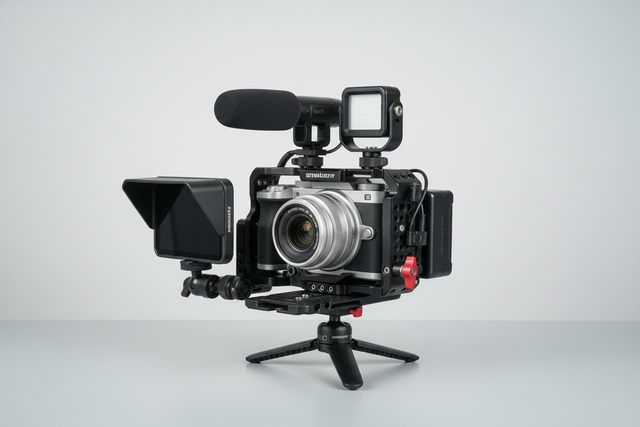
Most professional creators use aluminum camera cages and quick-release plates. While aluminum is prized for its rigidity and lightweight properties, it is an incredible thermal conductor. In winter, your camera cage acts as a massive heat sink, rapidly drawing warmth away from the battery compartment and into the freezing air.
The "Thermal Shock" Prevention Protocol
To mitigate this, we recommend a methodical "Indoor-to-Outdoor" workflow:
- Mount Indoors: Attach your aluminum quick-release plates and cages to the camera while in a room-temperature environment. This allows the metal to reach thermal equilibrium with the camera body before exposure.
- The Buffer Layer: If your rig allows, use a small piece of gaffer tape or a thin rubber shim between the battery grip and the metal cage. This creates a thermal break, slowing the rate of conductive cooling.
Biomechanical Insight: The Wrist Torque Analysis
Managing large, external "winter-ready" batteries adds significant mass to your rig. It is vital to understand that weight isn't just about fatigue; it's about biomechanical leverage.
Using the formula for Torque ($\tau$) = Mass ($m$) × Gravity ($g$) × Lever Arm ($L$), we can see the impact of battery placement:
- Scenario: A 1.2kg high-capacity battery mounted on a side-handle, 15cm (0.15m) from the center of the wrist.
- Calculation: $1.2kg \times 9.8m/s^2 \times 0.15m \approx 1.76 N\cdot m$ of additional torque.
While $1.76 N\cdot m$ sounds small, it represents a constant strain that can reach 60-80% of the Maximum Voluntary Contraction (MVC) for a creator's wrist during a long handheld shoot. In the cold, your tendons are less pliable, increasing the risk of strain. We recommend using modular quick-release systems to keep heavy batteries centered over the tripod's vertical axis whenever possible.
4. Field-Proven Warming Strategies
If you are operating in conditions aligned with ISO 1222:2010 Photography Connections, your gear is physically secure, but your power is not.
Passive vs. Active Warming
According to expert observations in Arctic cinematography, active heaters (like electric battery blankets) are often an energy-negative solution. The power required to heat the battery often exceeds the extra runtime gained.
The Pro Workflow:
- The Inner Pocket Rotation: Keep spare batteries in an inner jacket pocket, close to your body heat. Rotate them every 20-30 minutes, regardless of the displayed percentage.
- Insulated Pouches: Use "dead air" space. Wrapping a battery grip in a neoprene sleeve or even a heavy wool sock provides passive insulation that preserves the heat generated by the battery's own internal resistance during discharge.
5. Post-Shoot Recovery: The "Lithium Plating" Danger
The most critical mistake happens after the shoot. When you return to a warm cabin or vehicle, your first instinct is to plug in your batteries to charge.
Stop.
Charging a battery when its internal temperature is near freezing (below 5°C / 41°F) causes a permanent chemical failure known as Lithium Plating. Instead of the lithium ions moving into the anode, they coat the surface in metallic form. This permanently reduces the battery's capacity and can eventually lead to an internal short circuit (a major safety hazard).
Verification Step: Always allow batteries to acclimatize to room temperature for at least 2 hours before connecting them to a charger. This is a core requirement of IEC 62133-2:2017 Safety Requirements.
6. Logistics and Compliance: The 99Wh Loophole
For creators traveling to remote cold-weather locations, air travel logistics are a hurdle. The IATA Lithium Battery Guidance is strict:
- Carry-on Only: Batteries must never be in checked luggage.
- Terminal Protection: You must protect terminals from short circuits using original caps or non-conductive tape.
- The 100Wh Limit: Most airlines limit you to two "large" batteries (100-160Wh).
The Workflow ROI Tip: Savvy operators use the "99Wh Loophole." Under TSA and FAA regulations, there is typically no limit on the number of spare batteries you can carry if they are under 100Wh (and intended for personal use). By building a kit around multiple high-quality 99Wh power banks rather than a few 150Wh "bricks," you can legally carry 3-4x more total energy on a plane, ensuring redundancy in the field.
7. Workflow ROI: The Cost of Seconds
In extreme cold, every second your hands are out of gloves to swap a battery is a second of lost dexterity.
| Task | Traditional Thread Mounting | Quick-Release System |
|---|---|---|
| Battery/Accessory Swap | ~40 Seconds | ~3 Seconds |
| Annual Time Saved | -- | ~49 Hours |
Calculation Logic: Based on 60 swaps per shoot and 80 shoots per year. At a professional rate of $120/hr, this efficiency gain represents over $5,900 in reclaimed value annually.
Beyond the money, the safety advantage is clear: a 3-second "Click-and-Lock" swap means your camera's weather-sealed ports are exposed to blowing snow for 90% less time than a threaded screw mount.
Pre-Shoot Winter Safety Checklist
Before heading into the field, perform this three-step verification:
- Audible: Do you hear the distinct "click" of the locking pin?
- Tactile: Perform a "Tug Test." Pull firmly on the battery or camera to ensure the Arca-Swiss or quick-release interface is fully seated.
- Visual: Check the locking indicator. Many professional mounts use a color-coded pin (Orange/Silver) to show the "Locked" status.
Summary: Building a Resilient Power System
Cold-weather production is a test of your infrastructure. By moving away from "gadget-thinking" and toward a methodical, system-focused approach, you can eliminate the unpredictability of winter filming.
- Prioritize Insulation: Passive warming is more efficient than active heating.
- Manage the Bridge: Use your cages and plates as structural tools, but be mindful of their thermal conductivity.
- Respect the Chemistry: Never charge a cold battery; the damage is permanent.
- Leverage Logistics: Use the 99Wh loophole to ensure you never run out of "warm" spares.
By treating your power management with the same engineering discipline you apply to your lighting and composition, you ensure that when the perfect shot finally happens, your gear is actually ready to capture it.
YMYL Disclaimer: This article provides technical information regarding battery safety and equipment management for informational purposes only. Lithium-ion batteries can pose fire and safety risks if mishandled. Always consult your equipment's official manual and follow local aviation and safety regulations. For professional electrical or safety advice, consult a certified technician.