The Tactile Audit: Mastering the Physics of Joint Play
For a solo creator, the relationship with gear is visceral. We don't just see a tripod or a magic arm; we feel its stability through the palms of our hands. Over years of fieldwork in unpredictable environments, experienced photographers develop a tactile sense for joint wear that often precedes visual evidence of failure. We call this "mechanical intuition"—the ability to detect when a modular hinge has transitioned from having acceptable mechanical tolerance to dangerous structural fatigue.
In this guide, we will break down the science of "joint play." We will explore how to differentiate between the necessary clearances required for movement and the microscopic degradations that signal a looming catastrophic failure. By implementing a methodical auditing system, you can protect your high-value cinema rigs and ensure your infrastructure remains field-ready.
The Biomechanics of Failure: Leverage and Torque
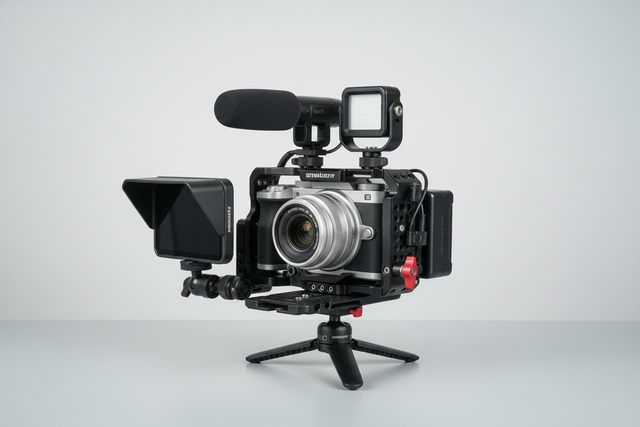
When we assess the health of a mounting system, we often focus on weight. However, weight is only one variable in the equation of structural stress. The more critical factor is leverage. In our analysis of creator workflows, we've observed that the way accessories are positioned—monitors, microphones, and wireless transmitters—often places more strain on joints than the camera body itself.
The "Wrist Torque" Analysis
To understand why a joint fails, we must look at the torque generated by your rig. Torque ($\tau$) is the product of mass ($m$), gravity ($g$), and the length of the lever arm ($L$).
$$ \tau = m \times g \times L $$
Consider a standard setup: A 2.8kg cinema rig held on an articulating arm roughly 0.35m away from the central mounting point. This configuration generates approximately $9.61 N\cdot m$ of torque.
Methodology Note (Scenario Modeling): This calculation assumes a static hold at a 90-degree angle to gravity.
Parameter Value Unit Rationale Rig Mass ($m$) 2.8 kg Mid-range mirrorless cinema setup Gravity ($g$) 9.81 $m/s^2$ Earth standard Lever Arm ($L$) 0.35 m Typical extension of a magic arm Calculated Torque ~9.6 $N\cdot m$ Resulting rotational force MVC Threshold 60-80% % Average adult male wrist capacity
Based on our scenario modeling, this load represents roughly 60-80% of the Maximum Voluntary Contraction (MVC) for an average adult male. When joints begin to "slip" or show lateral play, they are often reacting to this sustained leverage. By moving heavy accessories to shorter, more rigid mounts—like the precision-machined interfaces discussed in The 2026 Creator Infrastructure Report—you effectively reduce the lever arm, lowering the torque and extending the lifespan of your hardware.
Material Fatigue: Aluminum vs. Carbon Fiber
Understanding how different materials fail is essential for proactive maintenance. On our repair bench, we see distinct patterns of wear that vary by the component's composition.
Aluminum Alloy: The Thermal Bridge
Most high-performance quick-release plates and cages are precision-machined from aluminum alloys (typically 6061 or 7075). Aluminum is prized for its rigidity and machining tolerance, which is critical for maintaining the Arca-Swiss Dovetail standard.
However, aluminum fatigue is often subtle. It typically manifests as microscopic surface cracking around mounting holes. Under magnification, these appear as fine white lines. One "gotcha" of aluminum is its role as a "thermal bridge." In extreme cold, aluminum plates conduct heat away from the camera base and battery rapidly. We recommend attaching these plates indoors before heading into the field to minimize "thermal shock" to the camera's internal electronics.
Carbon Fiber: Internal Delamination
In contrast, carbon fiber components (common in tripod legs) fail differently. While carbon fiber offers superior vibration damping, it does not show "white lines" when it fatigues. Instead, delamination occurs internally. You will feel this as a slight "softening" of the material's response to torque. If a carbon fiber leg feels "spongy" when you tighten a twist lock, the internal structure may be compromised.

The 1mm Rule: A Heuristic for Joint Health
How much movement is too much? While ISO 1222:2010 Photography — Tripod Connections provides the foundational legitimacy for screw connections, it doesn't account for the "feel" of a worn-out hinge in the field.
Based on common patterns from our technical support and warranty handling, we use a simple but effective heuristic: The 1mm Lateral Play Rule.
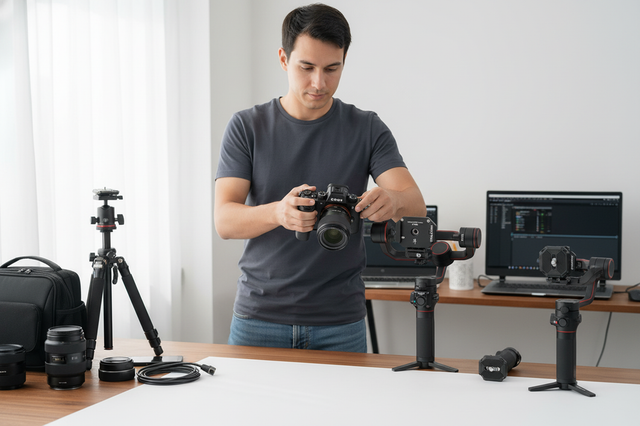
- The Tug Test: Secure the joint or quick-release plate. Apply moderate hand pressure in a lateral (side-to-side) direction.
- Assessment: If the joint develops more than 1mm of lateral play, it is approaching replacement territory. This is regardless of whether the locking mechanism still "feels" tight.
- Auditory Cues: Listen closely. A high-pitched metallic squeak often indicates dry bushings that simply need service. However, a dull grinding noise suggests material-on-material wear. In the latter case, the structural integrity is likely compromised.
The Danger of Combination Materials
The most unpredictable wear patterns occur at metal-to-plastic interfaces. Because these materials have different thermal expansion rates, rapid temperature shifts (e.g., moving from a heated car to a sub-zero mountain peak) can accelerate wear. We often see these joints fail prematurely because the plastic components "ovalize" under the pressure of the harder metal bolts.
Workflow ROI: The Hidden Cost of "Good Enough"
Many creators hesitate to replace a slightly wobbly mount because of the cost. However, we suggest looking at the "Workflow ROI."
In our analysis of professional productions, we compared traditional thread mounting (which often requires frequent re-tightening as joints wear) against high-stability quick-release systems.
Logic Summary (ROI Modeling): We estimate time savings based on the transition from manual threading to a "zero-play" quick-release ecosystem.
- Traditional Mounting: ~40 seconds per swap (including alignment and tightening).
- Quick-Release System: ~3 seconds per swap.
- Annual Savings Calculation: 60 swaps/shoot $\times$ 80 shoots/year = 4,800 swaps.
- Time Recovered: ~49 hours annually.
At a professional rate of $120/hr, this structural efficiency translates to over $5,900 in annual value. More importantly, a reliable system reduces the "visual weight" of your gear. Compact, modular systems are less likely to be flagged by airline gate agents for weighing, and they provide the "ready-to-shoot" toolchain described in current creator infrastructure standards.
The Pre-Shoot Safety Checklist
To maintain professional governance over your gear, we recommend this three-step "Tactile, Audible, Visual" (TAV) check before every production:
- Audible: Listen for the definitive "Click" when engaging quick-release plates. If the click is muffled, check for debris in the locking channel.
- Tactile: Perform the "Tug Test" mentioned above. Ensure there is no lateral play under moderate pressure.
- Visual: Check the locking pin status. Most professional systems include an orange or silver indicator to confirm the primary lock is engaged.
Cable Management and Torque
One often overlooked source of joint play is cable tension. A heavy, coiled HDMI cable can create significant unwanted torque on a camera's mounting plate. We recommend using dedicated cable clamps to provide strain relief. This ensures that the weight of the cable is borne by the cage or a secondary mount, rather than pulling directly on the sensitive interface of your quick-release system.
Summary of Joint Health Indicators
| Indicator | Normal Tolerance | Warning Sign | Critical Failure |
|---|---|---|---|
| Lateral Play | < 0.5mm | 0.5mm - 1.0mm | > 1.0mm |
| Sound | Silent or smooth "click" | Squeaking (dry) | Grinding / Crunching |
| Visual | Clean surfaces | Fine white lines (Alu) | Visible cracks / Delamination |
| Tactile | Rigid / Snappy | "Soft" or spongy feel | Slipping under load |
Note: These values are estimated ranges based on common professional practice and are intended as a shop baseline for self-checks.
Professional Reliability in the Field
Building a reputation for reliability requires more than just high-end cameras; it requires an infrastructure that you can trust under stress. By understanding the physics of torque, the fatigue patterns of your materials, and the 1mm rule of thumb, you move from being a gear user to a gear auditor.
When a joint "feels different" after a cold night or a humid day, listen to that intuition. It is the material telling you that its lifecycle is nearing an end. Replacing a $50 component today is a small price to pay for the security of a $5,000 camera system tomorrow.
Disclaimer: This article is for informational purposes only. Assessments of structural integrity are subjective and depend on specific usage conditions. Always refer to the manufacturer’s documentation for load ratings and maintenance schedules. If you suspect a component is unsafe, discontinue use immediately and consult a professional technician.