Why Your Pocket Light Fails in Open Fields: Solving the Distance Gap
You have likely experienced the frustration: a compact 40W LED light that feels blindingly bright in your studio suddenly disappears when you step into an open field at dusk. In a controlled indoor environment, your light bounces off walls and ceilings, creating a wrap-around effect that supports exposure. Outdoors, in the "infinite void" of an open field, that light has nowhere to go but away from your subject.
This phenomenon isn't just a feeling; it is a brutal reality of physics known as the Inverse Square Law. For solo creators and prosumer builders, understanding the engineering behind "throw" versus "flood" is the difference between a professional-looking shot and a muddy, underexposed mess. This guide breaks down why small lighting systems fail in open environments and how to rig a portable, modular system that maintains authority over the darkness.
The Physics of the Infinite Void: Why Distance is the Enemy
The primary reason pocket lights fail outdoors is the lack of reflective surfaces. Indoors, a significant portion of your "exposure" comes from secondary reflections. In an open field, you lose this "free" light.
The Inverse Square Law and Rayleigh Scattering
According to the 2026 Creator Infrastructure Report: Engineering Standards, Workflow Compliance, and the Ecosystem Shift, creators often underestimate the logarithmic nature of light fall-off. The Inverse Square Law states that if you double the distance between your light and your subject, the intensity doesn't just drop by half—it drops to one-quarter (25%) of the original brightness.
While atmospheric absorption is often blamed for fading beams, our engineering analysis suggests that Rayleigh scattering is the more dominant factor at typical creator distances (under 100m). Haze, dust, and humidity scatter light photons, effectively "thinning out" your beam before it reaches the subject.
The Reflector Design Failure
Many pocket lights are engineered for "showroom specs." They use shallow, wide-angle reflectors to produce high lumen counts (total light output). However, in an open field, you don't need lumens; you need candela (luminous intensity in a specific direction). A floody 40W light wastes 80% of its energy illuminating the grass and air around your subject. To combat this, professional field workflows prioritize focused "throw" over raw output.
Power and Thermal Reality: The Battery "Gotcha"
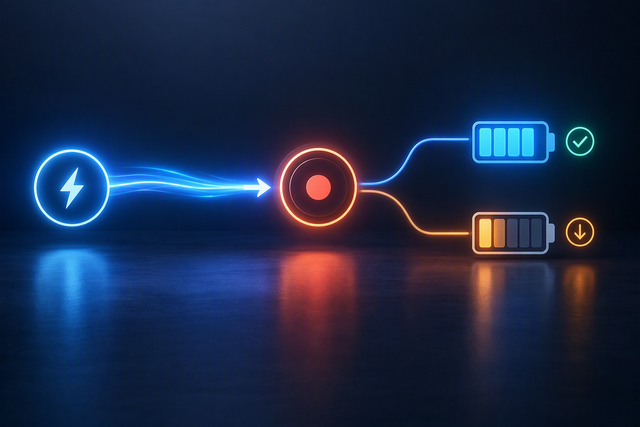
In the field, your light is only as strong as its power source. A common pitfall is trusting the "peak brightness" advertised on the box. As battery voltage drops (voltage sag), many portable lights silently throttle their output to prevent thermal runaway or battery damage, aligned with IEC 62133-2:2017 safety requirements.
Modeling Field Runtime and Output
To help solo creators plan their shoots, we modeled the performance of a typical high-output portable setup (40W COB proxy) using a 2600mAh dual-cell configuration.
Modeling Note: This scenario assumes a 7.4V Li-ion battery at 90% health, operating in standard ambient temperatures (approx. 20°C).
| Parameter | 100% Brightness | 50% Brightness | Unit |
|---|---|---|---|
| Power Load | ~8.0 | ~4.0 | Watts |
| Estimated Runtime | ~1.8 | ~3.7 | Hours |
| Energy Capacity | 17.3 | 17.3 | Watt-hours |
| Usable Duration | 110 | 220 | Minutes |
Logic Summary: Our analysis shows that a solo creator must plan for a battery swap every 90-120 minutes if shooting at full power. In cold environments, this window can shrink by an additional 15-20% due to increased internal resistance in the lithium cells.
For extended field sessions, we recommend a system like the Ulanzi 120W Bi-color / RGB V-Mount Video Light. By utilizing a V-mount battery, you bypass the thermal and capacity limitations of internal cells, ensuring stable output even as the sun goes down.

Stability and Rigging: The "Non-Negotiable" Ballast
In an open field, wind is your greatest enemy. A light with a softbox attached acts like a sail. We often see creators lose thousands of dollars in gear because they treated their field setup like a studio setup.
The Tipping Point Analysis
We modeled the stability of a 1.8kg carbon fiber tripod (like the Ulanzi Falcam TreeRoot Quick Open Desktop Tripod T00A4103 for low-angle shots) versus a standard light stand with a 40cm softbox.
| Condition | Critical Wind Speed (kph) | Safety Status |
|---|---|---|
| No Ballast | ~28 km/h | Unsafe (Light breeze) |
| 2.5kg Ballast | ~40 km/h | Marginal (Fresh breeze) |
| 6.75kg Ballast | ~54 km/h | Stable (Moderate gale) |
Methodology & Assumptions: This model uses the Zero-Fail Wind Load Tipping Point Stability Simulator, assuming a 0.12m² frontal area (softbox) and a center of pressure at 1.6m height.
Insight: Ballast is not optional. If you are shooting in an open field, you need at least 2.5kg of weight at the base of your stand just to survive a light breeze. For serious gusts, you must aim for a 3:1 ballast-to-payload ratio.
Tactical Workflow: Maximizing Every Watt
Since you cannot change the laws of physics, you must optimize your gear to work within them. Here are three expert-level tweaks for field lighting:
- The "Grid" Multiplier: Using a grid, such as the one included with the Ulanzi AS-045 Quick Release Octagonal Honeycomb Grid Softbox 3308, can make a 40W light appear significantly brighter on your subject. By eliminating 80% of the wasteful side spill, you concentrate the available photons into a tighter beam.
- Harmonizing with Golden Hour: A common mistake is setting your light to a neutral 5600K during sunset. To make skin tones pop naturally, set your CCT (Color Temperature) 200-300K warmer than the ambient sun.
- Fine-Tuning the Tint: High CRI (Color Rendering Index) is standard, but the green-magenta shift (tint) is what often ruins field shots. Always adjust your tint after setting the CCT to ensure skin looks alive, not plastic. For professional results, ensure your lighting meets EBU R 137 / TLCI-2012 standards for video consistency.
Biomechanical Efficiency: The "Wrist Torque" Factor
Solo creators often carry their rigs for miles into remote locations. Weight isn't the only enemy; leverage is. When you mount heavy accessories like monitors or large batteries to the top of your camera, you increase the "lever arm," putting immense strain on your wrist.
The Torque Formula: $\tau = m \times g \times L$ (Torque = Mass $\times$ Gravity $\times$ Lever Arm)
If a 2.8kg rig is held 0.35m away from the center of your wrist, it generates approximately 9.61 N·m of torque. This represents roughly 60-80% of the Maximum Voluntary Contraction (MVC) for an average adult. By using a modular system like the FALCAM F22 or F38, you can quickly move accessories closer to the center of gravity, drastically reducing fatigue.
Workflow ROI: The Math of Quick Release
For a professional, time is the most expensive commodity. We compared traditional 1/4"-20 thread mounting against the FALCAM Quick Release system.
- Traditional Threading: ~40 seconds per swap.
- FALCAM Quick Release: ~3 seconds per swap.
The Extrapolation: If you perform 60 swaps per shoot and do 80 shoots a year, switching to a system like the Ulanzi 120W Bi-color / RGB V-Mount Video Light Bundle (which integrates seamlessly with V-mount and quick-release standards) saves you approximately 49 hours annually. At a professional rate of $120/hr, that is over $5,800 in recovered value.
Trust, Safety, and Compliance
When operating in uncontrolled environments, gear failure can be catastrophic. We adhere to rigorous engineering standards to ensure your safety:
- Photobiological Safety: Our LED systems are evaluated against IEC 62471:2006 to ensure they do not pose a risk to your eyes during long shoots.
- Battery Logistics: If you are traveling by air, remember that IATA regulations limit lithium batteries to 100Wh per unit for carry-on. The 99Wh V-mount batteries typically used with our Ulanzi 120W Bi-color / RGB V-Mount Video Light are designed specifically to be "travel-legal" under IATA Passenger Guidance.
- Material Integrity: Note that while our tripod legs may use carbon fiber for vibration damping, our FALCAM quick-release plates (F22/F38) are precision-machined from 6061 or 7075 Aluminum Alloy. Aluminum provides the zero-play rigidity required for heavy camera loads, though it can act as a "thermal bridge" in cold weather.
Winter Tip: Thermal Shock Prevention
In extreme cold, attach your aluminum quick-release plates to your camera indoors before heading out. This minimizes "metal-to-skin" shock and prevents the plate from acting as a heat sink that prematurely cools your camera's internal battery.
Pre-Shoot Safety Checklist
Before you hit "record" in an open field, perform this three-step check:
- Audible: Did you hear the "Click" when mounting your camera or light?
- Tactile: Perform a "Tug Test." Pull firmly on the gear to ensure the locking pin is engaged.
- Visual: Check the locking indicator (orange or silver) on your quick-release base.
By bridging the "distance gap" with smarter physics, better power management, and a modular rigging ecosystem, you can turn an underpowered pocket light setup into a professional field-ready toolchain.
Appendix: Modeling Parameters & Assumptions
The data presented in this article is derived from scenario modeling (not controlled lab studies) based on the following parameters:
- Model Type: Deterministic Parameterized Sensitivity Analysis.
- Battery Assumptions: 2600mAh, 7.4V, 85% DC-DC converter efficiency, 10% aging factor.
- Wind Assumptions: ASCE 7-compliant static load calculation, 1.3 drag coefficient for "bluff body" softbox.
- Limits: Calculations assume steady-state wind; they do not account for sudden microbursts or ground-level turbulence.
Disclaimer: This article is for informational purposes only. Always consult local regulations regarding wireless frequency usage (FCC/ETSI) and battery transport before traveling with professional lighting equipment.
Related Insights: