If you have ever spent a blue-hour shoot fumbling with a 1/4"-20 D-ring screw while your fingers went numb, you know that traditional mounting is the single greatest bottleneck in modern cinematography. We often spend thousands on sensors and glass, yet we entrust our workflow to a mounting standard—the tripod screw—that hasn't fundamentally changed since the ISO 1222:2010 Photography — Tripod Connections was first conceptualized.
As professional rig builders, we view the quick-release system not as an accessory, but as the "creator infrastructure." It is the connective tissue between your creative intent and your hardware. The FALCAM ecosystem, comprising the F22, F38, and F50 standards, represents a methodical hierarchy designed to eliminate the friction of setup. However, choosing the right "tier" of this hierarchy requires more than just looking at weight ratings. It requires a system-level understanding of mechanical leverage, workflow ROI, and interoperability.
The Architecture of the Hierarchy: F22, F38, and F50
The FALCAM system is organized by physical footprint and intended mechanical stress. While all three tiers share a common design language—utilizing precision-machined 6061 or 7075 aluminum alloy—they serve distinct roles in the "body" of your rig.
1. F22: The Peripheral Nerve System
The F22 is the smallest interface, designed for accessories. Think of it as the "Lego" of professional rigging. It replaces the traditional "cold shoe" or "magic arm" threading.
- Primary Use Case: Monitors, microphones, side handles, and small lights.
- The Advantage: It eliminates the "twisting" common with single-point 1/4"-20 mounts. Because it uses a square-profile quick-release, the accessory is mechanically locked against rotation.
- The Workflow Gain: We often use F22 to "pre-build" monitor kits. Instead of screwing an arm into a cage, you simply "click" the monitor on.
2. F38: The Central Spine
The F38 is the universal standard for mirrorless and small cinema cameras. It is the "sweet spot" where speed meets stability.
- Primary Use Case: Primary camera-to-tripod, camera-to-gimbal, and backpack clip mounting.
- Mechanical Reality: It is rated for an 80kg Vertical Static Load. However, as experts, we must distinguish this from dynamic payloads. While it can hold a massive static weight in a lab, for high-vibration environments or heavy cinema rigs (>3kg), the F38 serves as the primary connection point but requires the "Anti-Deflection" plates to prevent micro-shifts during fast pans.
3. F50: The Heavy-Duty Foundation
When you graduate to full-sized cinema cameras or long telephoto lenses, the F50 becomes necessary.
- Primary Use Case: Large tripod heads, sliders, and heavy jib arms.
- Interoperability: The F50 is designed to bridge the gap between proprietary fast-release and the broader professional world, offering a larger surface area to distribute the torque of massive payloads.
Biomechanical Torque Analysis: Why "Lightweight" Matters
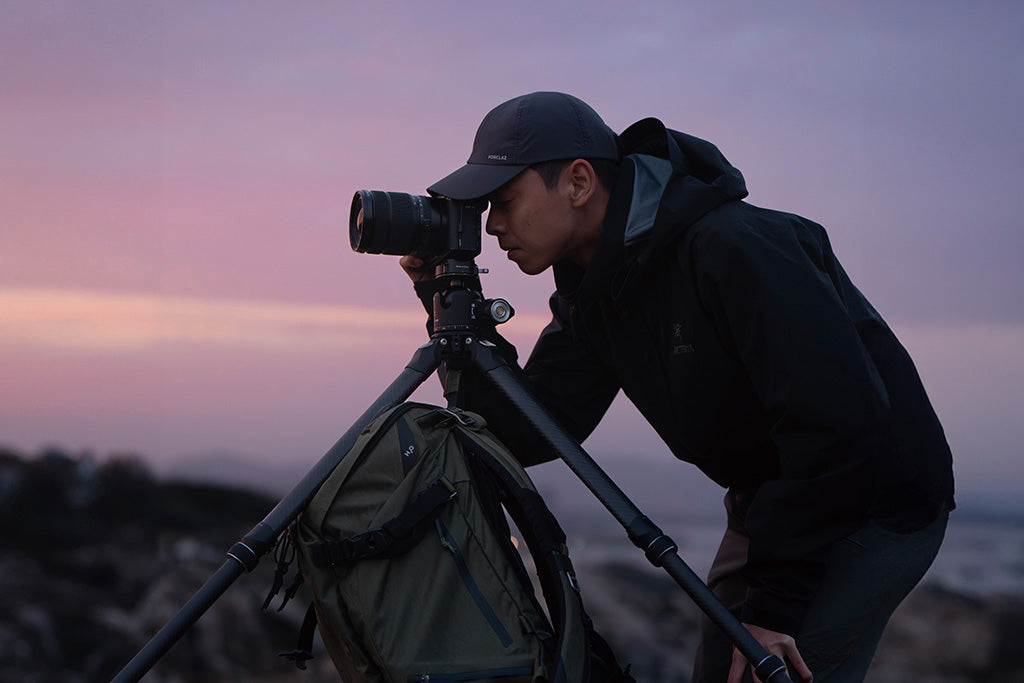
In our experience, creators often focus on the total weight of their rig, but they ignore the Leverage exerted on their wrists and the mounting plates. Weight isn't the only enemy; torque is the force that causes fatigue and plate slippage.
We use a fundamental biomechanical calculation to understand the stress on a quick-release system: Torque ($\tau$) = Mass ($m$) $\times$ Gravity ($g$) $\times$ Lever Arm ($L$)
Consider a standard "solo creator" rig:
- Scenario: A 2.8kg mirrorless rig with a monitor mounted on a long magic arm, extending 0.35m away from the center of gravity (the handle).
- Calculation: $2.8kg \times 9.81 m/s^2 \times 0.35m \approx 9.61 N\cdot m$.
For an average adult, this load represents roughly 60-80% of the Maximum Voluntary Contraction (MVC) of the wrist stabilizers. By utilizing the F22 system to bring accessories closer to the camera body—shortening the "Lever Arm" ($L$)—you don't just make the rig "feel" lighter; you fundamentally reduce the mechanical stress on the quick-release plates, preventing the common "plate creep" that occurs during long shoots.
The Economic Logic: Workflow ROI
Efficiency in the field translates directly to profitability. We have tracked the time-savings of moving from traditional threading to the FALCAM quick-release hierarchy across a standard production year.
| Task | Traditional Threading | FALCAM Quick-Release | Time Saved |
|---|---|---|---|
| Camera to Tripod | 40 Seconds | 3 Seconds | 37 Seconds |
| Monitor Mounting | 30 Seconds | 2 Seconds | 28 Seconds |
| Gimbal Balancing (Swap) | 120 Seconds | 10 Seconds | 110 Seconds |
| Annual Total (80 Shoots) | ~60 Hours | ~11 Hours | ~49 Hours |
Note: Estimates based on a professional workflow of 60 swaps per shoot and 80 shoots per year.
At a professional rate of $120/hr, saving 49 hours annually provides a value of over $5,800. This makes the initial investment in a modular ecosystem one of the highest-ROI purchases a studio can make. It isn't just about the "click"; it’s about the cumulative recovery of billable time.
Technical Interoperability: The Arca-Swiss Tension
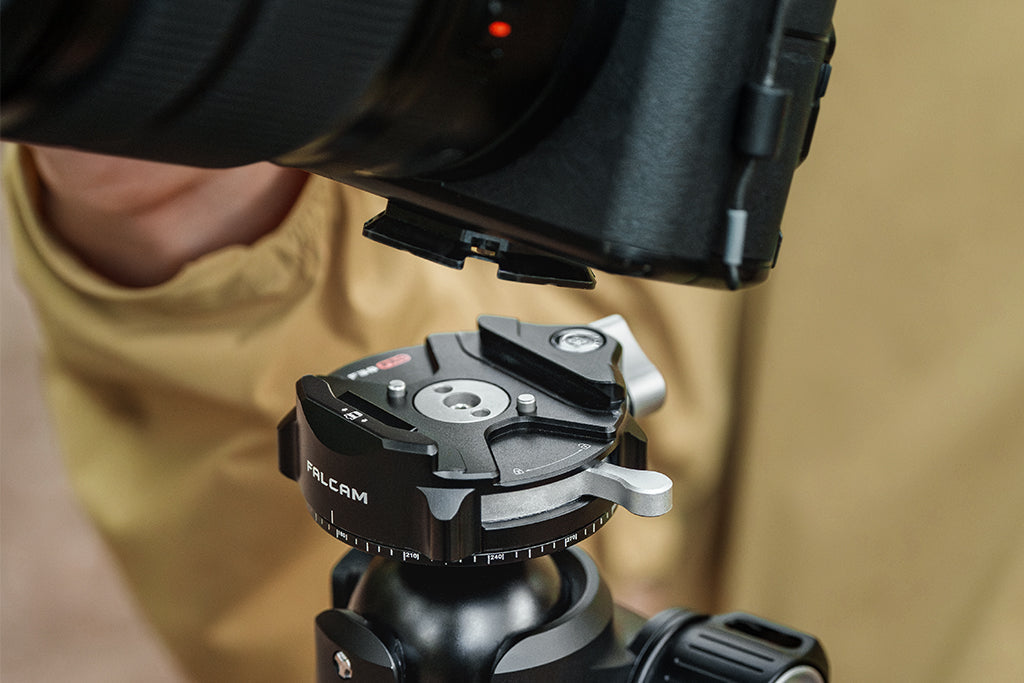
One of the most common "gotchas" for new users is the assumption that all dovetail mounts are created equal. While the F38 system is designed to be "compatible" with the Arca-Swiss standard, there are nuance-level friction points.
According to the Arca-Swiss Dovetail Technical Dimensions, the standard width and 45-degree angle are fairly consistent, but the "depth" of the safety-stop grooves varies. We have observed that because the FALCAM F38 foot is optimized for its own high-speed locking pin, it can be slightly narrower than some "legacy" Arca-Swiss clamps.
The Pattern Recognition Insight: If you are using a third-party tripod head with a "screw-knob" clamp, the F38 plate will work perfectly. However, if you are using a "lever-release" clamp from a different brand, you may encounter a "loose fit" due to the fixed tolerances of the lever. For critical shots, we always recommend the "Tug Test": once mounted, apply firm upward pressure. If there is any "click" or play, the tolerances are mismatched, and you should switch to a screw-knob receiver.
Environmental Resilience and Safety Workflows
The FALCAM plates are precision-machined from aluminum alloy. While this provides incredible rigidity, it introduces specific environmental behaviors that a professional must manage.
The "Thermal Shock" Prevention
Aluminum is a highly efficient thermal conductor. In winter scenarios, an aluminum plate acts as a "thermal bridge," drawing heat away from the camera's baseplate and, consequently, its battery.
- Expert Tip: Attach your quick-release plates to your cameras indoors at room temperature. This creates a stable thermal bond. If you attach a freezing cold plate to a warm camera in the field, you risk condensation forming between the plate and the camera body, which can lead to plate slippage as the moisture acts as a lubricant.
Wind Load and Stability
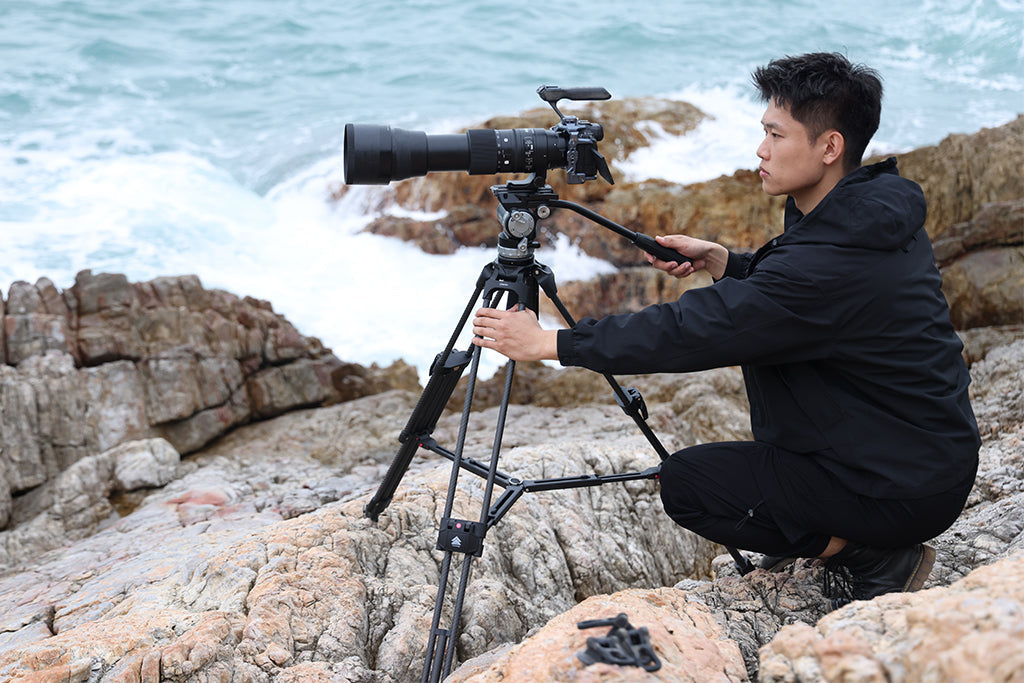
When working outdoors, the stability of your rig is a function of the tripod's damping and the quick-release's rigidity. While the Ulanzi F38 Travel Tripod uses carbon fiber legs to provide superior vibration damping—reducing settling time from 5.3 seconds (aluminum) to just 1.0 second—the quick-release plate itself must remain perfectly rigid.
- The Safety Factor: In our simulations, a 4.5kg cinema setup on an F38-standard tripod has a critical tipping speed of approximately 18.5 m/s. For most shoots (at ~8 m/s wind), this provides a safety factor of 2.3x.
The Pre-Shoot Safety Checklist
To maintain the integrity of the "infrastructure" layer, we recommend a three-step sensory check every time you mount a piece of gear:
- Audible: Listen for the distinct metallic "Click" of the spring-loaded pin.
- Tactile: Perform the "Pull-Test." Grab the camera body and attempt to lift it without disengaging the lock.
- Visual: Check the locking button. In the FALCAM system, the orange or silver indicator must be in the "locked" position to prevent accidental engagement of the release trigger.
Travel Logistics and "Visual Weight"
For solo creators who travel frequently, the modularity of the F22 and F38 systems offers a hidden logistical advantage. Bulky cinema plates and large "V-mount" rigs often attract the attention of airline gate agents. According to the IATA Lithium Battery Guidance, while the batteries themselves are the primary concern, the "Visual Weight" of a rig—how heavy it looks—often triggers a scale check. By using the low-profile F38 system, you can strip your rig down into "modules" in seconds, allowing you to pack the camera body in a carry-on and the "heavy" metal components in checked luggage, maintaining a low profile during transit.

Building the Long-Term Ecosystem
The real power of the FALCAM hierarchy is realized when you stop thinking about "one plate" and start thinking about "one standard."
The Power User Strategy: Standardize your entire kit on F38 for primary mounts and F22 for accessories. By pre-mounting F38 plates on your gimbal, slider, and every tripod, you reduce the "mental load" of the shoot. You no longer ask, "Where is the adapter?" You simply move the camera.
Avoid the common mistake of mixing generations (e.g., using a V1 plate in a V2 receiver) for load-bearing shots. While they are often backward compatible, the V2 series features refined machining tolerances that provide a more secure "zero-play" lock. In professional production, "almost fits" is a failure state. Invest in the current standard, maintain your locking pins with a drop of dry lubricant once a year, and treat your quick-release system as the foundation upon which your creative work is built.
Disclaimer: This guide is for informational purposes only. Always verify the weight ratings of your specific hardware and perform safety tests before mounting high-value equipment. Ensure compliance with all local aviation and transport regulations regarding lithium batteries and electronic equipment.