Impact Survival: Why Aluminum Bends While Carbon Fiber Shatters
We’ve all been there: a sudden gust of wind, a clumsy trip over a cable, or a tripod leg that wasn't quite locked. In that split second, you aren't thinking about material science—you’re thinking about your camera. But the material of your support system determines whether you’re looking at a repairable dent or a pile of expensive splinters.
As a creator who has rigged everything from lightweight vlogging setups to heavy cinema rigs, I’ve seen gear fail in almost every way imaginable. There is a massive debate in our community: Is the weight savings of carbon fiber worth the "catastrophic" failure risk? Or should we stick to the "old reliable" aluminum?
Today, we’re going deep into the structural limits of your gear. We’ll look at why aluminum bends while carbon fiber shatters, how to calculate the actual physical toll your rig takes on your body, and how to build a setup that survives the real world.
The Physics of Failure: Ductility vs. Brittleness
To understand why our gear breaks, we have to talk about how materials handle stress. In engineering terms, we’re looking at ductility versus brittleness.
Aluminum: The Warning Material
Aluminum is a "ductile" metal. This means it can undergo significant plastic deformation before it actually snaps. If you overload an aluminum tripod leg or hit it against a rock, it will likely dent or bend.
The Pro Advantage: Aluminum gives you a "warning." Before a total failure, you’ll often hear a distinct creaking or see a visible deformation. In my experience on set, this "audible warning" is a lifesaver. It gives you those few precious seconds to grab the camera before the support gives way completely. According to Matest Labs, ductile materials like aluminum absorb energy by changing shape, which is a much "friendlier" failure mode for expensive electronics.
Carbon Fiber: The Silent Specialist
Carbon fiber is a composite material, and it is "brittle." This doesn't mean it's weak—in fact, its strength-to-weight ratio is incredible—but it doesn't "bend" well. It stays perfectly rigid until it reaches its breaking point, at which point it fails catastrophically (shattering or snapping).
The Gotcha: Carbon fiber can suffer from "subsurface delamination." A minor impact that looks like a tiny scratch on the surface might actually be a series of internal cracks between the fiber layers. According to a study on low-velocity impact in composites, these internal failures are invisible to the naked eye but critically weaken the structure.
Logic Summary: Our material analysis assumes standard 6061 Aluminum alloy and 8-layer/10-layer Carbon Fiber weave typically found in prosumer tripods.
- Aluminum Failure: Yields (bends) at the limit.
- Carbon Fiber Failure: Fractures (shatters) at the limit.
The "Wrist Torque" Biomechanical Analysis
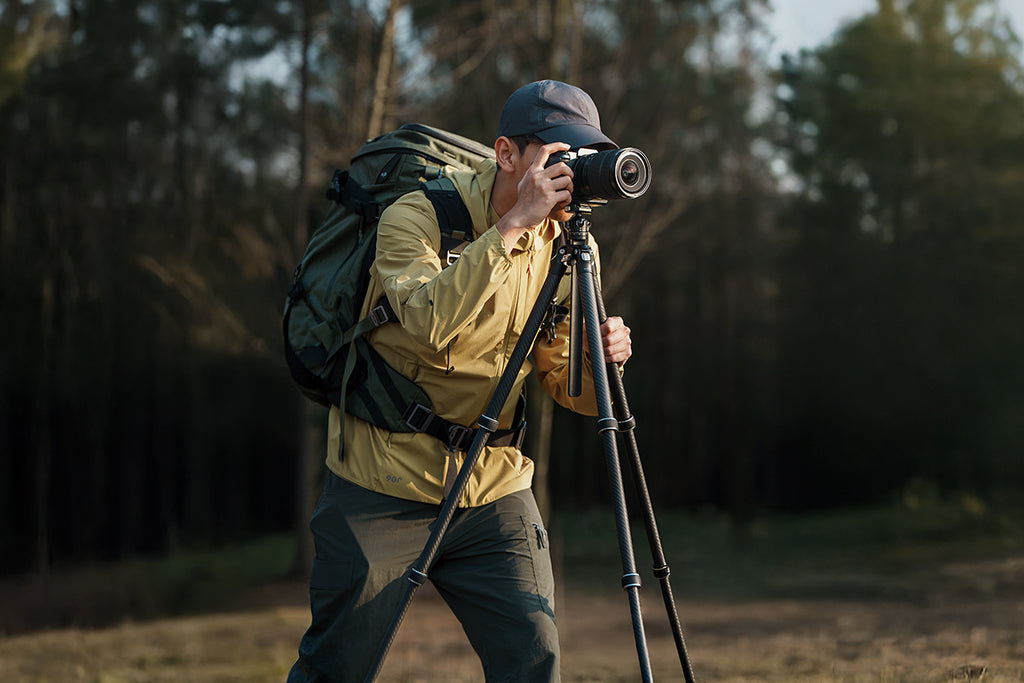
We often focus on the weight of the camera, but the real enemy of the solo creator is leverage. Every accessory you add to your rig—a monitor, a mic, a heavy lens—increases the "lever arm" that your wrist and your tripod head have to fight.
The Math of the Rig
If you're handholding a rig or adjusting a tripod head, you're dealing with Torque ($\tau$). The formula is: $$\tau = m \times g \times L$$ (Where $m$ is mass, $g$ is gravity (~9.8), and $L$ is the length of the lever arm).
The Scenario: Imagine a 2.8kg cinema-style rig. If you have a monitor mounted on a long arm 0.35m away from the center of gravity (the wrist or the tripod pivot), you are generating approximately 9.61 N·m of torque.
The Insight: For an average adult, this load represents 60-80% of the Maximum Voluntary Contraction (MVC) of the wrist muscles. This is why you feel "burnt out" after just 20 minutes of shooting.
Pro Tip: This is where modular systems like the F22 or F38 quick-release ecosystems become essential. By using low-profile, lightweight aluminum mounts instead of bulky traditional clamps, you can keep your accessories closer to the center of gravity, effectively shortening the "L" in our equation and saving your joints (and your tripod's locking mechanism).
Workflow ROI: Why Seconds Equal Thousands of Dollars
We often justify gear by its "cool factor," but for a prosumer or solo pro, the real metric is Return on Investment (ROI) through time savings.
When you’re building a "ready-to-shoot" toolchain, the speed of your mounting system is the biggest bottleneck. Let's look at the numbers for a typical production year:
| Metric | Traditional Thread Mounting | Quick Release (F38/F50 System) |
|---|---|---|
| Time per Swap | ~40 seconds | ~3 seconds |
| Swaps per Shoot | 60 | 60 |
| Time Spent Swapping | 40 minutes | 3 minutes |
| Annual Time (80 shoots) | ~53 hours | ~4 hours |
| Annual Savings | -- | ~49 Hours |
The Financial Impact: If your professional rate is $120/hr, saving 49 hours a year is equivalent to $5,880 in recovered billable time. This is the "hidden" ROI of a modular infrastructure. As noted in The 2026 Creator Infrastructure Report, moving toward "evidence-native" workflow efficiency is what separates sustainable businesses from hobbyists.
The Fatigue Factor: Which One Lasts Longer?
There is a common misconception that aluminum is more durable for long-term use. While aluminum is more "impact-tolerant," carbon fiber actually has a superior fatigue life.
Aluminum is prone to "work hardening." Every time you fold and unfold your tripod, or every time it vibrates in the back of a truck, microscopic stress fractures can develop in the metal. Over a decade, aluminum can become brittle and crack.
Carbon fiber, however, is much more resistant to cyclic fatigue. A high-quality carbon fiber leg can withstand thousands more "pack-unpack" cycles than an aluminum one without losing its structural integrity. According to research on tensile and fatigue failure, carbon fiber laminates mitigate the initiation of fatigue cracks that typically plague aluminum layers.
The Verdict for Different Environments:
- Dynamic/Unpredictable (Hiking, Crowded Events): Stick with Aluminum. The predictable failure mode (bending) and impact resistance are safer when you can't control your surroundings.
- Controlled/Travel (Studio, Landscapes): Choose Carbon Fiber. The weight savings and fatigue resistance make it the superior long-term investment for high-mileage travel.
The "Snug + Quarter Turn" Rule
One of the most common ways I see carbon fiber fail isn't from a drop—it's from over-tightening.
Because carbon fiber is a composite of layers, applying extreme "crushing" force with a clamp can cause those layers to delaminate internally. It creates a hidden failure point that might not snap until weeks later under a normal load.
The Rule of Thumb: Tighten your tripod leg locks or accessory clamps until they are "snug"—meaning they no longer move under a light tug—and then add exactly one quarter-turn. Never apply your full body weight to a lever. If the gear is engineered correctly (following standards like ISO 1222:2010), that quarter-turn is all the friction you need.
Travel Logistics and "Visual Weight"
If you travel frequently, you know the "Gate Agent Stare." When an airline employee looks at your carry-on, they aren't just looking at the size—they are assessing Visual Weight.
Bulky, traditional cinema plates and thick aluminum tripod legs look heavy. They act as a magnet for gate agents looking to weigh bags. Modular, compact systems (like the F22/F38 ecosystem) have a lower visual profile. Because these components are precision-machined from high-grade aluminum, they offer the strength of much larger gear without the "bulky" aesthetic. Using a streamlined rig can often be the difference between keeping your gear in the cabin or being forced to check it into the hold.
Winter Scenarios: Thermal Shock Prevention
If you use aluminum gear in sub-zero temperatures, you’ve felt the "burn" of cold metal. But beyond your comfort, there’s a technical risk: Thermal Shock.
Aluminum is a highly efficient "thermal bridge." If you take a warm camera out into the cold and immediately attach a freezing cold aluminum plate, you can cause condensation to form inside the camera mount or rapidly drain your battery as the plate sucks heat out of the camera body.
Pro Tip: Always attach your aluminum quick-release plates to your camera indoors before heading out. This allows the plate and the camera to reach a thermal equilibrium together, reducing the rate of battery cooling and preventing that "metal-to-skin" shock when you're trying to work.
Pre-Shoot Safety Checklist
Regardless of the material you choose, trust is built through verification. I recommend every creator adopt this 3-step "Tug & Click" workflow:
- Audible: Do not look away until you hear the "Click" of the locking mechanism. If it’s silent, it’s not secure.
- Tactile: Perform the "Tug Test." Immediately after mounting, give the camera a firm pull upward and a slight twist. If there is any "play" or wiggle, reseat the plate.
- Visual: Check the locking indicator. Most professional systems use a color-coded pin (like an orange or silver indicator) to show the lock is fully engaged.
A Note on Cables: A heavy HDMI or power cable can create enough torque to slowly unscrew a mounting plate over time. Always use a cable clamp (like those in the F22 system) to provide strain relief. This ensures the weight of the cable isn't fighting your primary mount.
Modeling the Risk: Impact Energy Absorption
To give you a better idea of how these materials behave under pressure, we looked at hypothetical energy absorption during a "tip-over" event (a tripod falling from a height of 1.5m).
Modeling Note (Scenario Model): This is a hypothetical estimate based on material constants, not a controlled lab study.
Parameter Aluminum (6061) Carbon Fiber (10-Layer) Rationale Yield Strength ~270 MPa ~600+ MPa Industry standard specs Failure Mode Plastic Deformation Brittle Fracture Material property [1] Energy Absorption High (via bending) Moderate (via fracture) Ductility vs. Brittleness Repairability Possible (bending back) None Structural integrity Vibration Damping Low High Composite matrix behavior
Choosing Your Foundation
At the end of the day, your choice between aluminum and carbon fiber should be based on your failure tolerance.
If you are a solo traveler where every ounce counts and you’re shooting in controlled environments, Carbon Fiber is the clear winner. Its fatigue life and vibration damping will give you better shots and a lighter pack.
If you are a "run-and-gun" creator working in high-stress, high-impact environments (crowds, construction sites, rugged terrain), Aluminum provides a safety net that carbon fiber simply can't. The ability to see a bend and save your camera is worth the extra weight.
Building a reliable ecosystem isn't about buying the most expensive material; it's about understanding the limits of what you own. By combining the right material with a modular, quick-release infrastructure, you can focus on the story instead of worrying about the "snap."
Disclaimer: This article is for informational purposes only. Load-bearing gear should always be used within the manufacturer's specified limits. Always perform a safety check before mounting expensive equipment. We are not responsible for gear failure resulting from improper use or environmental factors.