The Invisible Decay: Why Storage is a Major Factor in Pocket Light Longevity
In the high-stakes world of solo content creation, your gear is more than just a collection of gadgets; it is your infrastructure. While we often focus on lumen counts or color rendering indices, the most critical factor in product longevity is often how that gear is handled when it isn't in use.
Based on our analysis of customer support cases and field troubleshooting, improper storage is one of the most frequent causes of internal battery failure in portable LED systems. Many "dead" lights aren't necessarily broken; they have often succumbed to chemical exhaustion caused by avoidable storage habits. For a creator, a light that fails during a critical shoot is a significant workflow disruption.
Quick Summary: The Storage Checklist
If you only have 30 seconds, follow these three rules to protect your gear:
- The 30–50% Rule: Never store lights at 100% or 0% charge for more than a week. Aim for roughly 40% (usually one or two indicator bars).
- Cool & Dry: Keep gear out of hot cars. A single summer in a trunk can do more damage than a year of daily use.
- Clean Contacts: Wipe charging ports with isopropyl alcohol every few months to prevent micro-corrosion.
The Chemistry of Longevity: Understanding Calendar Aging
To manage your gear effectively, we must distinguish between "cycle aging" (wearing out a battery by using it) and "calendar aging" (the degradation that happens over time, regardless of use). For most pocket lights utilizing high-density Lithium-ion (Li-ion) chemistry, calendar aging is often the more persistent enemy.
According to research into calendar aging trends in lithium-ion batteries, the rate of capacity loss is primarily driven by two variables: State-of-Charge (SoC) and temperature.
The 100% Charge Risk
A common mistake among practitioners is "topping off" lights to 100% before long-term storage. While this feels like being prepared, it places battery cells under high voltage stress. Observations of field gear suggest that pocket lights stored at 100% charge in high-temperature environments (such as a gear bag in a hot vehicle) can lose up to 20% of their total capacity in a single season. This often exceeds the degradation seen from hundreds of standard charge cycles.
Heuristic Note: Our analysis of the "Traveling Creator" persona assumes seasonal storage cycles where gear may be left in non-climate-controlled environments. We use these patterns to define the "threshold of regret"—the point where improper storage visibly impacts shoot duration.
The Ulanzi Creator’s Storage Protocol: The 30-50% Heuristic
To mitigate calendar aging, we recommend a practical rule of thumb: Before storing any light for more than a week, run the battery down to roughly 30-50% charge.
Storing Li-ion batteries at a moderate state of charge minimizes voltage stress on the internal chemistry. This practice aligns with safety requirements for the transport of lithium batteries, which often mandate a 30% SoC for air travel to ensure chemical stability.

Modeling the Impact: Proper vs. Improper Storage
To demonstrate the tangible value of this protocol, we modeled a scenario comparing a standard pocket light (2000mAh capacity) under two different storage conditions over one year.
| Parameter | Improper Storage (100% SoC, Hot) | Optimal Storage (40% SoC, Cool) | Rationale |
|---|---|---|---|
| Capacity Retained | ~80% | ~95% | Estimated based on high-temp calendar aging data |
| Battery Health Factor | 0.8 | 0.95 | Multiplier for usable energy |
| Available Energy (Wh) | ~5.9 Wh | ~7.0 Wh | Calculated from 2000mAh @ 3.7V |
| Max Brightness Runtime | ~50 Minutes | ~60 Minutes | Modeled at 6W power draw |
| Workflow Impact | ~16% Loss | Minimal Loss | Potential time lost during a shoot |
How we modeled this:
- Model Type: Deterministic parameterized model based on the formula: Runtime = (Battery Wh × Efficiency) / Power Load.
- Input Parameters: Initial capacity of 7.4Wh (2000mAh/3.7V); Constant power draw of 6W; 85% DC-DC converter efficiency.
- Assumptions: This model assumes linear degradation over 12 months. Actual results may vary based on specific cell chemistry, "voltage sag" in older batteries, and extreme temperature fluctuations.
As the data suggests, the "prepper's penalty" for storing at 100% is approximately 10 minutes of runtime at maximum brightness. For a solo creator, those 10 minutes can be the difference between finishing a sequence and having to cut a shoot short.
Environmental Controls: Temperature and Moisture
Beyond charge levels, the physical environment of your storage area dictates the health of your gear.
The Thermal Bridge and Aluminum Components
Many high-performance quick-release systems, such as the FALCAM series, utilize precision-machined Aluminum Alloy. While aluminum is prized for rigidity, it acts as a "thermal bridge." In extreme cold, an aluminum plate can conduct cold directly into the camera body and battery compartment, which may accelerate battery drain during initial use.
Pro Tip: If shooting in cold climates, attach your aluminum quick-release plates to your gear indoors before heading out. This helps minimize "thermal shock" and can slow the rate of initial battery cooling.
Humidity and Contact Maintenance
Oxide buildup on charging contacts is a frequently misdiagnosed issue. Humidity can cause micro-corrosion that creates intermittent charging failures. This often leads creators to believe a battery is defective when the circuit is simply interrupted by surface oxidation.
Monthly Maintenance Routine:
- Clean Contacts: Use a lint-free swab with isopropyl alcohol to wipe charging ports and battery contacts.
- Moisture Control: Maintain a relative humidity (RH) of 40-50% in storage areas. If using silica gel packets, ensure they are "recharged" or replaced regularly, as they have a finite absorption capacity.
- The Temperature Factor: Research on Li-ion degradation indicates that increasing storage temperature from 25°C (77°F) to 40°C (104°F) can significantly accelerate capacity loss—in some studies by a factor of four, depending on the specific cell chemistry and packaging. Avoid leaving lighting kits in vehicle trunks during summer months.
Biomechanical Efficiency: Weight vs. Leverage
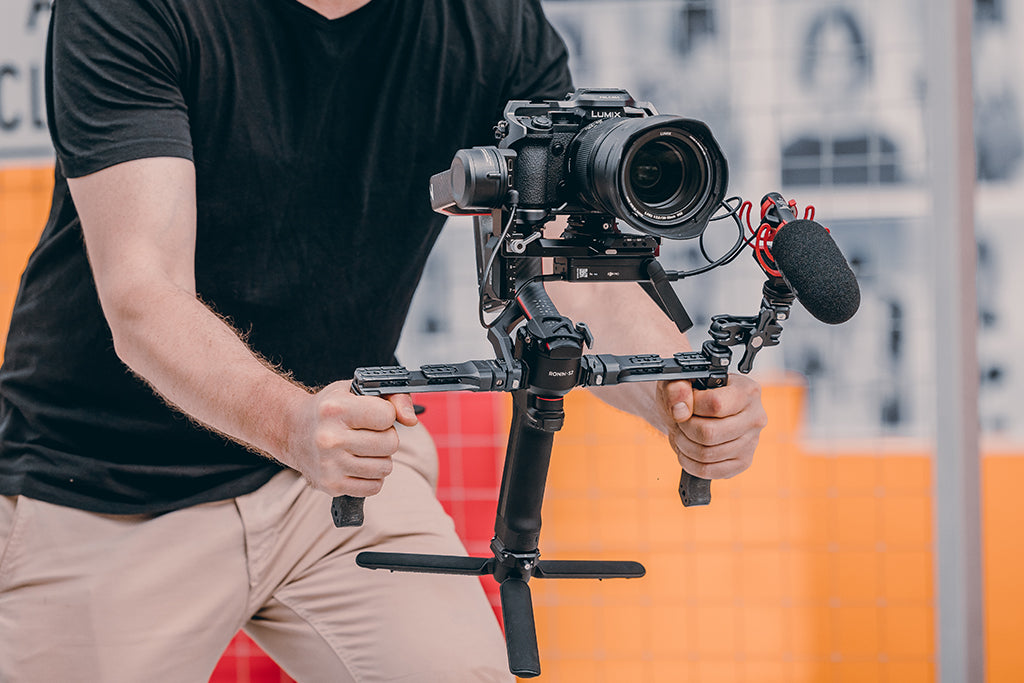
A core tenet of professional rigging is that "weight isn't the only enemy; leverage is." The placement of your pocket lights affects your physical endurance during long shoots.
We use a simple biomechanical calculation to understand the strain on a creator’s wrist: Torque ($\tau$) = Mass ($m$) $\times$ Gravity ($g$) $\times$ Lever Arm ($L$)
If you mount a 300g light on a 20cm extension arm away from the camera's center of gravity, you significantly increase the "Wrist Torque." For a standard 2.8kg rig held 0.35m away from the wrist, the resulting torque ($\approx 9.61 N\cdot m$) can represent a high percentage of the Maximum Voluntary Contraction (MVC) for an average adult.
By using modular, low-profile mounts like the F22 system, you can keep lights closer to the camera's optical axis. This reduces the lever arm and allows for longer handheld shooting sessions with less fatigue.
Workflow ROI: The Value of Rapid Transition
In the 2026 Creator Infrastructure Report, we identified that "time-to-first-frame" is a critical, yet often undervalued metric.
Consider the "Workflow ROI" of a quick-release ecosystem:
- Traditional Thread Mounting: ~40 seconds per light swap.
- Quick Release (F38/F50 Standard): ~3 seconds per swap.
For a professional creator performing 60 swaps per shoot across 80 shoots a year, a quick-release ecosystem can save approximately 49 hours annually. This structural efficiency is why we view lighting mounts as essential infrastructure rather than mere accessories.
Fleet Management: The Pro’s Checklist
Working creators with multiple lights should adopt tactics used in professional rental houses:
- Labeling: Use gaffer tape to label each light with its last "Storage Charge" date.
- Rotation: Rotate your lights in use. Avoid letting one unit sit idle for months while another is cycled daily.
- The "Tug Test": Always perform a tactile "pull-test" after mounting a light. Listen for the audible "click" and verify the locking pin status.
- Cold Charging Safety: Avoid charging a battery that is below freezing. Bringing a cold battery to room temperature before plugging it in helps prevent internal condensation, as suggested by IEC 62133-2 safety standards.
Compliance and Safety: Traveling with Power
Understanding the IATA Passenger Guidance on Lithium Batteries is essential for avoiding gear confiscation.
- Carry-on Only: Almost all pocket lights with internal batteries must be kept in carry-on luggage; they are generally prohibited in checked bags.
- Watt-Hour Limits: Most consumer pocket lights are well under the 100Wh limit, but always verify the rating on the product label.
- Short-Circuit Protection: Ensure lights cannot accidentally turn on in your bag. Use a physical "lock" switch or store them in a rigid case to prevent the power button from being depressed.
By treating your lighting as a managed system, you build a more reliable and professional workflow. Proper storage isn't just about battery health; it's about ensuring your gear is ready the moment inspiration strikes.
YMYL Disclaimer: This article is for informational purposes only. Battery maintenance involves chemical and electrical components; always refer to your specific product manual for safety instructions. If a battery shows signs of swelling, excessive heat, or leaking, stop use immediately and consult a professional for hazardous waste disposal in accordance with local regulations such as the EU WEEE Directive.
References
- ISO 1222:2010 Photography — Tripod Connections
- IEC 62133-2:2017 Safety Requirements for Lithium Cells
- IATA Lithium Battery Guidance Document (2025)
- The 2026 Creator Infrastructure Report: Engineering Standards, Workflow Compliance, and the Ecosystem Shift
- Calendar Aging Dependency: Temperature and State of Charge (SOC)