The Challenge of the "Ground-Level" Perspective
Getting the lens within an inch of the pavement is one of the most effective ways to transform mundane smartphone footage into cinematic B-roll. This ultra-low perspective creates foreground depth, emphasizes leading lines, and provides a sense of scale that standard eye-level shots lack. However, achieving this is rarely as simple as placing a phone on the ground.
In our experience troubleshooting creator workflows, we frequently see the same mistake: using a standard tripod at its minimum height. While many travel tripods claim "low-angle" capabilities, their center column often prevents the camera from getting truly close to the surface, leaving the setup vulnerable to micro-vibrations and instability. For a professional result, the rigging must be specialized. We believe in the principle of "specialized subtraction"—removing the bulk of a traditional cage or tripod to allow placement in spaces where a standard camera physically cannot fit.
The Physics of Low-Profile Stability
To achieve stable ground-level shots, we manage three critical variables: the center of gravity (CoG), surface friction, and cable management. When a rig is top-heavy, even a slight breeze or a passing vehicle can introduce shake.
The 1.5x Stability Heuristic
Based on our scenario modeling of low-profile support systems, we utilize a specific rule of thumb for ground rigging: the support base width should be at least 1.5 times the height of the camera's center of mass.
Modeling Note (Scenario Analysis): This heuristic is designed for static or slow-panning shots on flat surfaces. It assumes a standard smartphone weight (~200g-250g) and a low-profile mount.
| Parameter | Value/Range | Unit | Rationale |
|---|---|---|---|
| Smartphone Mass | 200 - 250 | g | Standard flagship weight |
| Max Height (CoG) | 50 - 100 | mm | Vertical distance from ground |
| Min Base Width | 75 - 150 | mm | Calculated 1.5x ratio |
| Surface Friction | 0.5 - 0.8 | $\mu$ | Typical asphalt/concrete friction |
| Wind Load Limit | < 15 | mph | Threshold for micro-vibration |
By keeping the base wider than the height of the center of mass, you significantly increase side-to-side stability. This is why a flat plate or a wide-legged desktop tripod is often superior to a vertical clamp for ground work.

Core Rigging Components for Mobile B-Roll
To build a reliable ground rig, you need a system that balances rapid reconfiguration with mechanical security. We recommend a modular approach based on the Arca-Swiss standard, which ensures ecosystem interoperability as defined by Arca-Swiss Dovetail Technical Dimensions.
1. The Low-Profile Support Base
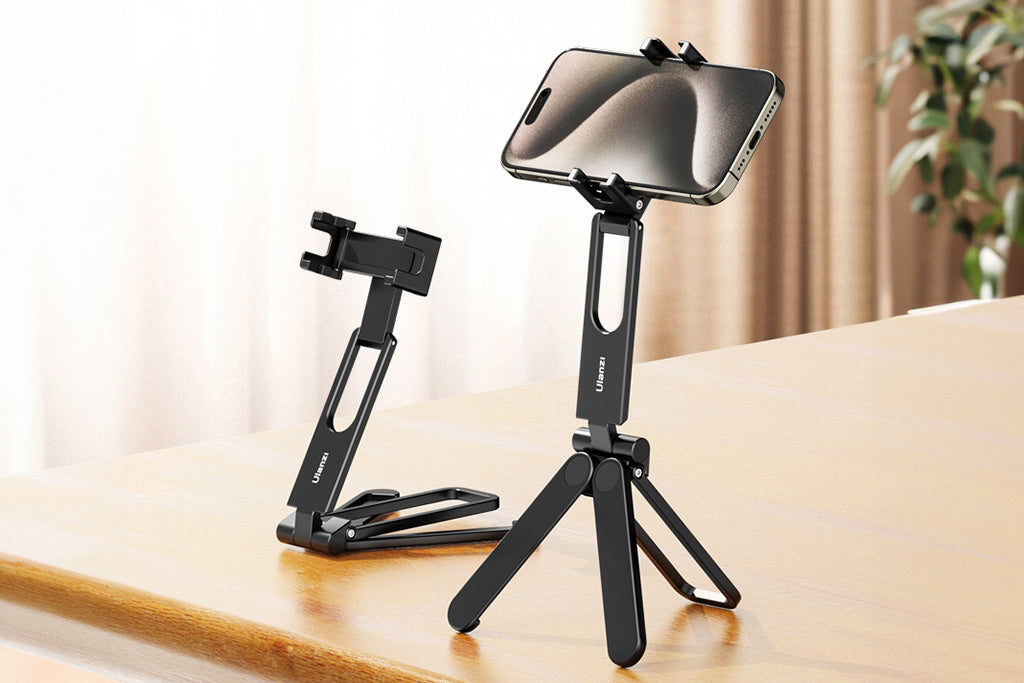
For tabletop or flat-ground shooting, a dedicated desktop tripod is the foundation. The Ulanzi Falcam TreeRoot Quick Open Desktop Tripod T00A4103 is an optimized solution here. Its quick-open linkage allows you to transition from a handheld grip to a stable ground support in a single motion. Weighing only 167g, it maintains a low "Visual Weight," making it less likely to be flagged during travel logistics.
2. The Quick-Release Interface
Speed is the primary driver of creativity for solo creators. We utilize the F38 system for its efficiency. According to ISO 1222:2010 Photography — Tripod Connections, standardized screw connections provide the baseline for security, but the F38 adds a layer of speed.
The Ulanzi F38 Quick Release Video Travel Tripod 3318 features a ball head with a 10kg vertical static load capacity. While the 10kg rating is a laboratory result for static weight, it provides a massive safety margin for smartphone rigs, which typically weigh less than 1kg. This overhead is what prevents the "creep" or sagging often seen in cheaper ball heads when tilted at extreme angles.
3. Magnetic Integration for Stealth
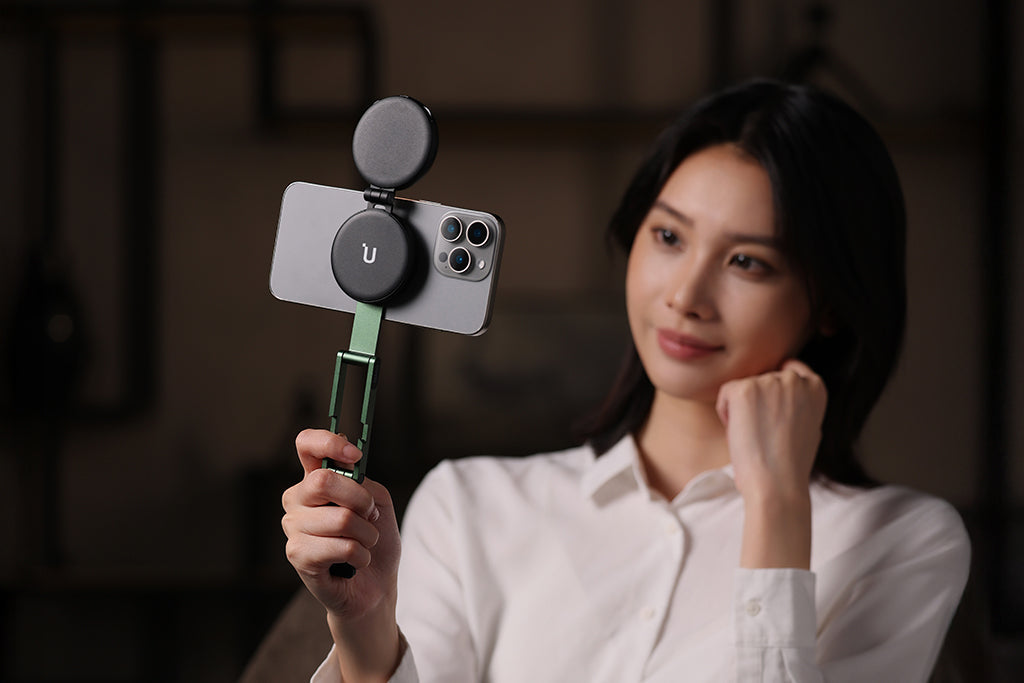
For truly tight spaces—like under a vehicle or flush against a metal curb—a magnetic mount is often the only viable option. The Ulanzi MA89 MagLock Phone Holder Mount M065 allows for near-instant attachment. However, we must address a common pitfall: magnetic systems excel for rapid reconfiguration but should be paired with a secondary mechanical lock for load-bearing setups.
Biomechanical Analysis: Why Low-Profile Rigging Saves Your Body
Rigging isn't just about the camera; it’s about the creator. When you are shooting low to the ground, you are often in awkward physical positions. The weight of your rig creates leverage that can lead to rapid fatigue.
The "Wrist Torque" Calculation
We can quantify the strain of a mobile rig using the formula for Torque ($\tau$): $$\tau = m \times g \times L$$
- $m$: Mass of the rig (kg)
- $g$: Gravity (~9.8 $m/s^2$)
- $L$: Lever arm (distance from the wrist to the rig's center of mass in meters)
If you hold a 1kg mobile rig (phone + cage + light + mic) at the end of a 0.3m extension arm, you generate approximately 2.94 $N\cdot m$ of torque. For an average adult, maintaining this load for extended periods can represent 60-80% of their Maximum Voluntary Contraction (MVC). By using a low-profile ground rig like the Ulanzi Falcam TreeRoot Quick Open Desktop Tripod T00A4103, you transfer that load entirely to the ground, eliminating biomechanical strain and allowing for longer, more precise takes.
Workflow ROI: The Economic Case for Quick Release
Professional creators often view gear as an investment in time. To justify the shift to a modular quick-release ecosystem, we modeled the "Workflow ROI" for a typical shoot.
The Efficiency Gain Model
- Traditional Thread Mounting: ~40 seconds per swap (unscrewing/rescrewing).
- F38 Quick Release: ~3 seconds per swap (click and lock).
- Time Saved: 37 seconds per transition.
If a professional solo creator performs 60 equipment swaps per shoot (switching from tripod to handheld to ground rig) and works 80 shoots per year, the total time saved is approximately 49 hours annually. At a professional rate of $120/hr, this equates to a $5,880 value in recovered productivity. As noted in The 2026 Creator Infrastructure Report, these small structural efficiencies are what separate sustainable businesses from hobbyists.
Practical Setup Scenarios
Scenario A: The Urban Stealth Setup (Magnetic/Low Profile)
This setup is for creators who need to move fast in public spaces without drawing attention.
- Core: Ulanzi MA89 MagLock Phone Holder Mount M065.
- Support: A flat Arca-Swiss plate or a small metal surface.
- Benefit: The "specialized subtraction" approach allows the phone to sit virtually flush with the ground.
- Constraint: Best for static shots on flat, magnetic-friendly surfaces.
Scenario B: The All-Terrain Stability Setup
For shooting on grass, gravel, or uneven pavement.
- Core: Ulanzi Falcam TreeRoot Quick Open Desktop Tripod T00A4103.
- Interface: F38 Quick Release.
- Benefit: The wide leg spread handles uneven terrain while keeping the lens low.
- Constraint: Requires slightly more vertical clearance than a flat plate.
Safety, Compliance, and Gear Longevity
When rigging at ground level, your gear is exposed to unique risks: dust, moisture, and physical impact.
Battery Safety in the Field
If your mobile rig includes external power banks, they must adhere to safety standards. We ensure all our integrated lithium solutions meet IEC 62133-2:2017 for cell safety. For traveling creators, remember that lithium batteries must remain in carry-on luggage according to IATA Lithium Battery Guidance.
The "Thermal Shock" Prevention
One non-obvious mechanical issue is the "thermal bridge" created by aluminum quick-release plates. In extreme cold, an aluminum plate can conduct heat away from the camera base, accelerating battery drain.
- Expert Tip: Attach your aluminum QR plates to your devices indoors before heading out into the cold. This allows the materials to reach an equilibrium state and reduces the rate of battery cooling.
Advanced Rigging: The Super Clamp Utility
Sometimes the ground isn't a flat surface—it’s a railing, a pipe, or a curb. The Ulanzi CO17 Super Clamp with Dual Ballhead Magic Arm C046GBB1 is the "Swiss Army Knife" of low-profile rigging. With a 3.5kg load capacity and 360° adjustment, it can secure a phone to nearly any structure within 2.28" wide. This is particularly useful for Overhead Rigging or securing a side-car rig to a bicycle for low-angle tracking shots.
Cable Management & Port Protection
A common point of failure in mobile rigging isn't the mount, but the torque on the phone's USB-C port. When using external mics or lights, the weight of the cable can strain the internal connector.
- Solution: Use a rigid cage or a cable clamp. This distributes the accessory weight to the rig's frame rather than the port.
Pre-Shoot Safety Checklist
Before hitting record on a ground-level shot, perform this three-step verification:
- Audible: Listen for the distinct "Click" of the quick-release mechanism.
- Tactile: Perform a "Tug Test." Gently pull on the phone to ensure the locking pin is fully engaged.
- Visual: Check the locking indicator. On the F38 system, ensure the safety lock is in the "locked" position to prevent accidental detachment.
Building a Reliable Infrastructure
Mobile ground rigging is more than just a creative choice; it is a technical challenge that requires an understanding of physics, biomechanics, and ecosystem compatibility. By moving away from "one-size-fits-all" tripods and embracing a modular, low-profile system, you gain the ability to capture perspectives that were previously impossible.
As the industry shifts toward "ready-to-shoot" toolchains, the brands that prioritize engineering discipline and stable interfaces will become the default choice for the next generation of filmmakers. Whether you are Balancing Heavy Rigs or optimizing for One-Handed Vlogging, the goal remains the same: maximum shot versatility with a minimum visible footprint.
Disclaimer: This guide is for informational purposes. Always ensure your rigging is secure before use. For high-speed or safety-critical applications, secondary safety tethers are recommended., cover_image_url: