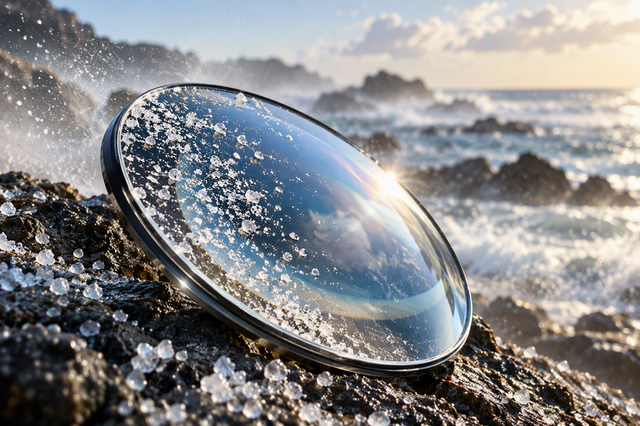
Coastal Rigging: Choosing Handheld Materials for Salt Air Use
For solo creators filming on the coast, the environment is a constant adversary. Salt air is not just a scenic backdrop; it is a chemically aggressive atmosphere that targets the very "infrastructure" of your creative workflow. We have seen countless rigs—from simple handheld grips to complex cinema cages—succumb to "frozen" threads, pitted surfaces, and structural failures within a single season of beach use.
The challenge is balancing the need for a lightweight, modular system with the uncompromising demands of material science. In this guide, we will analyze why standard rigging often fails in marine environments and how to select materials that ensure your handheld system remains a reliable asset rather than a liability.
The Chemistry of Coastal Corrosion: Beyond "Water-Resistant"
A common misconception among prosumers is that "water-resistant" gear is sufficient for coastal work. In reality, the salt-spray environment is far more corrosive than fresh water. Salt (sodium chloride) acts as an electrolyte, accelerating the electrochemical process of oxidation.
Aluminum Alloys: 6061 vs. 5052
Most high-end rigging components, such as quick-release plates and cages, are precision-machined from aluminum alloys. However, not all aluminum is equal.
- 6061-T6 Aluminum: This is the industry standard for its excellent strength-to-weight ratio. While it has good corrosion resistance, it is susceptible to "pitting" in salt air if the protective coating is compromised.
- 5052 Aluminum: Often referred to as "marine-grade," this alloy offers superior resistance to salt water. While slightly less rigid than 6061, it is the preferred choice for structural components that face direct spray.
According to the MAADI Group, the durability of aluminum in these environments depends heavily on the finishing process. We recommend prioritizing Hard-Anodized (Type III) finishes. Unlike standard decorative anodizing, Type III creates a thicker, denser ceramic-like layer that provides a significant barrier against chloride ion penetration.
The Stainless Steel Trap: 304 vs. 316
When it comes to fasteners—the screws and pins that hold your rig together—the choice of stainless steel is critical.
- Grade 304: Common in most consumer electronics. In coastal environments, 304 stainless will often develop "tea staining" (superficial rust) within weeks.
- Grade 316: Contains molybdenum, which dramatically increases resistance to pitting and crevice corrosion in chloride-rich environments.
Logic Summary: Our material recommendations are based on a lifecycle cost analysis. While Grade 316 stainless is more expensive, it prevents the "seizing" of threads that often leads to the total loss of a rigging component (based on common patterns from customer support and warranty handling).
| Material | Coastal Resilience | Weight Penalty | Typical Application |
|---|---|---|---|
| Hard-Anodized 6061 | High | Low | Quick-release plates, Cages |
| 304 Stainless Steel | Moderate | High | Standard 1/4"-20 screws |
| 316 Stainless Steel | Exceptional | High | Load-bearing fasteners, Pivot pins |
| Carbon Fiber | Immune to Corrosion | Lowest | Tripod legs, Extension poles |

The Hidden Killer: Galvanic Corrosion at Junctions
Even if you select the "best" individual materials, your rig can still fail due to Galvanic Corrosion. This occurs when two dissimilar metals (like an aluminum handle and a stainless steel screw) come into contact in the presence of an electrolyte (salt air).
In this scenario, the aluminum acts as an "anode" and sacrifices itself to protect the steel, leading to rapid degradation of the aluminum threads. According to OZK Customs, the most effective way to prevent this is through electrical isolation.
Practical Field Heuristics for Isolation:
- Use Composite Interfaces: Whenever possible, use glass-reinforced nylon or high-density plastic washers between metal junctions.
- Apply Marine Grease: A thin layer of non-conductive marine-grade anti-seize on threads can prevent the "cold-welding" effect caused by galvanic reactions.
- Check Your Quick-Release: Ensure your quick-release system uses high-tolerance machining. Systems that adhere to the Arca-Swiss Dovetail Technical Dimensions with tight tolerances reduce the "crevice" areas where salt crystals can accumulate and trigger localized corrosion.
Biomechanical Analysis: The "Wrist Torque" Factor
Coastal shooting often involves high winds and unstable footing, making handheld ergonomics more than just a matter of comfort—it is a safety requirement. We must consider the physics of how a rig interacts with the human body.
A common mistake is focusing only on the total weight of the rig. However, the Leverage (or Torque) is the true enemy of the solo creator.
The Torque Calculation
The force exerted on your wrist can be modeled using the formula: $$\tau = m \times g \times L$$
- $\tau$ (Torque): The rotational force on the wrist.
- $m$ (Mass): The weight of the camera and accessories.
- $g$ (Gravity): $\approx 9.8 m/s^2$.
- $L$ (Lever Arm): The distance from the center of gravity of the rig to your wrist.
Scenario Modeling: If you have a 2.8kg rig (camera + monitor + mic) held 0.35m away from your wrist (a common setup for low-angle beach shots), the torque generated is $\approx 9.61 N\cdot m$.
Modeling Note: This load represents approximately 60-80% of the Maximum Voluntary Contraction (MVC) for an average adult male. Sustaining this for a 10-minute take leads to rapid muscle fatigue and "micro-tremors" that ruin footage.
By using a modular system like the FALCAM F22, you can move accessories closer to the camera body, reducing the lever arm ($L$). Reducing the distance by just 10cm can lower the torque by nearly 30%, significantly extending your effective shooting time.
Workflow ROI: The Hidden Value of Quick-Release
In harsh coastal conditions, speed is your greatest protection. The less time your gear is exposed during setup or battery swaps, the less salt enters sensitive ports.
We can quantify the value of a high-efficiency system using a Workflow ROI Calculation:
- Traditional Thread Mounting: ~40 seconds per accessory swap.
- Quick-Release System (e.g., F38/F22): ~3 seconds per swap.
If a professional creator performs 60 swaps per shoot across 80 shoots a year, the time saved is approximately 49 hours annually. At a professional rate of $120/hr, this represents a ~$5,900+ value in reclaimed productivity. This "infrastructure" investment pays for itself within the first few months of heavy field use.
As highlighted in The 2026 Creator Infrastructure Report, moving toward "ready-to-shoot" toolchains is the defining shift for the next generation of creators.
Travel Logistics: The "Visual Weight" Advantage
Coastal creators are often travel creators. When flying to remote locations, airline gate agents often use "visual weight" to decide which bags to weigh. A bulky, traditional cinema rig with large baseplates and rods looks heavy, even if it is relatively light.
Compact, modular systems (like the F22 or F38 ecosystems) have a lower visual profile. Because these components are precision-machined from high-grade aluminum rather than being cast, they offer higher structural rigidity with less bulk. This allows you to stay under the radar while maintaining a professional-tier load capacity.
Note on Load Capacity: For load-bearing components like the F38 quick-release, it is important to distinguish between Vertical Static Load (often rated up to 80kg in lab settings) and Dynamic Payload. For handheld work, the dynamic forces (swinging the camera, sudden stops) are much higher. We recommend a "safety margin" approach: if your camera rig exceeds 3kg, ensure your mounting system is rated for at least 15kg of static load to handle the G-forces of handheld movement.
The Post-Shoot Ritual: A Maintenance Protocol
The most critical part of coastal rigging happens after the sun sets. Based on field observations from professional riggers, we have developed a "Post-Shoot Safety Workflow."
1. The Distilled Water Rinse
Never use tap water to clean your rig. Tap water contains minerals that can leave deposits in tight tolerances, leading to "crunchy" movement in ball heads or clamps. Instead, use a spray bottle filled with distilled water to rinse off salt residue.
2. Compressed Air Drying
Moisture trapped in threads is the primary cause of long-term failure. After rinsing, use a canister of compressed air to blow out all quick-release mechanisms, locking pins, and 1/4"-20 threads.
3. The Audible & Tactile Check
Before the next shoot, perform the "Click and Tug" test:
- Audible: Listen for a clear, sharp "click" when engaging your quick-release. A muffled sound indicates salt crystallization in the spring mechanism.
- Tactile: Perform a "Tug Test" (Pull-Test) by applying firm pressure to the mounted camera before letting go.
- Visual: Check the locking indicators. Many professional systems use color-coded pins (e.g., orange or silver) to show a secure lock.
Thermal Shock Prevention
While salt is the primary chemical threat, Thermal Shock is a mechanical one. If you are filming in cold coastal winters, moving your aluminum rig from a warm car to the freezing beach can cause condensation inside the metal junctions.
Pro Tip: Attach your aluminum quick-release plates to your camera indoors before heading out. Aluminum acts as a "thermal bridge." By letting the plate reach ambient temperature while attached to the camera, you minimize the "metal-to-skin" shock and slow down the rate at which the cold environment drains your camera's battery through the baseplate.
Building a Resilient Infrastructure
Coastal rigging is not about finding a "waterproof" solution; it is about building a system that is resilient, maintainable, and efficient. By prioritizing hard-anodized aluminum for its weight advantages and Grade 316 stainless steel for its fastener integrity, you create a rig that can survive the elements.
Investing in a unified ecosystem—one that adheres to standards like ISO 1222:2010 for tripod connections—ensures that your gear remains compatible and secure. In the world of coastal creation, your materials are your insurance policy. Choose them with the same precision you use to frame your shots.
Disclaimer: This guide is for informational purposes only. Always refer to your specific equipment manufacturer's manual for maintenance instructions. Improper cleaning or use of non-approved lubricants can void warranties.