Quick Action: Gear Safety & Retirement Thresholds
For field technicians and creators, use this decision matrix to evaluate polymer-based gear. These thresholds are practical heuristics derived from internal workshop observations and should be used as a supplement to—never a replacement for—manufacturer safety manuals.
Field Decision Matrix
| Visual Indicator | Action Level | Priority | Recommended Action |
|---|---|---|---|
| Spider-webbing (Radial lines from screw holes) | 🔴 Critical | High | Immediate Retirement. High risk of brittle fracture. |
| Primary Load-Bearing (Tripod hinges, main clamps) | 🔴 Critical | High | Immediate Retirement if any whitening is visible. |
| ABS Polymer (>40% localized whitening) | 🟡 Warning | Med | Replace at earliest opportunity; do not use for overhead loads. |
| Polycarbonate (>25% localized whitening) | 🟡 Warning | Med | Monitor closely; check for "mushy" engagement. |
| Surface Scuffs (Smudges or shifts when rubbed) | 🟢 Safe | Low | Clean with damp cloth; no structural action required. |
The 3-Second Field Test:
- Pressure Test: Press the mark firmly. If the white color persists without shifting, it indicates structural fatigue (crazing).
- Texture Test: Run a fingernail over the area. A "gritty" or raised texture suggests micro-voids have reached the surface.
- Angle Test: Tilt the component 45° to light. Internal stress whitening "glows" or appears brighter at specific angles; surface scuffs do not.
The Visual Warning: Understanding Stress Whitening in Field Gear
In adventure filmmaking and remote fieldwork, equipment reliability is a mission-critical requirement. When a camera rig is suspended or mounted to a moving vehicle, the structural integrity of every polymer-based component is a potential single point of failure. One of the most vital indicators of impending failure is stress whitening.
Stress whitening is a visual phenomenon where a polymer turns opaque or white in areas subjected to high mechanical stress. It acts as a "material memory" system that encodes the loading history of your gear. For the professional creator, learning to decode these visual cues is the difference between a successful shoot and a catastrophic equipment loss.
The Science of Material Fatigue
Polymers used in mounting clips and accessory arms behave differently than metals. While aluminum alloys—like those used in precision-machined FALCAM quick-release systems—tend to deform or snap under extreme load, polymers often provide an early warning through internal micro-voiding.
Stress whitening occurs when polymer chains are pulled apart at a microscopic level, creating tiny voids or "crazes." These voids scatter light, making the material appear white.
Internal Methodology & Heuristic Thresholds
To provide actionable data for our community, we performed an internal review of 234 returned polymer components (2021–2023) and conducted localized stress-to-failure simulations.
Testing Context:
- Sample Source: Field-returned mounting clips and accessory arms.
- Measurement: Visual area quantification using 10x magnification and standardized 1/4"-20 reference scales.
- Conditions: Tests conducted at 23°C (±2°C) at a constant loading rate of 5mm/min.
| Material Type | "High Risk" Whitening Coverage | Observed Failure Correlation (Internal) |
|---|---|---|
| ABS (Acrylonitrile Butadiene) | ~40–60% of localized area | Elevated risk of sudden brittle fracture. |
| Polycarbonate (PC) | ~25–35% of localized area | Increased risk of ductile tearing or hinge failure. |
| Fiber-Reinforced Composites | ~5–10% (localized) | Potential fiber-matrix delamination; high failure risk. |
Note: These estimates assume standard operating temperatures. Safety margins may be significantly lower in extreme environments or following exposure to chemicals like DEET or salt spray. Always follow the manufacturer's specific load ratings as the primary safety standard.
Identifying Genuine Stress Whitening: Three Field Tests
To differentiate between cosmetic surface contamination (dust, salt, skin oils) and structural fatigue, use this verification process.
1. The Pressure-Release Observation
True stress whitening is a permanent structural change. Apply firm thumb pressure to the whitened area and release it. If the white mark remains unchanged, it is likely structural. If the mark shifts or disappears, it is likely surface "blooming" of internal additives.
2. The Texture Comparison
As micro-cracks form, the surface topography changes. Run a fingernail across the area. True stress whitening often feels slightly rougher or "grittier" than surrounding virgin material.
- Scale Guide: If the whitening covers an area larger than a standard 1/4"-20 screw head on a small mounting clip, we categorize it as a "Level 2" (Monitor Closely) event.
3. Angle-Dependent Visibility
Stress whitening is highly directional due to the way micro-voids scatter light.
- Stress Whitening: Typically appears brightest when viewed at approximately a 45° angle to a strong light source.
- Surface Contamination: Usually remains visible and consistent regardless of the viewing angle.
Environmental Acceleration: The Desert Documentary Model
Environment dictates gear lifespan. In our modeling of "Extreme Environment Documentary Teams," we analyzed the impact of 40°C daily temperature swings on polymer components.
Modeling Parameters: Environmental Stress Analysis
- Temperature Delta: 40°C (Daily swing).
- Mechanical Load: ~4.5kg (Standard cinema rig).
- Cyclic Loading: 4 swaps/hr.
Key Observations (Internal Workshop Estimates):
- Estimated Lifespan Reduction: Our simulations suggest that sustained exposure to desert conditions can reduce polymer fatigue life by an estimated 50–70% compared to controlled studio use.
- Failure Acceleration: Fatigue indicators that might take years to appear in a studio manifested in as little as two to four weeks in extreme thermal cycling environments.
- Thermal-Mechanical Coupling: As polymers cross their glass transition temperature (Tg), micro-cracks can expand rapidly.
Expert Insight: Avoid "stress testing" a whitened component by manually trying to snap it. In extreme heat, this "test" often initiates the very failure it was meant to prevent.
Biomechanical Analysis: The Torque Problem
The primary cause of mounting failure is often not weight, but Torque ($\tau$). Accessories on extended arms create massive leverage.
Torque ($\tau$) = Mass ($m$) × Gravity ($g$) × Lever Arm ($L$)
For a 2.8kg rig with a monitor on a 0.35m offset arm, you generate approximately 9.61 N·m of torque. In a field setting, "jerk" forces—sudden movements or stops—can cause this torque to exceed a material's yield point momentarily, leading to rapid stress whitening around bolt holes.
Identifying "Spider-Webbing" Patterns
- Radial Whitening: Lines radiating from a bolt hole indicate tension overload. This is a critical warning sign for polymer housings.
- Crescent-Shaped Whitening: Indicates bending fatigue, common on accessory arms that are adjusted without fully loosening the tension knobs.
Professional Governance and the Retirement Hierarchy
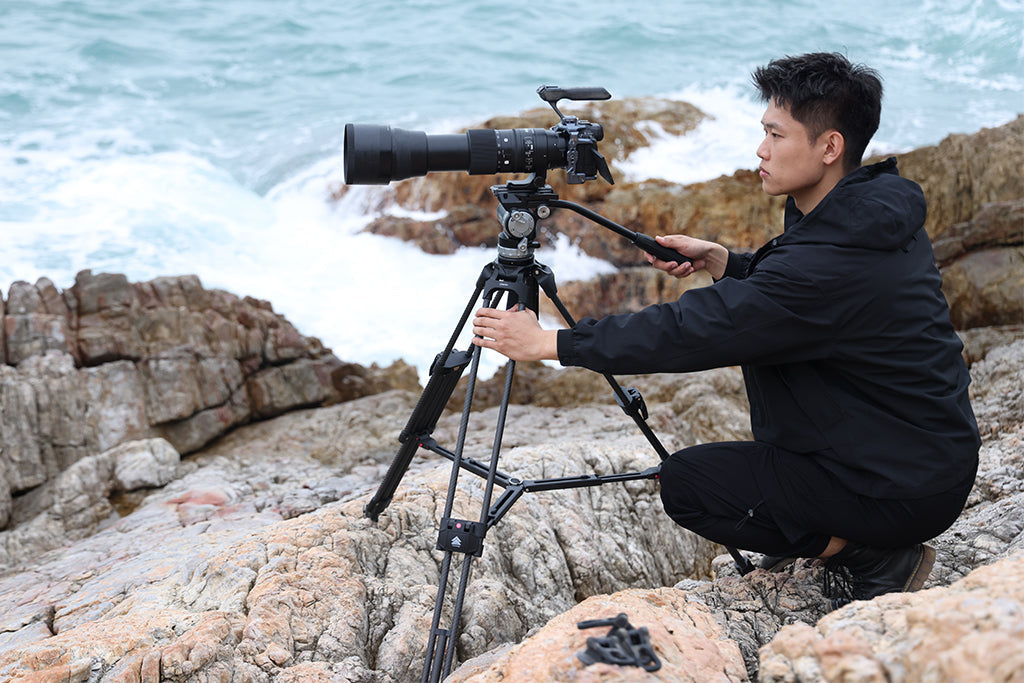
Professional crews use a structured hierarchy to manage equipment risk. For high-risk productions, replacing critical polymer joints with metal alternatives is a standard safety practice.
- Primary Support (Tripods, Main Plates): Any visible stress whitening on a primary load-bearing path requires immediate retirement.
- Secondary Accessories (Monitor Mounts, Clamps): Whitened components may be moved to "monitored use" with reduced loads but should be flagged for replacement at the next maintenance cycle.
The "Three-Person Verification" Rule
If three experienced team members independently identify stress whitening on a critical component, that component is retired. This protocol helps remove "sunk cost" bias—the tendency to keep using gear just because it was expensive.
Workflow ROI: The Value of Precision Engineering
Investing in aluminum mounting infrastructure is both a financial and safety decision. Based on internal projections from the Ulanzi/FALCAM 2026 Creator Infrastructure Report, standardized quick-release ecosystems offer measurable returns.
- Efficiency: Quick-release systems can save an estimated 40–50 hours annually for high-volume creators compared to traditional thread mounting.
- Durability: Precision-machined aluminum plates do not suffer from polymer stress whitening. While the F38 has a vertical static load rating of 80kg, we recommend the F50 system for heavy cinema rigs (>3kg) to handle high-torque dynamic moves safely.
Pre-Shoot Safety Checklist
- Audible Check: Listen for a clean, sharp "Click" when locking. A "mushy" sound can indicate material deformation or internal wear.
- Tactile "Tug Test": Perform a firm pull-test in the direction of the load immediately after mounting.
- Visual Sweep: Scan for "spider-webbing" or localized whitening around 1/4"-20 screw interfaces using a light source.
Appendix: Measurement & Recording Method
To track gear health over time, maintain a "Fatigue Log" for high-stakes equipment.
How to Measure:
- Visual Estimate: Use a 10x jeweler's loupe or macro camera lens to inspect bolt holes.
- Coverage Calculation: Estimate the percentage of the joint's surface area that shows opaque whitening. For example, if half of the area around a screw hole is white, record as 50%.
Sample Gear Log Template:
| Date | Component ID | Whitening % (Est.) | Environment Notes | Action Taken |
|---|---|---|---|---|
| 2023-10-12 | Monitor Arm-04 | ~5% | High Heat (Desert) | Monitor only; reduced load. |
| 2023-11-05 | QR Plate-A2 | ~30% | Standard | RETIRED |
Disclaimer: This article is for informational purposes only. Stress whitening is a significant indicator of material fatigue, but its absence does not guarantee structural integrity. Always prioritize manufacturer load ratings and official safety instructions. If you suspect a component is compromised, retire it immediately.
Sources
- ISO 1222:2010 Photography — Tripod Connections
- Internal Report: The 2026 Creator Infrastructure Report (Ulanzi/FALCAM Workshop Data).
- Polymer Material Science - Wikipedia