Executive Summary: Solving the "Drift"
Handheld camera drift is primarily caused by an offset Center of Gravity (CoG) creating unintended wrist torque. To eliminate horizon tilt and muscle fatigue:
- Recalibrate Balance: Use the "Two-Finger Pivot Test" to locate the rig's nodal point.
- Minimize Leverage: Place counterweights and batteries as close to the camera body as possible rather than at rail ends.
- Standardize Infrastructure: Utilize quick-release ecosystems (like F38/F22) to maintain a consistent CoG when switching between handheld, tripod, and gimbal modes.
The Physics of Fatigue: Why Your Rig Drifts
You are mid-shot, tracking a subject through a crowded market. Your rig is packed with a monitor, a wireless receiver, and a heavy cinema zoom. Ten minutes in, you notice a subtle but persistent tilt to the left. You fight it with your wrist, but the "micro-tremors" start. By the end of the day, your forearm is on fire.
This isn't a lack of skill; it is a failure of physics. In modular rigging, every gram added is a lever arm acting against your anatomy. To build a "ready-to-shoot" toolchain, we must move beyond assembly and into calibration.
The "Wrist Torque" Biomechanical Analysis
The primary cause of handheld drift is unintended torque ($\tau$), the rotational force produced when mass is offset from its pivot point (your wrist). We calculate this using:
Torque ($\tau$) = Mass ($m$) $\times$ Gravity ($g$) $\times$ Lever Arm ($L$)
Consider a common prosumer setup (Scenario A):
- Mass ($m$): 2.8 kg (Camera body + lens + accessories)
- Gravity ($g$): $9.8 m/s^2$
- Lever Arm ($L$): 0.35 m (Distance from the wrist pivot to the rig's center of mass)
- Calculation: $2.8 \times 9.8 \times 0.35 = 9.604$ N·m
Based on ergonomic datasets for adult wrist strength (where Maximum Voluntary Contraction or MVC typically ranges between 7 and 14 N·m depending on the plane of motion), a 9.6 N·m load can represent 60% to 80% of an operator's maximum capacity. Holding a rig at this intensity triggers rapid muscle fatigue and "hunting" behavior, where you over-correct for a tilting horizon.
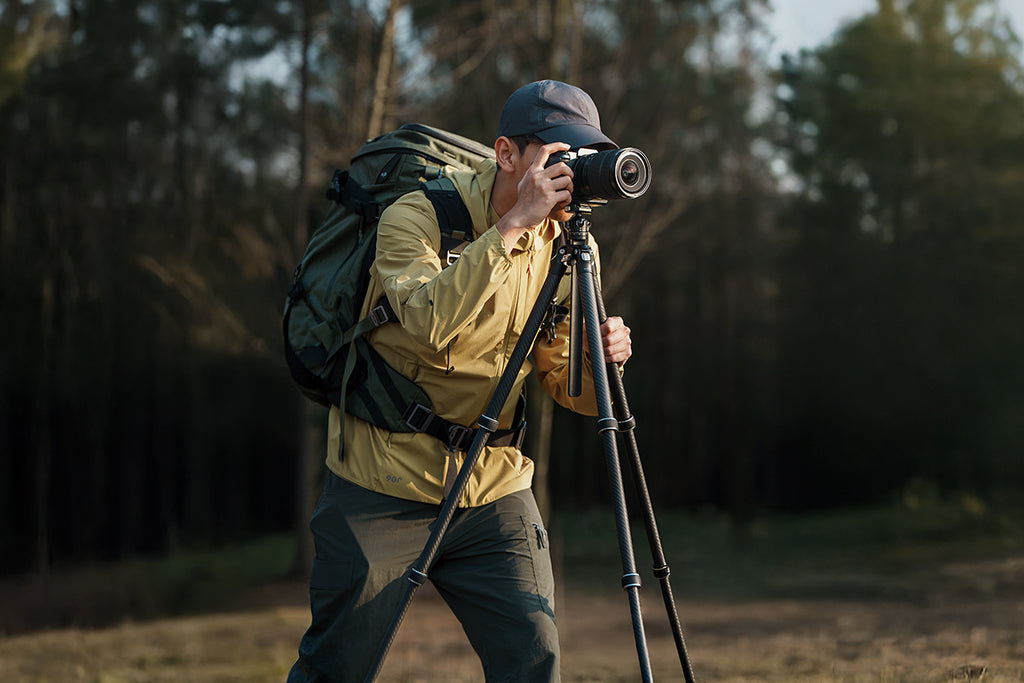
Modeling Transparency: Handheld Torque & Fatigue
The following table models a heavier "Documentary Cinema" build. Note how a small increase in mass or distance significantly impacts the fatigue threshold.
| Parameter | Scenario B Value | Unit | Context/Source |
|---|---|---|---|
| Rig Mass ($m$) | 3.2 | kg | Cinema Body + V-Mount |
| CoG Distance ($L$) | 0.31 | m | Measured from wrist pivot |
| Calculated Torque | ~9.7 | N·m | Result: $m \times g \times L$ |
| MVC Limit (Wrist) | ~11 | N·m | Representative Heuristic* |
| Fatigue Threshold | 18% | % | ISO 11228-3 (Static Loading) |
*Note: MVC values are heuristic averages based on general ergonomic principles; individual limits vary by grip technique and conditioning. The ISO 11228-3 threshold suggests that sustained static loads exceeding 18% of MVC significantly increase the risk of "drift" and musculoskeletal strain.
The Modular Trap: Balancing the Horizontal Axis
Most creators balance their rig visually, but the goal is physical equilibrium.
The "Two-Finger Pivot Test"
Before shooting, perform this simple check:
- Place two fingers under the camera cage—one under the lens mount and one on the opposite side of the cage base.
- Lift the rig slightly.
- If the rig immediately tilts, your horizontal CoG is offset.
- If you can balance it for 5 seconds without it sliding or tilting, you have reached the nodal balance point.
Counterweight Placement: The "Dumbbell Effect"
A common mistake is placing a heavy counterweight at the extreme end of a rail to balance a heavy lens. While this achieves balance, it increases rotational inertia, making the rig harder to stop once it starts moving.
Expert Insight: At our workshop, we advise placing smaller counterweights closer to the lens's nodal point or utilizing the camera's battery grip area. A practical rule of thumb: for every 100g change in lens weight, adjust your counterweight by 50-100g, but keep that mass as close to the camera body as possible to minimize the lever arm ($L$).
The Workflow ROI: Efficiency as Infrastructure
Every time you unscrew a plate to move from handheld to a tripod, you risk shifting the CoG. Standardizing with a quick-release ecosystem (like Arca-Swiss, F38, or F22) ensures your calibration stays intact.
The Math of Quick-Release (Annual Savings)
We calculated the time value of switching from traditional 1/4"-20 threaded mounting (~40s per swap) to a standardized quick-release system (~3s per swap).
| Scenario | Swaps/Shoot | Shoots/Year | Time Saved (Hrs) | Value (@$120/hr) |
|---|---|---|---|---|
| Conservative | 10 | 40 | ~4.1 | $492 |
| Neutral | 30 | 60 | ~18.5 | $2,220 |
| Professional | 60 | 80 | ~49.3 | $5,916 |
Assumptions: Savings calculated as (37 seconds saved per swap) x (total annual swaps). While individual results vary, the structural efficiency of "ready-to-shoot" toolchains is a primary driver of long-term profitability for solo creators.
Engineering Standards and Safety
Material Integrity: Aluminum vs. Carbon Fiber
While carbon fiber is excellent for tripod legs due to vibration damping, quick-release plates require the zero-play rigidity of 6061 or 7075 Aluminum Alloy. Aluminum provides the tight machining tolerances necessary to prevent "plate creep," which can throw off your CoG mid-shot.
Load Capacity: Static vs. Dynamic
A "80kg" rating for a plate (like the F38) refers to the Vertical Static Load. For handheld creators, the Dynamic Payload—the weight the system can handle during sudden movements—is much lower. If your cinema rig exceeds 3kg, we recommend using anti-deflection plates or broader interfaces (like the F50) to prevent twisting under high torque.
Battery Safety (IATA/IEC)
When rigging large external batteries:
- Ensure batteries are rated below 100Wh for air travel (IATA Guidance).
- Use mounts that comply with IEC 62133-2 to prevent short circuits during rough handling.
Pre-Shoot Safety Checklist
Adopt this three-step verification to ensure your rig is a foundation, not a liability:
- Audible: Listen for the distinct "Click" of the quick-release lock.
- Tactile: Perform the "Tug Test." Physically pull the camera to ensure the plate is seated.
- Visual: Check the locking pin status (e.g., ensure the indicator is in the "Locked" position).
Pro Tip: Manage your cables. A dangling HDMI cable can create enough lateral torque to cause subtle drift during a long take. Use modular cable clamps to keep the mass centered.
Building a Trusted Foundation
Fixing handheld drift is about mastering physics. By centering your rig's gravity, you reduce biomechanical strain, allowing you to focus on the creative composition. A rig that is balanced, secure, and efficient isn't just a tool—it is the infrastructure that allows your creativity to move without friction.
Disclaimer: This article is for informational purposes based on general ergonomic principles and workshop experience. Biomechanical limits and equipment capacities vary. Always consult manufacturer specifications and safety guidelines before operating heavy camera equipment.