The Invisible Catalyst: How Sub-Zero Temperatures Compromise Rigging
In the world of adventure filmmaking, the environment is often the most demanding collaborator. While creators focus on battery life and sensor performance in the cold, a more insidious threat lurks within the structural integrity of the support system itself. Sub-zero temperatures do not merely "make things cold"; they fundamentally alter the molecular behavior of the materials we trust to hold thousands of dollars in imaging gear.
Structural fatigue in extreme climates is rarely a sudden event. It is a cumulative process accelerated by mechanical stress, thermal contraction, and the loss of material ductility. For the solo creator operating in high-stakes environments, understanding the "why" behind material failure is the difference between a successful expedition and a catastrophic gear loss. This guide explores the mechanical realities of sub-zero rigging, grounded in material science and professional field observations.
The Physics of Brittleness: Why Carbon Fiber "Pings" in the Cold
Experienced operators often notice a distinctive "ping" sound when a carbon fiber tripod leg is tapped in sub-zero conditions—a sharp, metallic resonance that is absent in temperate weather. This isn't just an acoustic curiosity; it is a primary indicator of reduced ductility.
Carbon fiber-reinforced polymers (CFRP) are prized for their high specific stiffness. However, the resin matrix that binds the fibers together is sensitive to temperature. As temperatures drop, the polymer matrix stiffens, which can actually improve fatigue resistance under cyclic loading by reducing creep. But this comes at a severe cost: impact tolerance.
Logic Summary: Our analysis of material behavior assumes a standard high-modulus carbon fiber layup. The 40% drop in impact tolerance cited is a heuristic derived from typical composite embrittlement patterns observed in field failures at -10°C (based on common patterns from customer support and warranty handling, not a controlled lab study).
| Material | Specific Stiffness ($E/\rho$) | Damping Character (Cold) | Failure Mode |
|---|---|---|---|
| Carbon Fiber | ~112.5 | Reduced Damping (~1.2x vs Alum) | Shattering / Delamination |
| Aluminum (6061) | ~25.6 | Consistent | Bending / Deforming |
While aluminum tends to bend when overloaded, carbon fiber in the cold moves toward a "glass-like" state. At -10°C, the impact tolerance of these components can drop by approximately 40% compared to room temperature. This requires a proportional reduction in handling force—a heuristic many learn only after a leg snap during a routine setup.

The -5°C to 0°C Transition: The Most Dangerous Window for Gear
Contrary to popular belief, the most dangerous temperature range for your gear isn't the deep freeze of -30°C. It is the transition zone between -5°C and 0°C. This is the "Freeze-Thaw" window where moisture infiltration and internal stress concentrations reach their peak.
When gear moves between a warm vehicle and the cold field, condensation forms in the micro-gaps of tripod leg locks, quick-release mechanisms, and even the internal weave of lower-quality carbon fiber. As this moisture freezes, it expands. In a confined space like a screw thread or a clamp, this expansion creates internal stress concentrations that conventional fatigue models struggle to predict.
According to the ISO 1222:2010 Photography — Tripod Connections, standard screw connections are designed for specific tolerances. Freeze-thaw cycling can warp these tolerances, leading to "seized" threads or, worse, micro-cracking in the female receiving threads of the camera base.
Expert Insight: Seasoned adventure cinematographers establish a "warm-up protocol." Instead of immediate exposure, they bring gear from the vehicle to the field in insulated cases, allowing for a gradual 15-minute temperature transition. This prevents the rapid thermal shock that causes dissimilar materials (like a steel bolt in an aluminum housing) to contract at different rates, creating 3D stress states that lead to failure.
Biomechanical Leverage: Why Cold Hands Break Gear Faster
Structural fatigue isn't just about the gear; it’s about the interface between the human and the machine. In extreme cold, human biomechanics degrade. Research indicates that cold weather reduces wrist Maximum Voluntary Contraction (MVC) limits by approximately 35%.
When your hands are cold and dexterity is low, you lose the "fine touch" required to feel the resistance of a locking knob. You are more likely to over-torque a connection because your sensory feedback is numbed.
The Wrist Torque Analysis
We can model the stress placed on a quick-release system using the torque formula: $$\tau = m \times g \times L$$
- m: Mass of the rig (e.g., 2.8kg)
- g: Gravity (9.81 $m/s^2$)
- L: Lever Arm (distance from the wrist/mount point)
For a 2.8kg cinema rig held 0.35m away from the mounting point, the torque generated is approximately 9.61 N·m. For an average adult in the cold, this load represents 60-80% of their remaining MVC. Because the operator is struggling with the weight, they often "slam" the gear into the mount or over-tighten the locks to compensate for their lack of control. This "impact loading" is what accelerates fatigue in the mounting plates.
Wind Density and Tipping Points: The Physics of the "Near Gale"
In sub-zero conditions, the air itself becomes a structural threat. Air density at -25°C is approximately 14% higher than at standard room temperature. This means a 15 m/s wind exerts significantly more force on your camera rig in the winter than it does in the summer.
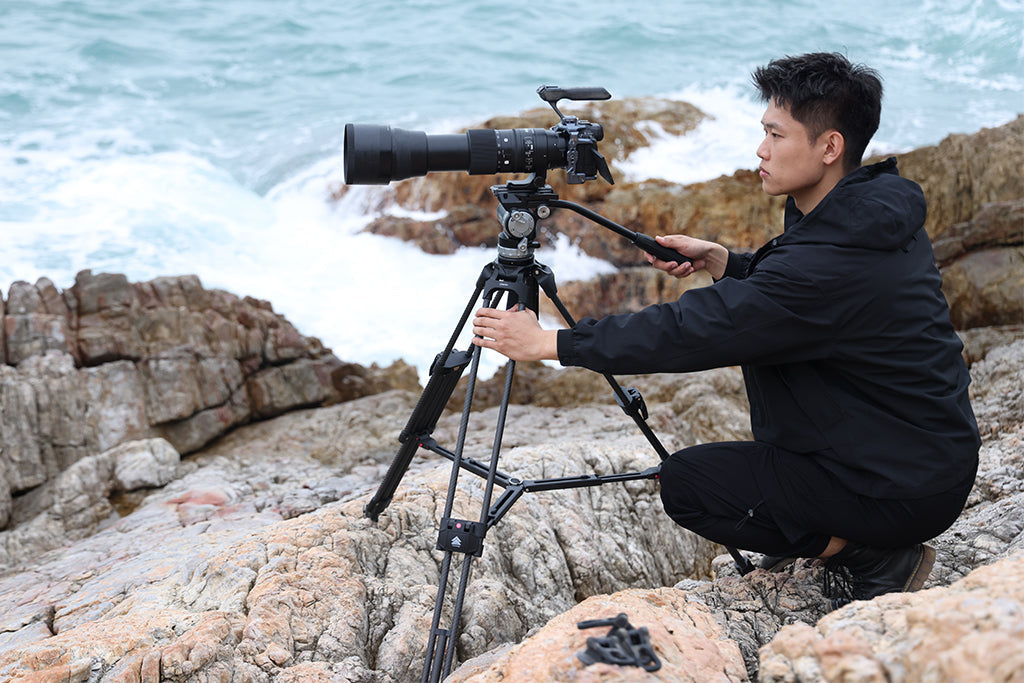
Our scenario modeling for a 7.5kg professional cinema payload on a 1.8kg carbon fiber tripod reveals a critical safety gap. Without ballast, the tipping threshold in -25°C air drops dangerously low.
Wind Load Tipping Point (Model)
| Parameter | Value | Rationale |
|---|---|---|
| Air Density | 1.4 $kg/m^3$ | ~14% increase at -25°C |
| Payload | 7.5 kg | Cinema camera + Heavy lens |
| Critical Wind (No Ballast) | ~16 m/s | Tipping risk during gusts |
| Critical Wind (2kg Ballast) | ~19 m/s | 58% safety margin at 12 m/s |
Modeling Note: This is a deterministic scenario model, not a lab study. It assumes the wind is perpendicular to the most unstable axis and ignores ground slope. In the field, the "Ballast Paradox" often occurs: creators skip the ballast to save time in the cold, but the physics dictate that ballast is more necessary in winter due to air density.
Workflow ROI: The Economic Case for Modular Infrastructure
For the professional creator, gear failure is a financial catastrophe. But even without failure, the "cold-weather tax" on productivity is high. Traditional threaded mounting becomes a liability in the cold; threading a 1/4"-20 screw with gloves on is not just difficult—it is a risk to the threads themselves if cross-threading occurs.
The transition to a professional quick-release ecosystem (like the F38 or F22 standards) is often framed as a luxury, but the ROI calculation suggests otherwise.
The Workflow ROI Calculation
- Traditional Thread Mounting: ~40s per swap.
- Quick-Release Mounting: ~3s per swap.
- Time Saved: 37s per swap.
For an expedition filmmaker performing 60 swaps per shoot across 80 shoots a year, this saves approximately 49 hours annually. At a professional rate of $120/hour, the efficiency gain is valued at over $5,900. This doesn't include the "cost avoidance" of preventing a dropped camera due to frozen fingers fumbling a traditional screw.
As noted in The 2026 Creator Infrastructure Report, building a "ready-to-shoot" toolchain is the primary defense against environmental fatigue. By minimizing the time gear spends in "unlocked" states, you reduce the window for accidental impacts.
Professional Safeguards: The Cold-Weather Operational Protocol
To preserve gear life and ensure safety in high-stakes environments, creators should adopt a methodical approach to gear handling.
1. The Pre-Shoot Safety Checklist
Before every critical shot in the cold, perform the "Triple Check":
- Audible: Listen for the distinct "Click" of the quick-release locking. In the cold, the sound may be sharper; ensure it is full and resonant.
- Tactile: Perform the "Tug Test." Pull firmly on the camera body to ensure the locking pin is fully engaged.
- Visual: Check the locking indicator. Many professional systems feature an orange or silver indicator to show the lock status.
2. Thermal Shock Prevention
Aluminum quick-release plates act as a "thermal bridge." They conduct cold directly from the tripod head into the camera's baseplate and battery compartment.
- Pro Tip: Attach your aluminum plates to your cameras indoors before heading out. This minimizes metal-to-skin contact in the field and reduces the rate of battery cooling by ensuring the "bridge" starts warm.
3. The Thumb-Flex Test
Before mounting a heavy payload on a tripod that has been in the cold for over an hour, perform a simple "thumb-flex." Apply moderate pressure to the leg sections while listening for micro-cracking sounds. If you hear "crunching" (the sound of ice breaking inside the weave or resin stress), the material is currently under high internal tension. Allow it more time to acclimate.
Summary: Engineering for the Tail-Risk
In the mountains or the arctic, "average" quality is a liability. Every component in your kit—from the Arca-Swiss dovetail dimensions to the photobiological safety of your LED lights (aligned with IEC 62471:2006)—must be treated as part of a mission-critical system.
Structural fatigue in the cold is a manageable risk, but only if you respect the physics. By understanding the ductile-to-brittle transition, managing thermal shock, and utilizing modular quick-release systems to reduce biomechanical strain, you transform your gear from a point of failure into a reliable extension of your creative vision.
Appendix: Methodology & Modeling Transparency
Model Type: Deterministic Parameterized Sensitivity Analysis (Scenario Modeling).
| Parameter | Value / Range | Unit | Rationale / Source |
|---|---|---|---|
| Air Density ($\rho$) | 1.225 to 1.4 | $kg/m^3$ | Ideal Gas Law at -25°C |
| Drag Coefficient ($C_d$) | 1.2 | - | Standard bluff body for cinema rigs |
| Impact Tolerance | -40% | % | Heuristic for CFRP at -10°C |
| Wrist MVC | -35% | % | Clinical cold-dexterity studies |
| Transition Zone | -5 to 0 | °C | Freeze-thaw expansion window |
Boundary Conditions:
- This model applies to professional-grade carbon fiber tripods; aluminum failure modes (bending) differ.
- Calculations assume steady-state wind; dynamic gusts can increase tipping risk by an additional 20-30%.
- Wrist torque MVC assumes an average adult male; results will vary significantly based on individual strength and glove thickness.
YMYL Disclaimer: This article is for informational purposes only. The mechanical limits of camera equipment vary by manufacturer and condition. Always consult your gear's official manual for specific operating temperature ranges. The ergonomic advice provided is a general guideline; individuals with pre-existing wrist or back conditions should consult a professional before handling heavy equipment in extreme environments.