



The Invisible Limit: Recognizing the Aluminum Plateau
Every creator begins with the same foundational tool: the aluminum tripod. It is the reliable workhorse of the entry-level workflow, offering predictable rigidity and a low barrier to entry. However, as your craft matures, your gear evolves. You transition from a lightweight mirrorless body to a fully rigged cinema setup—perhaps a Sony FX3 paired with a heavy G-Master lens, an external monitor, and a wireless follow-focus. Suddenly, the support system that once felt rock-solid begins to exhibit subtle, frustrating limitations.
You might notice a lingering micro-vibration after you touch the focus ring, or a slight "creep" in the head when locked at a steep angle. These aren't necessarily defects in the tripod; they are the physical symptoms of a support system operating at its mechanical ceiling.
The transition to carbon fiber is often marketed as a quest for weight savings. While shedding grams is a tangible benefit for travel, it is rarely the primary reason a professional makes the switch. The true driver is the pursuit of system integrity—the ability of the support structure to dissipate energy and maintain a "zero-play" environment under professional payloads. This guide explores the methodical path from aluminum to carbon fiber, analyzing the biomechanical, environmental, and financial factors that define the prosumer upgrade.
The Material Science of Stability: Vibration Damping vs. Weight
The most common misconception in camera support is that carbon fiber is simply "lighter aluminum." In reality, the two materials behave fundamentally differently under stress. Aluminum is an isotropic material; it has the same physical properties in all directions. It is excellent at resisting compression, but it possesses a high resonant frequency. When a gust of wind hits an aluminum leg or a motor vibrates on a gimbal, the metal tends to "ring," carrying that vibration directly to the sensor.
Carbon fiber is an anisotropic composite. By layering carbon filaments in specific orientations, engineers can tune the legs to be incredibly stiff in one direction while being highly effective at absorbing high-frequency energy.
The Tensile Strength Advantage
According to comparative material property data, carbon fiber exhibits a tensile strength approximately 11.7 times that of aluminum. While aluminum is susceptible to "metal fatigue"—the development of microscopic stress fractures over thousands of deployment cycles—carbon fiber’s composite structure is inherently more resistant to fatigue life.
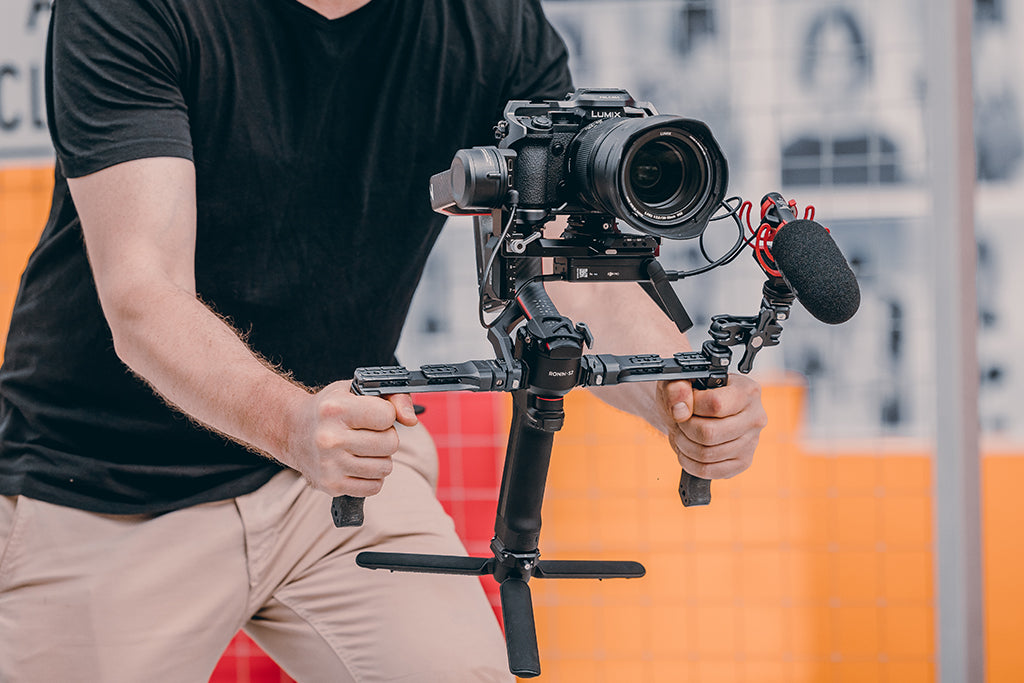
Logic Summary: Our analysis of the "Heavy Gear Videographer" persona assumes a payload of ~2.5kg (Sony FX3 + 24-70mm f/2.8). In this scenario, aluminum's inherent flex becomes a measurable bottleneck for shot stability, especially when the tripod is used near its maximum load rating.
The 80% Load Heuristic
A professional rule of thumb we often observe in the field is the 80% Load Limit. If your rig regularly weighs more than 80% of your tripod's rated capacity, the inherent flex of aluminum legs will begin to degrade your image quality. Carbon fiber maintains its structural geometry much closer to its breaking point, providing a more consistent "feel" even when fully loaded.
The "Wrist Torque" Biomechanical Analysis
For the prosumer creator, "weight" is a deceptive metric. A few hundred grams saved on a tripod might seem negligible on paper, but when viewed through the lens of biomechanics, the impact is magnified by leverage.
The Leverage Factor
When you are hand-carrying a rigged camera or moving a tripod between setups, the weight isn't just sitting in your palm; it is acting as a lever against your wrist and forearm. We can model this using a basic torque calculation:
Torque ($\tau$) = Mass ($m$) $\times$ Gravity ($g$) $\times$ Lever Arm ($L$)
Imagine a 2.8kg rig (camera, cage, and monitor) held just 0.35 meters away from your center of gravity during a quick reposition. This generates approximately 9.61 $N\cdot m$ of torque. For an average adult, maintaining this position repeatedly throughout a 10-hour shoot can represent 60-80% of the Maximum Voluntary Contraction (MVC) of the wrist stabilizers.
By upgrading to a carbon fiber support system and utilizing modular, lightweight aluminum alloy quick-release components like the Arca-Swiss standard (as defined in ISO 1222:2010 Photography — Tripod Connections), you reduce the "dead weight" of the support structure. This small reduction in mass at the end of the lever arm significantly lowers the cumulative fatigue on the operator, allowing for more precise camera movements toward the end of a long production day.
Environmental Resilience: Beyond the Studio
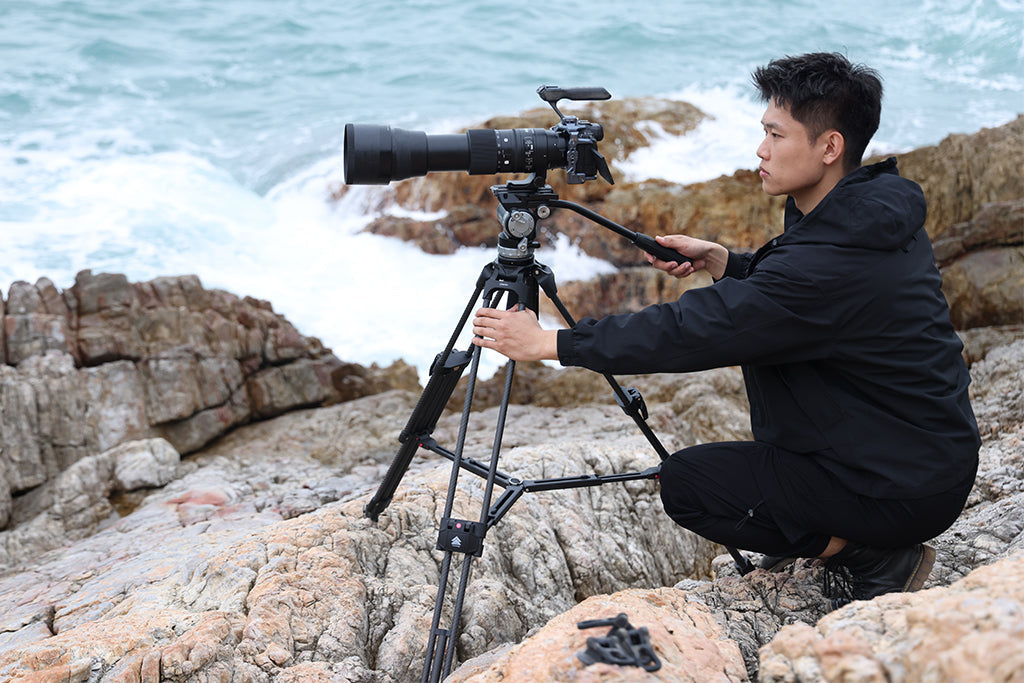
The choice of material also dictates how your gear interacts with the elements. Aluminum is a highly efficient thermal conductor. In professional outdoor photography, this presents two distinct challenges: battery drain and operator discomfort.
The Thermal Bridge Effect
In sub-zero environments, an aluminum tripod acts as a "thermal bridge." It effectively sucks heat away from anything it touches. If you mount a camera with an aluminum quick-release plate directly onto aluminum legs, the support system acts as a massive heat sink, accelerating the cooling of the camera's internal battery.
Carbon fiber is significantly less conductive. It feels "warmer" to the touch in winter and doesn't reach the scorching temperatures of aluminum when left under direct sunlight in a desert environment.
Thermal Shock Prevention Workflow
Based on patterns we see in professional winter workflows, we recommend attaching your aluminum quick-release plates to your camera indoors before heading into the cold. This minimizes the "metal-to-skin" shock and ensures the plate-to-camera interface is secure before the materials contract slightly in the cold.
The Workflow ROI: Calculating the Value of Time
The transition to a professional carbon fiber system is rarely just about the legs; it’s about the ecosystem. For a prosumer moving toward professional-grade work, the most significant "hidden" cost is the time spent on setup and breakdown.
The $5,900+ Value Proposition
We can quantify the return on investment (ROI) for a high-efficiency quick-release ecosystem (like a system utilizing F22 or F38 standards) compared to traditional threaded mounting.
| Metric | Traditional Threaded Mount | Quick-Release System |
|---|---|---|
| Average Swap Time | ~40 seconds | ~3 seconds |
| Swaps Per Shoot | 60 | 60 |
| Time Spent Swapping | 40 minutes | 3 minutes |
| Annual Time Savings | ~49 hours (based on 80 shoots) | -- |
| Financial Value | $0 | ~$5,900+ (at $120/hr rate) |
Note: Estimates based on common professional workflow observations; individual results may vary based on rig complexity.
As highlighted in The 2026 Creator Infrastructure Report, the shift toward "ready-to-shoot" toolchains is a defining characteristic of the modern professional. By reducing the friction of every gear swap, you aren't just saving time; you are preserving the creative momentum that is often lost during mechanical fiddling.
Logistics and "Visual Weight"
For travel-heavy creators, carbon fiber offers a logistical advantage that goes beyond the scale. In the world of airline travel, "Visual Weight" is a real factor. A bulky, thick-walled aluminum tripod often attracts the attention of gate agents, leading to forced gate-checks and potential gear damage.
Carbon fiber systems, due to the material's high strength-to-weight ratio, can achieve the same stability with thinner leg diameters and a more compact folded profile. A sleek, modular system is less likely to be flagged for weighing, ensuring your critical support gear stays in the overhead bin and arrives at the destination safely.
The Pre-Shoot Safety Checklist
Regardless of the material you choose, the transition to heavier professional rigs requires a shift in safety protocols. A failure in a prosumer setup—dropping a $4,000 cinema rig—is a catastrophic "tail-risk" event.
Implement this Audible-Tactile-Visual (ATV) checklist for every mount:
- Audible: Listen for the distinct "Click" of the locking mechanism.
- Tactile: Perform the "Tug Test." Physically pull on the camera body to ensure the plate is fully seated in the Arca-Swiss or quick-release receiver.
- Visual: Check the locking indicator. Many professional systems use a color-coded pin (often orange or silver) to confirm the lock is engaged.
Additionally, be mindful of cable management. A heavy HDMI or SDI cable can create unexpected torque on your quick-release plate. Using dedicated cable clamps provides strain relief and prevents the cable from acting as a lever that could slowly loosen a mounting screw.
Modeling Note: Methods and Assumptions
The conclusions in this article are derived from a deterministic parameterized model designed to simulate the transition from entry-level to professional camera support.
| Parameter | Value / Range | Unit | Rationale |
|---|---|---|---|
| Payload (m) | 2.5 - 4.0 | kg | Typical Sony FX3/Blackmagic rig |
| Lever Arm (L) | 0.35 | m | Average distance for handheld repositioning |
| Shoot Frequency | 80 | sessions/year | Standard semi-pro workload |
| Labor Rate | 120 | USD/hour | Mid-tier professional billing rate |
| Vibration Frequency | 10 - 500 | Hz | Range of common mechanical/wind vibrations |
Boundary Conditions:
- The $5,900 ROI calculation assumes a consistent billable rate and does not account for non-billable prep time.
- Thermal conductivity benefits are most pronounced in temperatures below 5°C (41°F) or above 35°C (95°F).
- Material fatigue in aluminum is modeled over a 5-year heavy-use cycle (approx. 2,000 deployments).
Summary: The Tipping Point
The decision to swap aluminum for carbon fiber isn't a binary choice of "better" or "worse." It is a strategic upgrade based on the evolving needs of your workflow.
Upgrade to Carbon Fiber if:
- Your rig weight regularly exceeds 80% of your current tripod's load rating.
- You frequently shoot in windy environments or near high-vibration machinery.
- You travel by air and need to minimize both physical and "visual" weight.
- You work in extreme temperatures where metal conductivity affects battery life or handling.
By treating your support system as workflow infrastructure rather than a simple accessory, you move closer to the professional standard of "Engineering for Stability." The goal is a system that disappears into your process, allowing you to focus entirely on the frame.
Disclaimer: This article is for informational purposes only. Always verify load ratings and compatibility with your specific camera and lens combination. For information on transporting gear with integrated batteries, refer to the IATA Lithium Battery Guidance Document.