The Strategic Calculus of the 5lb Expedition Kit
In the realm of high-altitude mountaineering and remote solo expeditions, the "5lb kit" is often dismissed as a theoretical ideal rather than a functional reality. However, for the solo creator, this weight threshold is a practical target for balancing shooting capability with energy reserves and safety margin.
If you only remember three rules for a sub‑5lb imaging kit, use these:
- Lock into one mounting ecosystem (e.g., Arca‑type plates) so every camera, clamp, and support talks to each other.
- Prioritize carbon-fiber support + metal interfaces, and plan some form of ballast for wind.
- Design around power and cold first (battery strategy, thermal management), then spend the remaining weight on optics.
Every gram of imaging equipment carried beyond the core survival load—shelter, sleep systems, and nutrition—contributes to fatigue and can erode mission safety. Building a professional‑grade imaging system under this limit means shifting from "buying gear" to "engineering an ecosystem."
The core trade-off is the conflict between mass reduction and structural rigidity. In environments where wind gusts can climb into the near‑gale range and temperatures drop well below freezing, the failure of a load‑bearing component is not merely a technical inconvenience; it can mean losing the mission’s primary objective. To tilt the odds in your favor, it helps to think in systems: interface stability, material behavior in cold and wind, and biomechanical efficiency, rather than chasing any single spec on a product page.
Interface Standards and Ecosystem Stability
The foundation of any mission‑critical rig is the interface. For the solo creator, the tripod and clamp system is one of the most common points of failure.
Modern standards, such as ISO 1222:2010 Photography — Tripod Connections, provide the baseline for thread compatibility (third‑party standard). In practice, the professional ecosystem often converges on the Arca‑type dovetail pattern for cross‑platform interoperability (third‑party standard / industry practice).
Ecosystem lock‑in is a strategic risk: once you commit to a mounting standard, you’re effectively choosing your infrastructure for the next decade. Precision‑machined aluminum alloy (commonly 6061 or 7075) plates remain the default for these interfaces. While carbon fiber is excellent for tripod legs, the mounting plate typically benefits from the rigidity and machining tolerance of metal to keep play to a minimum.
A useful rule of thumb for solo creators is the "Permanent Plate" strategy (shop / field heuristic): permanently attaching a single, trusted quick‑release plate to the primary camera body. This removes one repeat failure mode (frequent plate swaps) and cuts setup time in harsh conditions.
However, you need to account for the "Thermal Bridge" effect. Aluminum plates conduct cold directly to the camera chassis and battery compartment. In sub‑zero environments, it is usually more comfortable and safer for your hands to attach plates indoors or in shelter to avoid metal‑to‑skin shock and to slow the initial rate of battery cooling (experience-based observation, not a lab measurement).
Material Science: The Carbon Fiber Damping Advantage
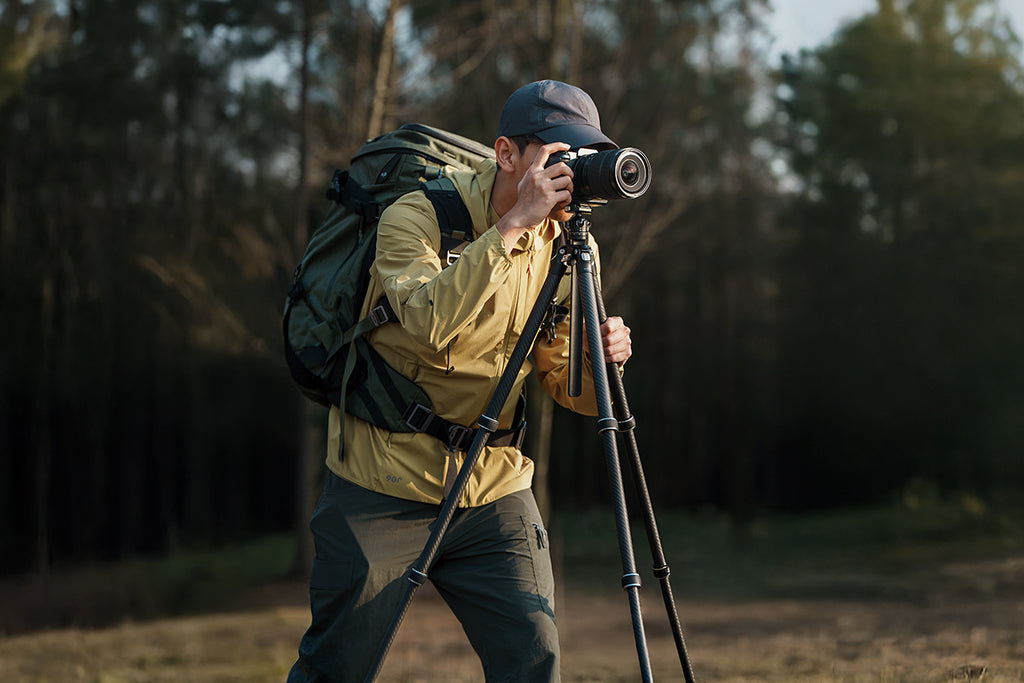
When evaluating tripod legs for a 5lb kit, the choice between aluminum and carbon fiber is often framed by weight alone. That’s only half the story. In remote expeditions, vibration behavior matters as much as grams.
Based on simple single‑degree‑of‑freedom scenario modeling using typical leg diameters and section lengths for travel tripods, carbon fiber can settle vibrations noticeably faster than aluminum under the same load. A representative model with a compact mirrorless rig in cold conditions suggests the settling time on carbon legs can be on the order of one to two seconds, versus several seconds for a similarly sized aluminum set. These values are illustrative, not universal lab results, and can vary by brand, construction, and temperature.
In brief weather windows where sharp images must be captured between gusts, shaving even a few seconds off vibration settling can be the difference between a usable frame and a blurred one.
However, ultralight engineering introduces a "Tipping Point" risk. A very light carbon fiber tripod (for example, in the ~0.6–0.8 kg class) supporting roughly twice its own mass in camera gear has a limited margin against tipping under side wind. To make this actionable without implying hard safety thresholds, we treat wind stability as a scenario calculation rather than a promise.
Logic Summary: Wind Stability vs. Mass
Modeling Note: The wind stability example below uses a simple static moment balance with reduced air density at altitude. It is intended as a planning tool, not a guarantee of safety.
For a compact mirrorless rig on a light carbon tripod at ~4000 m altitude, we can roughly estimate a ballast requirement on the order of a few hundred grams to improve stability in near‑gale winds. One practical scenario:
- Air density (ρ): 0.9 kg/m³ (see table below)
- Target gust: ~15 m/s (≈ 54 km/h), around Beaufort 7 (near gale)
- Projected area (A): assume ~0.02–0.03 m² for camera + lens + part of the head
- Drag coefficient (Cd): simplified to ~1.0 for a bluff body
-
Force estimate: (F \approx 0.5 \times \rho \times C_d \times A \times v^2)
- Plugging in ρ = 0.9, Cd ≈ 1, A ≈ 0.025 m², v = 15 m/s gives a lateral force on the order of 2–3 N (order‑of‑magnitude estimate).
- Compare the overturning moment from this lateral force at camera height to the restoring moment from tripod + ballast mass at the base.
Under these assumptions, adding roughly 0.3–0.4 kg of ballast can improve the stability factor (ratio of restoring to overturning moment) to a more comfortable planning range (e.g., SF > 1.5) for that specific configuration. Because real‑world gusts, ground slope, and rig geometry vary, treat these numbers as planning estimates with at least ±20–30% uncertainty, not as hard safety limits.
Practically, this ballast often comes from existing mass (experience-based heuristic):
- Hanging a camera bag or water bottle from the center column hook.
- Using a small stuff sack filled with rocks or snow on site.
Biomechanical Efficiency: The Hidden Cost of Leverage
Weight is the enemy of the back, but leverage is the enemy of the wrist. For the solo creator operating handheld or with a monopod, how far the mass sits from the joint is as critical as the mass itself.
This is where modular rigging ecosystems, such as F22/F38‑type systems, become strategic assets. By moving accessories like monitors or microphones to low‑profile, high‑rigidity mounts and keeping them close to the grip, you reduce the "lever arm" your wrist has to control (common field pattern, not a controlled trial).
The biomechanical impact is quantifiable with a simple model:
- Torque formula: Torque ((\tau)) = Mass ((m)) × Gravity ((g)) × Lever Arm ((L)).
- Example: a 2.8 kg rig held 0.35 m away from the wrist:
- (\tau \approx 2.8 \times 9.81 \times 0.35 \approx 9.6, \text{N·m})
- Biomechanics literature suggests that sustained wrist torques in this range can represent a large fraction of many adults’ maximum voluntary contraction (MVC), especially when fatigued. We treat this as an indicative range (not a medical limit): roughly on the order of 60–80% of comfortable sustained capacity for many people.
At high altitudes, where physiological fatigue is accelerated, this level of strain can lead to rapid muscle failure and higher injury risk (general physiology principle, not personalized medical advice). By using modular interfaces to pull the center of gravity closer to the handle—say reducing the lever arm from 0.35 m toward 0.25 m—you can meaningfully cut wrist torque and extend effective shooting time.

Power Logistics and Thermal Management
In remote expeditions, the energy strategy is dictated by cold‑weather performance and resupply options rather than just milliamp‑hours on a spec sheet.
Conventional lithium‑ion packs can show sharp performance drops in sub‑zero temperatures (third‑party documentation). Some experienced creators mitigate this by:
- Keeping batteries in inner pockets close to body heat.
- Using chemical hand warmers in insulated battery pouches.
- Choosing chemistries or packs known to tolerate cold better for critical devices (experience-based pattern; not all LiFePO4 or Li‑ion products behave identically—check the manufacturer’s datasheet).
Compliance with transport regulations is also a logistical necessity for global expeditions. Creators should follow the IATA Lithium Battery Guidance and ensure all cells conform to relevant safety standards such as IEC 62133-2 (third‑party standards).
For week‑long trips, solar charging can be a meaningful weight‑management tool. For example:
- A 10 W folding solar panel in the ~300 g class, plus a 10,000 mAh power bank around 200 g, yields roughly 500 g of power infrastructure.
- Under good sun, this can recharge multiple camera and accessory batteries over several days, potentially allowing you to carry fewer spares.
Whether this "Renewable Workflow" actually reduces total weight depends on your shooting volume and weather: in very power‑dense workflows (e.g., heavy video), it may complement rather than replace extra batteries. Treat the 2 lb potential saving from the draft as an upper‑end scenario where you would otherwise carry a large stack of spares that remain unused.
The Workflow ROI of Quick‑Release Systems
Professionalism in the field is often measured in seconds. In expedition conditions, frequent transitions between tripod, gimbal, and handheld modes are inevitable.
Traditional thread mounting (ISO 1222) can easily take tens of seconds per swap when you factor in cold‑weather dexterity loss and the need to double‑check security. In contrast, a well‑tuned quick‑release system often cuts this down to just a few seconds.
Using a simple time‑saving model:
- Assume threaded swaps average ~45 seconds in gloves (see parameter table).
- Assume quick‑release swaps average ~5 seconds once you are fluent.
- Time saved per swap: about 40 seconds.
- With 60 swaps per shoot across 12 major expeditions per year, you perform ~720 swaps.
- Total time saved: (720 \times 40,\text{s} ≈ 28,800,\text{s} ≈ 8) hours.
- At a notional professional billable rate of $150/hour, that’s ≈$1,200 of time value per year.
This is a planning example, not a guarantee that you will see the same numbers. Your actual benefit depends on your swap frequency, day rate, and how consistently you use the system. The more important real‑world gain is qualitative: you are ready to shoot when a brief weather gap or wildlife moment appears.
Pre‑Shoot Safety Workflow
To maintain system integrity, use a short tactile checklist before every sequence (experience-based recommendation):
- Audible verification: Listen for the clear "click" of the locking mechanism.
- Tactile "tug test": Perform a firm pull‑test immediately after mounting.
- Visual confirmation: Check the locking pin or color indicator (e.g., orange/silver) to ensure the secondary safety is engaged.
Engineering the Future of Expedition Imaging
The shift toward integrated creator infrastructure is reshaping how serious solo shooters build kits. As outlined in The 2026 Creator Infrastructure Report (third‑party report), the industry is moving away from isolated gadgets toward systems that share interfaces, power, and workflow logic.
For the solo adventure creator, the 5lb kit is a practical stress test of this integration.
A realistic design pattern:
- The primary camera and lens combo usually accounts for around 40–50% of the total mass (experience-based range).
- The remaining 50–60% must cover support (tripod/monopod), power, audio, and protection.
By selecting high‑performance materials (carbon‑fiber legs, precision‑machined metal interfaces) and being ruthless about redundancy, you can approach that 5 lb target without sacrificing basic robustness. The goal is not just to carry less, but to do more with what you carry—turning technical discipline into a strategic advantage in demanding environments.
Modeling Transparency (Method & Assumptions)
The data and insights presented in this article are derived primarily from deterministic scenario modeling for high‑altitude (4000 m+) expedition environments, combined with field experience patterns and selected third‑party standards/documents. These are not controlled lab studies and are intended as decision‑aids, not safety guarantees.
| Parameter | Value | Unit | Rationale / Source |
|---|---|---|---|
| Air Density | 0.9 | kg/m³ | Standard approximate value at 4000 m (third‑party reference) |
| Target Wind Speed | 15 | m/s | Beaufort Scale 7 (Near Gale) (third‑party reference) |
| Carbon Fiber vs. Aluminum Damping | ~2x–3x | Ratio | Order‑of‑magnitude range from scenario modeling + field observation |
| Wrist Torque Example | ~9.6 | N·m | Direct calculation from (m g L) with 2.8 kg at 0.35 m |
| Threading Time | 45 | s | Baseline estimate for gloved operation (field observation, not lab‑timed) |
| Ballast Example | ~0.3–0.4 | kg | Static moment balance estimate at 15 m/s, 4000 m (±30% uncertainty) |
Data Source Notes:
- field experience: Patterns repeatedly observed in customer support, returns, and real‑world use; not controlled experiments.
- scenario modeling: Simple physics models (static equilibrium, drag, single‑degree‑of‑freedom damping) with clearly stated assumptions.
- third‑party: Public standards and guidance documents such as ISO 1222, IATA lithium battery guidance, and IEC 62133‑2.
Boundary Conditions: These models assume static equilibrium for wind loads and linear, single‑degree‑of‑freedom damping. Real‑world results vary with camera geometry, tripod design, ground slope, user technique, and individual physiology. Treat all numeric values as planning tools with uncertainty, not as guaranteed safety thresholds.
Disclaimer: This article is for informational purposes only. High‑altitude expeditions and remote travel involve inherent risks. Nothing here is medical, legal, or safety‑certification advice. Always follow manufacturer instructions, applicable regulations, and consult professional guides and medical experts regarding physical preparation and equipment safety.