Center of Gravity: Why Weight Distribution Matters for MoJo
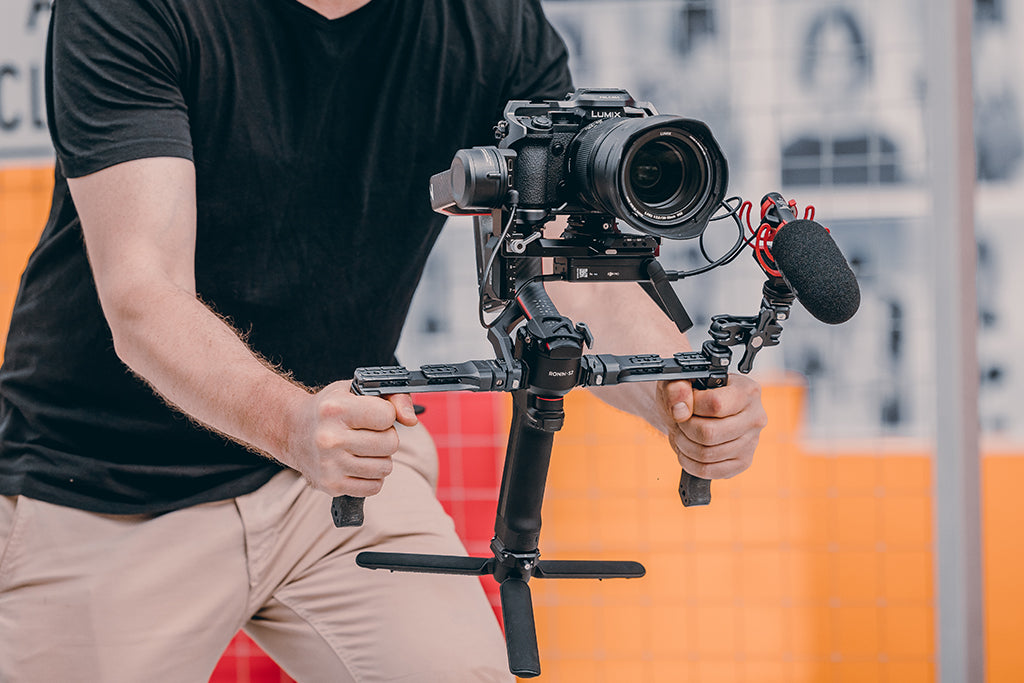
In the world of mobile journalism (MoJo) and solo travel videography, there is a deceptive metric that often leads to physical burnout: total rig weight. Based on common patterns observed in our customer support interactions and field repairs, creators often obsess over shaving grams off their camera body or lens, only to mount a monitor on a 10-inch articulating arm or stack a heavy V-mount battery at the very top of their cage.
The perceived weight of a rig—and the subsequent fatigue it causes—is often influenced more by the Center of Gravity (CoG) than the scale itself. A 2kg rig that is well-balanced can feel more maneuverable than a 1kg rig with a significant forward-leaning bias.
This article examines the biomechanical physics of weight distribution. We will show you how to optimize your creator infrastructure to shoot longer, move more efficiently, and reduce the risk of long-term physical strain.
The Physics of the "Lever Arm Multiplier"
To understand why your wrist may ache after only twenty minutes of shooting, we must look at the relationship between mass and leverage. In physics, this is expressed as Torque ($\tau$), the rotational force applied around a pivot point (your wrist).
The fundamental formula is: Torque ($\tau$) = Mass ($m$) $\times$ Gravity ($g$) $\times$ Lever Arm ($L$)
Where $L$ is the horizontal distance from your wrist to the rig’s Center of Gravity. When you mount a microphone or a light far forward on a cold shoe, you are not just adding the weight of that accessory; you are increasing the "Lever Arm." This creates a multiplier effect. Even a lightweight accessory, when placed at the end of a long arm, can generate more destabilizing torque than the camera body itself.
The "Christmas Tree" Pitfall
A common mistake among solo creators is the "Christmas Tree" effect—stacking accessories vertically or forward to keep the screen clear. Based on community rigging discussions and ergonomic observations, this approach can significantly increase forward torque. A more balanced approach involves moving the CoG closer to the shooter’s body or the wrist pivot point.
Modeling the Fatigue: A Biomechanical Deep Dive
To demonstrate the impact of distribution, we modeled two common scenarios for a travel videographer. These models use biomechanical torque calculations and are informed by general ergonomic principles found in ISO 11228-3 (handling of low loads at high frequency).
Scenario A: The Professional Travel Rig (2.1kg)
We compared a "front-heavy" setup (monitor and mic mounted forward) against an "optimized" setup (accessories mounted laterally or closer to the body).
| Parameter | Front-Heavy Setup | Optimized Setup | Improvement (Est.) |
|---|---|---|---|
| Total Mass | 2.1 kg | 2.1 kg | 0% |
| CoG Distance ($L$) | 35 cm (0.35m) | 15 cm (0.15m) | -57% |
| Calculated Torque | ~7.21 N·m | ~3.09 N·m | ~57% Reduction |
| % of Female MVC* | ~75% - 100%+ (High) | ~30% - 55% (Moderate) | Significant |
*MVC (Maximum Voluntary Contraction) represents a heuristic estimate of the percentage of peak muscle force required. These values are illustrative and vary based on individual strength and grip style.
Scenario B: The Minimalist Smartphone Rig (0.8kg)
Even lightweight kits are not immune to poor physics. A 0.8kg smartphone rig with a high-mounted light and dangling battery can exceed sustained ergonomic thresholds.
| Parameter | Poor Distribution | Optimized Distribution | Improvement (Est.) |
|---|---|---|---|
| Total Mass | 0.8 kg | 0.8 kg | 0% |
| CoG Distance ($L$) | 25 cm (0.25m) | 12 cm (0.12m) | -52% |
| Calculated Torque | ~1.96 N·m | ~0.94 N·m | ~52% Reduction |
Modeling Note & Assumptions (Reproducible Parameters):
- Model Type: Deterministic biomechanical leverage model ($\tau = m \cdot g \cdot L$).
- Inputs: Calculations assume a static horizontal hold (maximum moment) with gravity at 9.81 m/s².
- Mass Distribution: The 2.1kg rig assumes a 1.2kg body/lens base with 0.9kg of accessories. The "Front-Heavy" model places the accessory CoG 45cm from the pivot, while the "Optimized" model brings it to 15cm.
- Boundary Conditions: These figures do not account for dynamic acceleration (swinging the camera) or individual physiological differences.

System-Level Solutions: Building Your Creator Infrastructure
Optimizing your CoG requires a modular ecosystem that allows for lateral mounting rather than vertical stacking. This is where "creator infrastructure" becomes a practical advantage.
1. Lateral Mounting via the F22 Ecosystem
Instead of using long articulating arms that move the CoG away from the camera, side-mounting points allow for a more centered mass. By using quick-release plates on the side of a cage, you can mount monitors and wireless receivers closer to the handle, keeping the mass centered over your grip.
2. The Arca-Swiss Standard and Stability
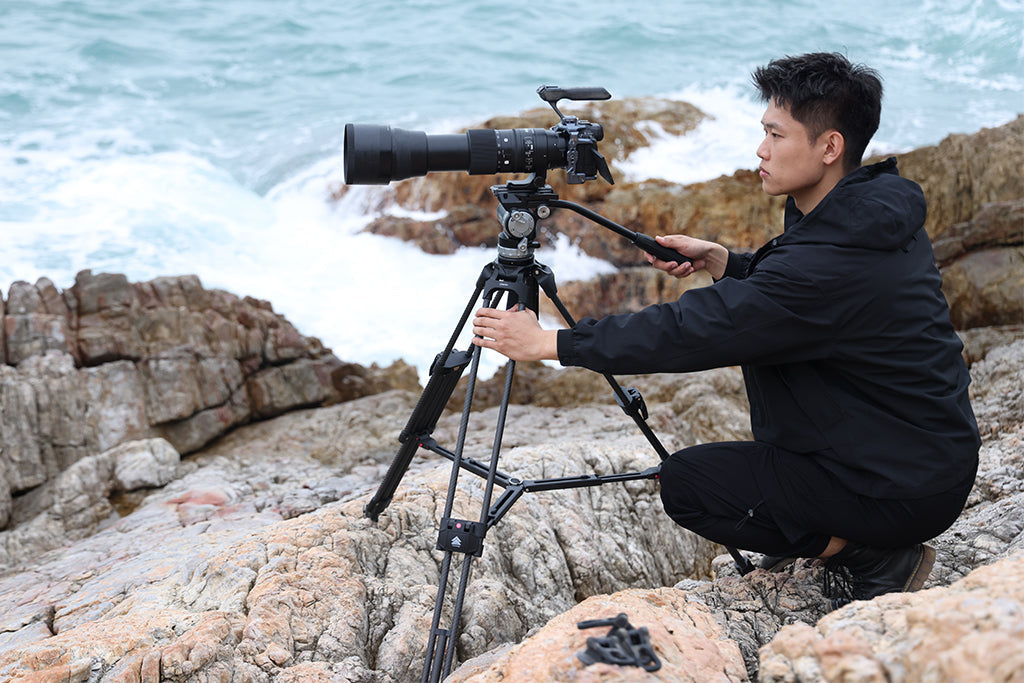
For tripod work, the Arca-Swiss Dovetail Technical Dimensions (Industry Blog) provide the foundational dimensions for secure mounting. A wider base, like that found in the F50 system, provides a more stable connection with heavy lenses, helping to mitigate the "tipping" torque that can affect panoramic pans.
3. Material Choice: Aluminum vs. Carbon Fiber
While carbon fiber is often used for vibration damping in tripod legs—as discussed in The 30% Weight Rule: Is Carbon Fiber Worth the Travel Cost? (Brand Editorial)—quick-release plates are typically precision-machined from 6061 or 7075 Aluminum Alloy.
Aluminum provides the rigidity and zero-play tolerance required for a secure CoG. However, be aware of the "Thermal Bridge" effect. In extreme cold, aluminum plates can conduct heat away from the camera body. We recommend attaching your plates indoors when possible to minimize thermal shock to your equipment.
Field Heuristics: Testing Your Balance
You don't need a lab to determine if your rig is poorly balanced. Experienced videographers often use these practical "rules of thumb" to verify their setup.
The "Wrist Pivot Test"
Hold your rig at its natural grip point with a relaxed wrist. If you can comfortably maintain a level horizon for over one minute without feeling a "pulling" sensation in your forearm, your CoG is likely well-distributed. If your wrist begins to dip or strain within 30 seconds, your lever arm may be too long.
The "Elbow Test"
Hold the rig at the intended shooting height. If your elbow naturally drops or your shoulder begins to hike up to compensate for the weight, the CoG is likely too far forward. This is a practical, no-cost alternative to technical load-transducer measurements.
The Workflow ROI: Quantifying Efficiency
Investing in a modular quick-release system is both an ergonomic choice and a workflow decision based on time-on-target.
The Workflow ROI Formula:
- Annual Savings = (Time Saved per Swap) × (Swaps per Shoot) × (Shoots per Year)
Scenario Analysis:
- Traditional Thread Mounting: ~40 seconds per equipment swap.
- Quick Release (F38/F22): ~3–5 seconds per swap.
- Time Saved: ~35 seconds per swap.
For a professional MoJo performing 60 swaps per shoot across 80 shoots a year, this system saves approximately 35 to 50 hours annually. At a professional rate of $100/hr, this represents a potential $3,500 – $5,000 value in recovered time. Actual results will vary based on your specific equipment rotation and hourly rate.
Field Readiness: The MoJo Safety & Logistics Protocol
A balanced rig is only effective if it is secure. Follow this safety checklist derived from professional field constraints:
- The Audible "Click": Do not assume a plate is locked by sight alone. Listen for the mechanical engagement of the spring-loaded pin.
- The "Tug Test": Immediately after mounting, give the camera a firm physical pull (perpendicular to the plate) to verify the locking mechanism is engaged.
- Visual Check: Look for the safety indicators (often orange or silver) on your quick-release base.
- Cable Management: Secure all cabling along the main axis of the rig. Dangling cables can snag and create a shifting center of gravity during movement.
Logistics and "Visual Weight"
When traveling, the physical bulk of your gear can be as important as the actual weight. Compact, modular systems like the F38 often have a lower "Visual Weight." In our experience, streamlined rigs are less likely to be flagged by airline gate agents for weighing compared to bulky, "rigged-out" setups. Navigating these constraints is essential for the Travel-Ready MoJo.
Enhancing Your Lighting Distribution
Your lighting setup also affects the overall balance of your kit. When using portable softboxes, a Mini Bowens Mount allows for a smaller physical footprint compared to standard studio mounts, keeping the weight closer to the light source's pivot point.
When selecting a modifier, look for quick-assemble designs weighing approximately 300g–500g. This lightweight profile helps ensure that when the light is mounted on a travel tripod or handheld pole, it does not create excessive top-heavy torque.
Summary of Ergonomic Principles
| Goal | Action | Biomechanical Benefit |
|---|---|---|
| Reduce Wrist Strain | Move accessories from top to side mounts. | Shortens the Lever Arm ($L$), reducing Torque ($\tau$). |
| Improve Stability | Use Arca-Swiss compatible bases. | Lowers the effective CoG relative to the support. |
| Prevent Fatigue | Use the "Wrist Pivot Test" to find balance. | Helps keep muscle exertion within manageable ranges. |
| Increase Speed | Transition to a unified Quick Release system. | Reduces repetitive micro-stresses and saves significant time. |
By shifting your focus from "total weight" to "weight distribution," you can transform your gear from a physical burden into a more efficient tool. A balanced rig often results in smoother pans, steadier handheld shots, and a more sustainable career in the field.
Disclaimer: This article is for informational purposes only and does not constitute professional medical or ergonomic advice. Handheld filming involves repetitive strain; if you experience persistent pain, consult a qualified healthcare professional or ergonomic specialist.
Sources:
- ISO 1222:2010 Photography — Tripod Connections (Technical Standard)
- NIOSH: Elements of Ergonomics Programs (Government Guideline)
- IATA Lithium Battery Guidance Document (Industry Standard)
- Arca-Swiss Dovetail Technical Dimensions (Industry Blog)
- EBU R 137 / TLCI-2012 (Technical Recommendation)